Join WhatsApp Channel

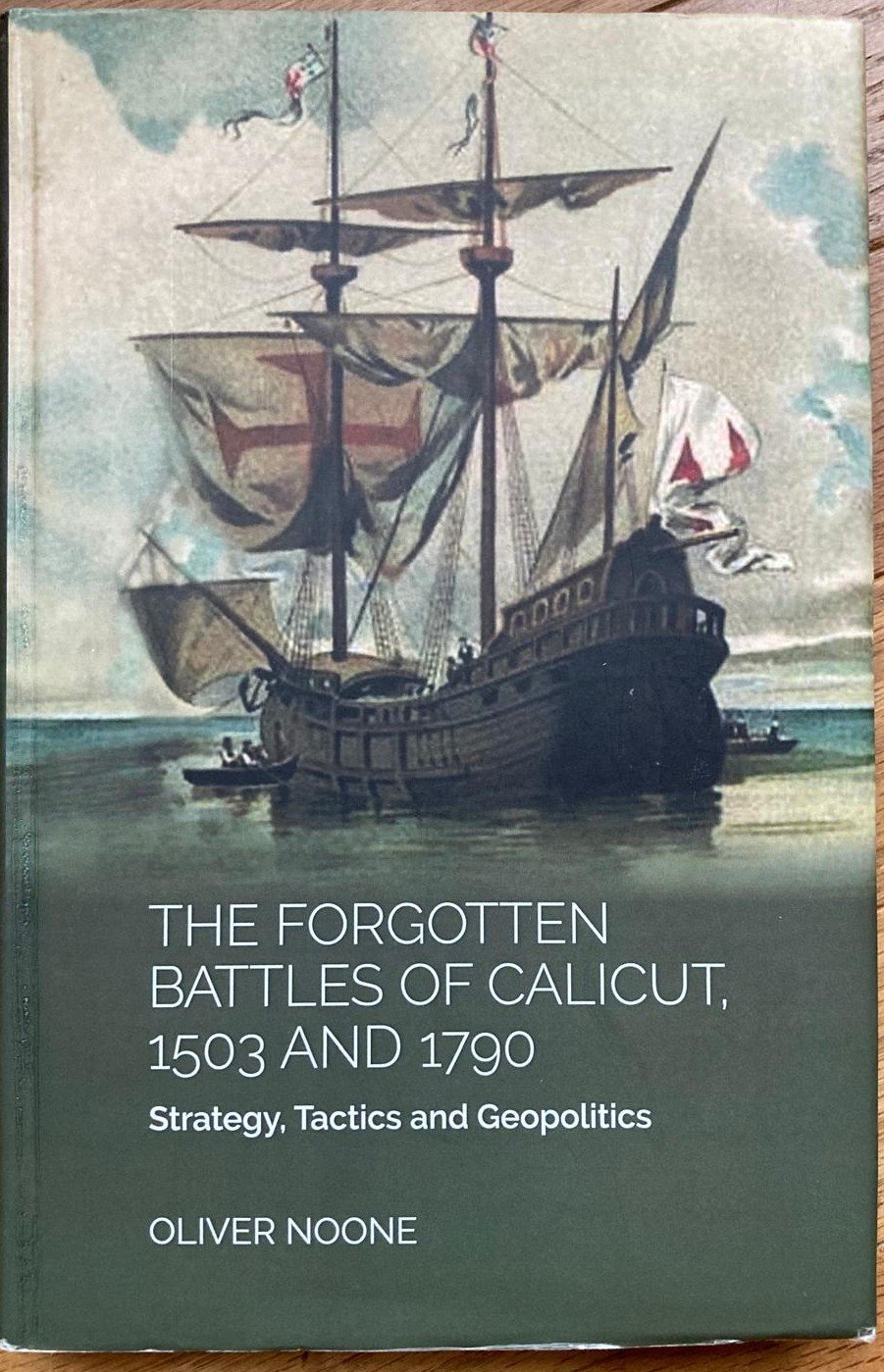
Oliver Noone’s book is an ambitious and engaging study of Calicut’s place in the longer history of colonial expansion in South Asia. Its central claim is that two relatively neglected military encounters—the naval battle off Calicut in January 1503 and the battle of Tarvananghurry on 10 December 1790—serve as bookends for two distinct but connected phases of European empire: first, maritime coercion and commercial intrusion; later, inland conquest through diplomacy, alliance-building, military-fiscal organization, and technological advantage.
This framing is one of the book’s major strengths. Rather than treating the two battles as isolated episodes, Noone uses them as narrative anchors from which to reconstruct the wider worlds that made them possible: Portuguese entry into the Indian Ocean, the militarization of trade, the reorganization of power on the Malabar coast, the shifting balance among Mysore, the Marathas, Hyderabad, and the East India Company, and the contingent emergence of British supremacy. The result is a work that crosses military, imperial, maritime, and South Asian history while remaining highly readable and accessible to non-specialists. Noone, who is a medical doctor by training, conducted research in repositories in Britain and India, including the British Library, the Bodleian Library, and the National Library of Wales in Aberystwyth. He combines that research with a clear commitment to public-facing historical writing.
The book unfolds by moving outward from the two battles into the larger contexts that gave them historical meaning. It is divided into seven chapters. The opening chapter sketches the main developments from the sixteenth to the eighteenth century, beginning with Portuguese, Dutch, and British struggles at sea and ending with the British defeat of Tipu Sultan under Cornwallis on land. This long chronological sweep sets up the book’s governing insight: Calicut matters not only as a local site but also as an entry point from which to track changing forms of imperial violence.
It was Portuguese maritime expansion starting at the naval battle of Calicut in 1503 that set the stage for wider European colonization of the subcontinent. Securing the seas allowed for land-based conquest that would follow with the British establishing their Indian empire. Succeeding chapters provide rich contextual details surrounding the two battles foregrounding a range of European and Indian actors that include the Zamorin of Calicut, the Mughals, the Nizam of Hyderabad, the Marathas, Tipu Sultan of Mysore, the British, French, and Dutch East India Companies. Military strategy, technological inputs, science, diplomacy, commerce, and finance.
British successes could be attributed to a combination of factors: opportunism, intelligence, mapmaking, and the manipulation of fractured regional politics. Noone convincingly argues that British ascendancy emerged contingently as an expression of “emergent strategy” (p. 231) rather than from any master plan.
The most striking achievement of the book is its ability to connect local battles to large-scale transformations in regional and even global history. Noone consistently reminds the reader that these conflicts cannot be understood narrowly as episodes of military history. They are windows into the deeper social, political, intellectual, economic, legal, and technological processes that underwrote colonial rule on the subcontinent and beyond. A second strength is the book’s handling of indigenous actors. The Zamorin, Tipu Sultan, the Nizam of Hyderabad, the Marathas at Poona, the Nawabs of Arcot, and a wide array of local intermediaries, diplomats, and military agents are not treated as mere background to European action. Instead, Noone gives them real agency and shows how European expansion depended on negotiation with already existing political formations whose rivalries and ambitions shaped the possibilities of empire.
Readers interested in military strategy will also find much value here. Noone provides substantial detail on battlefield tactics at sea and on land, the practicalities of alliance-making, and the different ways maritime and terrestrial warfare worked across the two periods. At the same time, the book’s appeal is broader than military history alone, since it also attends to the infrastructures of empire—cartography, intelligence systems such as the harkara network, fiscal extraction, commercial interests, and scientific knowledge.
The book’s argument can be stated even more sharply than Noone himself sometimes does: the battles of 1503 and 1790 are not simply two forgotten episodes in Calicut’s past, but two strategic thresholds in the history of European empire in South Asia. The first reveals the coercive and disruptive insertion of Portuguese power into an already connected Indian Ocean world; the second reveals the consolidation of British territorial power through this opening through coalition politics, logistics, and inland warfare.
Seen in this way, the two battles do more than provide chronological contrast. They organize the narrative around a transition from one mode of colonialism to another—from maritime predation, commercial militarization, and attempts to dominate sea-lanes, to the more complex regime of treaty systems, military-fiscal capacity, intelligence, scientific knowledge, and political brokerage that enabled British supremacy on land. This is the interpretive thread that gives the book its strongest coherence, and a review can profitably highlight it as the work’s major conceptual contribution.
One might therefore say that Noone’s real subject is not only Calicut, nor even only two forgotten battles, but the changing ecology of empire itself. The book shows how European domination was assembled differently in different moments: by cannon and convoy in the early sixteenth century, and by diplomacy, alliance, surveillance, and coordinated war-making in the late eighteenth. That insight deserves to be foregrounded because it clarifies why the two battles belong in the same book at all. At the widest level, the book also opens onto larger historiographic debates about the relationship between maritime history and territorial empire, the role of indigenous intermediaries in colonial expansion, and whether European success should be explained primarily through technology and military organization or through contingent alliance systems and local political fragmentation. Those are precisely the conversations into which Noone’s book can productively be inserted, involving scholars like Sebastian Prange, Pius Malekandathil, Mahmood Kooria, Mohibbul Hasan, Kate Brittlebank, among others.
Any reservations about the book are relatively minor and do not diminish its overall value. A few editorial matters could be improved in future editions: the use of CE rather than AD may strike some readers as stylistically uneven within a book otherwise rooted in older imperial and military chronologies; some of the images, especially on pp. 48–49, would benefit from enlargement; and a small number of citation and punctuation inconsistencies could be standardized, including clarifying the use of dated racial language such as “Negroes” (p. 239).
Overall, The Forgotten Battles of Calicut is an impressive, thoughtful, and highly readable book. It succeeds in recovering two neglected encounters and, more importantly, in showing why they matter for the history of empire, warfare, and South Asia. Its greatest strength lies in demonstrating that European expansion was never a simple story of inevitable conquest, but a historically contingent process built through violence, diplomacy, technology, finance, and collaboration with and against indigenous powers.
The book is also a salutary reminder that serious historical work can emerge from sustained personal commitment outside formal academic structures. More broadly, the book is admirable as an example of disciplined historical work undertaken outside a conventional academic career. Noone’s archival labor, wide travel, and narrative care have produced a study that is meaningful, historically relevant, and accessible to broad readership.
Oliver Noone, The Forgotten Battles of Calicut, 1503 and 1790: Strategy, Tactics and Geopolitics. New Delhi: Gyan Publishing, 2023. 285 pp. $27.36 (hardcover), 7 illustrations, 17 maps. ISBN-13: 978-9362801685.