Join WhatsApp Channel

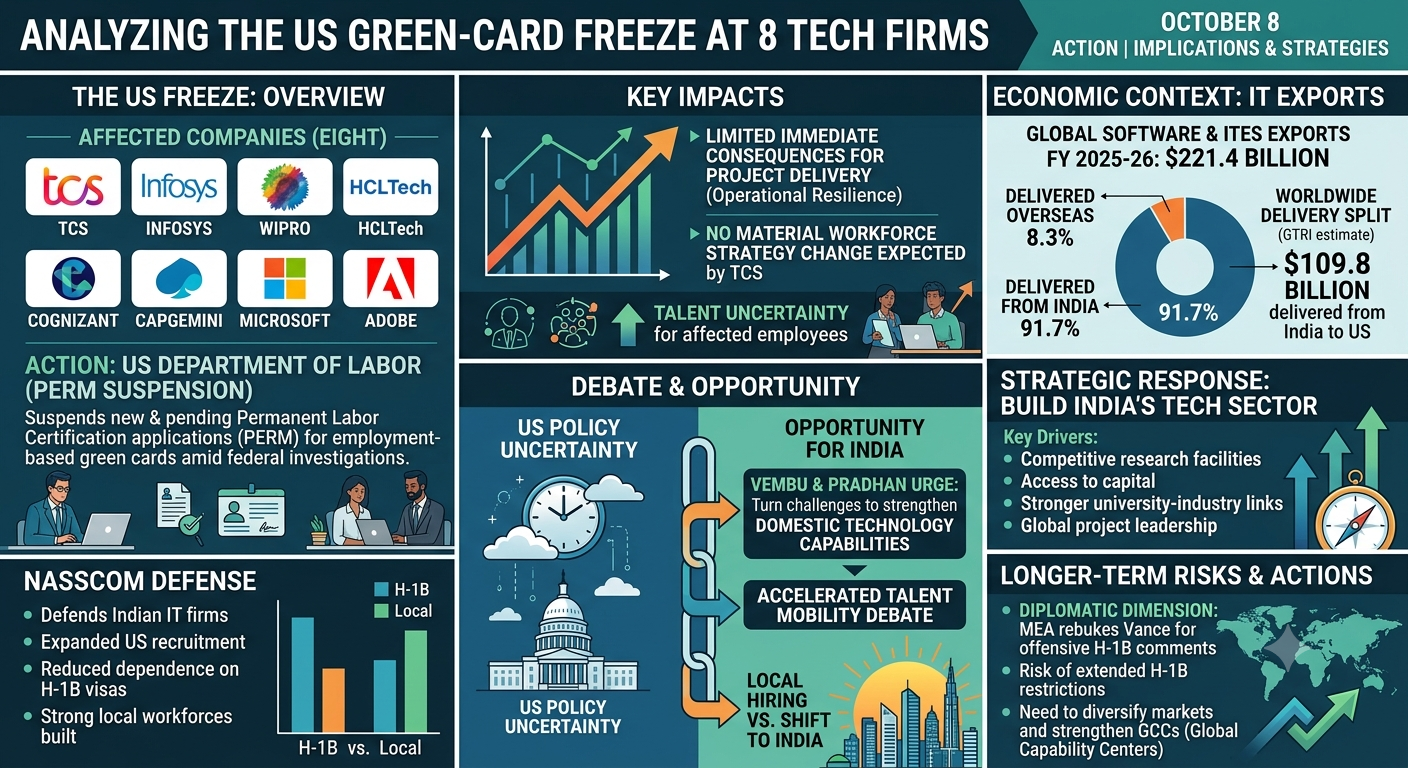
The US freeze on green-card sponsorship at eight technology companies may have limited immediate consequences for project delivery, but it is accelerating a debate over talent mobility, local hiring and whether more high-value technology work could shift to India as Washington tightens scrutiny of foreign workers.
Nasscom has defended Indian IT firms, saying they have expanded US recruitment and reduced their dependence on H-1B visas, while Tata Consultancy Services (TCS) expects no material impact on its workforce strategy or client engagements. Zoho co-founder Sridhar Vembu and former education minister Dharmendra Pradhan have urged India to turn the uncertainty into an opportunity to strengthen domestic technology capabilities.
The October 8 action by the US Department of Labor covers TCS, Infosys, Wipro, HCLTech, Cognizant, Capgemini, Microsoft and Adobe. It suspends new and pending applications under the Permanent Labor Certification Program (PERM), a key stage in the employment-based green-card process, amid federal investigations into alleged misuse of foreign-worker programs.
The suspension does not automatically cancel existing H-1B visas, invalidate work authorizations or stop applications under the separate temporary-worker program. But it leaves affected employees facing uncertainty over permanent residency and raises questions about the future direction of US immigration policy.
Nasscom challenges displacement claims
Nasscom said Indian technology companies had reduced their reliance on H-1B visas, expanded local recruitment and built stronger workforces in the United States. Operating in more than 80 countries, the industry body said, Indian IT firms remained committed to local laws and regulatory requirements.
It also argued that relatively few employees moved from H-1B status to permanent residency through PERM, limiting the freeze’s immediate operational implications.
TCS said its PERM applications had been in the single digits over the past two years. It reiterated plans to hire an additional 15,000 employees in the US over the next five years, saying local recruitment and campus hiring formed the core of its workforce strategy.
The responses suggest that companies with established US recruitment and offshore delivery networks may be able to absorb the immediate disruption. But the impact will vary across employers, and a limited number of applications does not diminish the consequences for individual employees whose permanent-residency plans are stalled.
The selection of companies also raises questions. Major employers such as Amazon, Google, IBM, Meta, Apple, Intel and Accenture were not included in the list cited by the industry report. The available information does not establish why these eight companies were selected or whether further restrictions will follow.
Vembu, Pradhan urge India to seize the opportunity
Vembu argued that Indian professionals had contributed substantially to US technological development despite growing resistance to foreign workers.
“Indians have made a major contribution to America’s technological prowess. Yet, a big part of America no longer wants us,” he wrote on X, urging Indian professionals facing uncertainty to return home and help build India’s technology sector.
Pradhan endorsed the appeal, saying every challenge offered an opportunity to deepen domestic capabilities and encourage innovation.
Their intervention highlights the potential for India to attract experienced engineers, researchers and technology managers who may reconsider their long-term prospects in the US. But a return of talent cannot be assumed, nor will patriotic appeals alone persuade professionals to relocate.
India will need competitive research facilities, access to capital, stronger university-industry links and opportunities to lead globally relevant projects if it wants to convert immigration uncertainty into a sustained technology advantage.
MEA rebukes Vance
The dispute has acquired a diplomatic dimension after US Vice President JD Vance described H-1B workers as “indentured servants,” prompting India’s Ministry of External Affairs (MEA) to call the characterization deeply offensive and insensitive to the term’s historical and colonial associations.
The MEA said Indian professionals were highly educated and skilled contributors to the US economy and innovation ecosystem. Skilled-worker mobility, it added, benefits both countries through research, productivity, competitiveness and job creation.
Vance has accused foreign outsourcing companies of bringing in workers at lower wages while replacing American employees. The Trump administration has cited alleged abuses of foreign-worker programs as justification for tighter scrutiny. Those allegations, however, should not be treated as proof that every company affected by the freeze has violated the law.
The distinction between temporary work visas and permanent residency is also important. The PERM suspension does not automatically affect existing H-1B status, although it can disrupt eligible employees’ green-card applications.
India-based delivery offers protection
The economic stakes are substantial. Reserve Bank of India data cited by the Global Trade Research Initiative (GTRI) put software and IT-enabled services exports at $221.4 billion in fiscal 2025-26. The US accounted for $119.7 billion, or 54.1 percent.
GTRI estimates that 91.7 percent of India’s software and IT-enabled services exports worldwide were delivered from India, with 8.3 percent handled by professionals at overseas client locations. Applying this global split to US exports suggests that about $109.8 billion was delivered from India and $9.9 billion through on-site work.
The calculation is indicative, not a US-specific breakdown, and not all on-site work depends on PERM-sponsored employees. Nevertheless, it illustrates why the freeze is unlikely to cause a proportionate loss of export revenue.
The greater risk would emerge if Washington extended restrictions to H-1B hiring or other skilled-worker pathways, making specialized roles harder to fill and raising recruitment and retention costs.
That possibility could strengthen the case for expanding India’s global capability centers (GCCs), where multinationals conduct engineering, research, analytics and product development. Indian IT firms could also move more specialized work to domestic delivery centers, reducing exposure to immigration-dependent staffing.
But such investment will depend on India’s ability to supply advanced skills, reliable infrastructure and regulatory certainty, not merely on US restrictions.
For now, Nasscom and TCS expect the immediate impact to be manageable. The longer-term challenge is less reassuring: the US remains India’s largest technology export market, leaving the industry exposed to policy decisions beyond its control.
The freeze does not establish that wider restrictions are inevitable. It does, however, give Indian companies a reason to diversify markets, strengthen local US recruitment and build higher-value technology capabilities at home.
The opportunity is not simply to bring more work back to India, but to ensure that Indian operations increasingly lead research, engineering and innovation rather than serving primarily as offshore delivery centers.