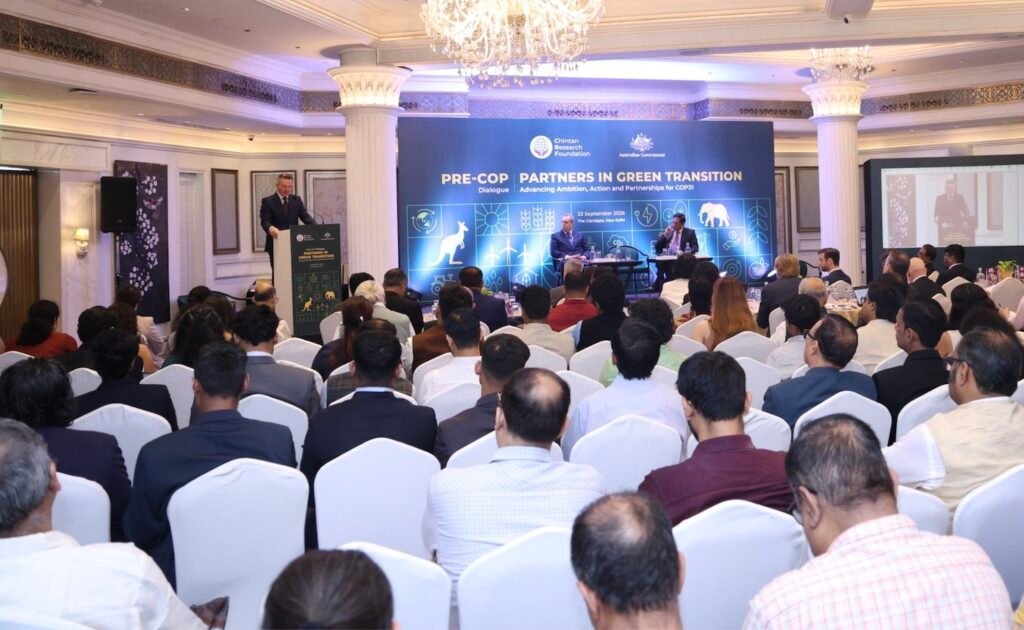
Australia and India may be fierce rivals on the cricket field, but on clean energy they are “on the same team,” Australian Minister for Climate Change and Energy Chris Bowen told an audience in New Delhi on September 23, 2026.
“As two countries that share a love of cricket, and a healthy rivalry at the crease, it is good to know that when it comes to clean energy, we are on the same team,” Bowen said at the Chintan Research Foundation’s Pre-COP Dialogue, “Partners in Green Transition,” at The Claridges in New Delhi. He described India as “an indispensable voice in the future of global climate and energy policy.”
With Australia set to lead negotiations at COP31, Bowen said the summit must be about “implementation and acceleration.” He named electrification, access to finance, clean energy deployment, modern grids and storage among its priorities.
The view from Australian rooftops
Advertisement
Bowen made his case largely through what the transition has meant for Australian households. He said one in three Australian homes has rooftop solar and that Australia generates more solar energy per person than any other country.
He said a country of just 27 million people installed 10 percent of the world’s new batteries in March, making Australia the third-largest battery market in the world behind only China and the United States.
Bowen argued the shift was also reflected in wholesale energy prices. He said Australia’s national grid had passed 50 percent renewable generation. He cited the International Energy Agency as reporting a 30 percent fall in average wholesale energy prices last quarter and called the timing “not a coincidence.” With Australia on a path to 82 percent renewable electricity by 2030, he said, Australians now have “the ability to take control of their energy bills.”
“No conflict can stop the sun shining”
The trip came as conflict in the Middle East shakes global energy markets. Bowen said ahead of the trip that it was intended to strengthen Australia’s fuel security. His itinerary was set to include the Jamnagar oil refinery in Gujarat, which his office described as the world’s largest, followed by talks in Saudi Arabia on the closure of the East-West pipeline.
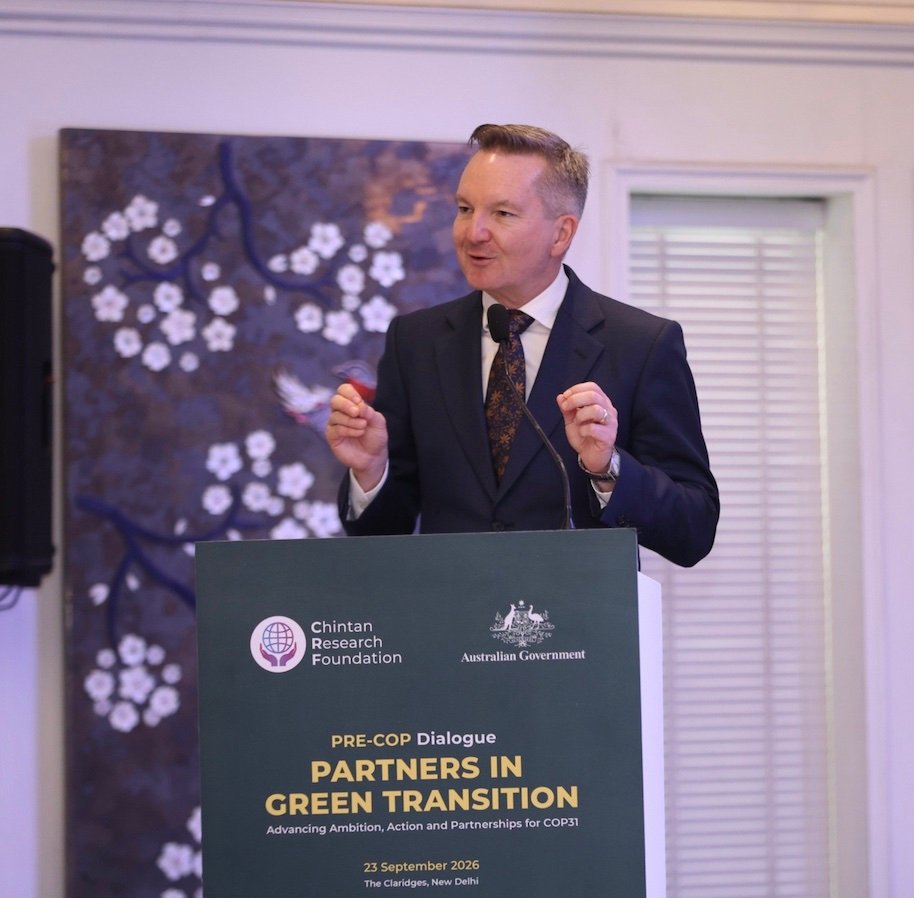
“Australia’s fuel supply remains secure and our strong relationships with international partners are an essential part of that work,” Bowen said before departing.
In New Delhi, he argued that the shock was a reason to speed up the transition, not slow it. “No conflict can stop the sun shining. No disruption can stop the wind blowing,” he said.
India’s numbers
Bowen said India’s record showed what the transition looks like at scale. He said around 700 million people in India have gained access to electricity since 2000. He said India has installed around 300 gigawatts of non-fossil power capacity toward a 2030 target of 500 gigawatts, including 160 gigawatts of solar, which he called a more than 50-fold leap since 2014.
He said India, as the fastest-growing major economy in the world, was proving that clean energy “is not a brake on prosperity. It is a pathway to it.”
“India as an important and respected member of the COP will be a key and respected partner,” Bowen said.
Solar technicians, hydrogen and green iron
Bowen pointed to the India-Australia Renewable Energy Partnership launched by Prime Ministers Anthony Albanese and Narendra Modi. He cited the Australia-India Rooftop Solar Training Academy in Gandhinagar, which he said will train 2,000 solar technicians in its first two years and create opportunity for women and young people.
For Australian industry, he framed India as a natural partner. He said Australia’s research and critical minerals capabilities could complement India’s National Green Hydrogen Mission. He pointed to Orica’s 50-megawatt electrolyzer in Newcastle as an example of renewable hydrogen decarbonizing industry. He also said Australia has the potential to supply green iron, “the metal the world will need to reduce emissions from steel.”
Bowen said Australia’s Future Made in Australia agenda and India’s Make in India program were complementary when it comes to diversified supply chains. He argued that green industrialization needs international cooperation on common standards, reliable markets and resilient supply chains.
“Together Australia and India can develop future industries that support growth, competitiveness and decarbonization,” Bowen said.
He added that the two countries “share strong connections from our diasporas.”
Partners at the negotiating table
During his visit, Bowen met India’s Minister for Environment, Forest and Climate Change Bhupender Yadav. Their discussions covered priorities for the upcoming pre-COP meeting in Fiji and COP31, and Yadav reaffirmed India’s support for Australia in its role as President of COP31 negotiations.
Bowen said COP Presidents had more than once asked the pair to co-facilitate difficult negotiations. He said that “over many hours together at COPs,” they had become “firm friends and partners.”
A few meters from the sea
Bowen said the stakes were visible close to home. He noted that the recent floods in Nepal had killed Nepalese people as well as visitors from India and Australia.
He described standing at the narrowest point of Tuvalu, “where a few meters is all that separates the ocean from the water on the other side.” He said the sea there has risen by around 15 centimeters over the past three decades. The Pre-COP in Fiji, with a leaders’ event in Tuvalu, will bring delegates from more than 50 countries to see those impacts firsthand, he said.
Bowen said Australia’s COP31 leadership was not simply a diplomatic exercise. “It is an investment in the security and prosperity of our region and the wider Indo-Pacific,” he said.