Join WhatsApp Channel

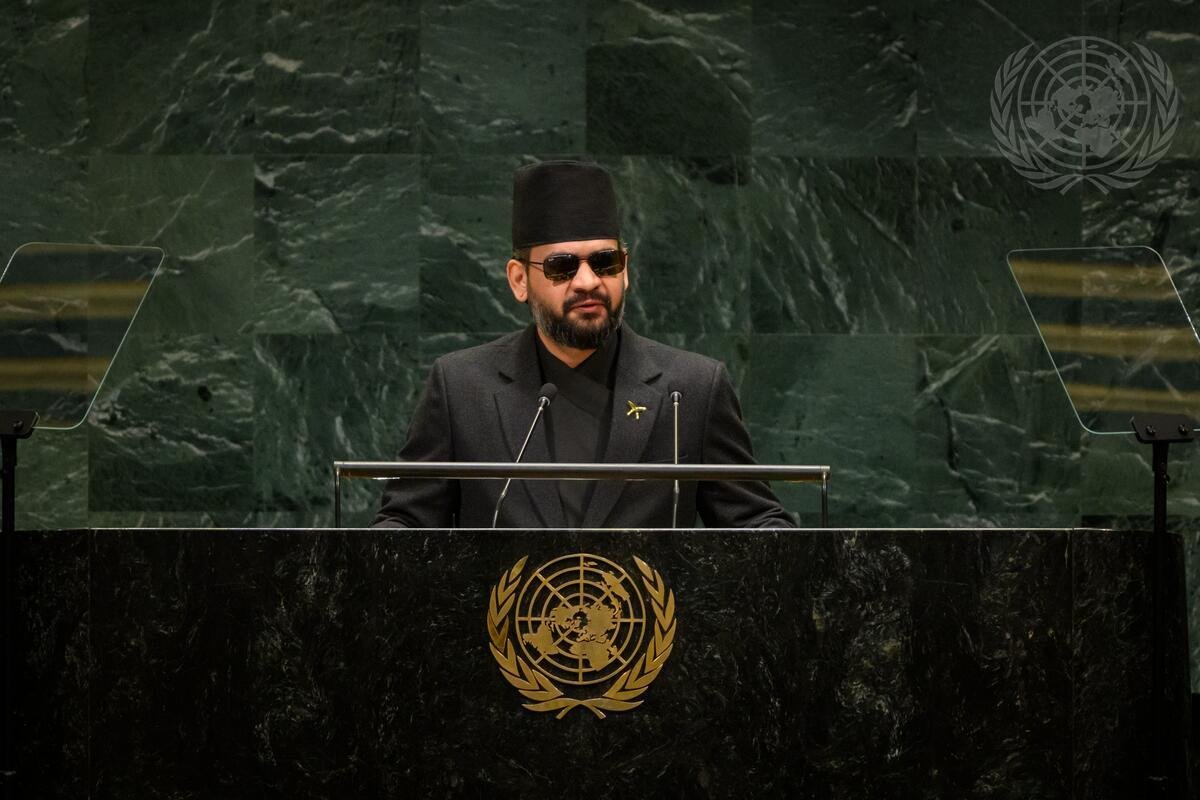
Prime Minister of Nepal Balendra Shah told world leaders that the catastrophic flash floods that swept through his country’s mountain communities four weeks ago were a warning that demanded a global response.
The Bhotekoshi-Trishuli disaster, which some have called a “Himalayan tsunami,” was more than a local tragedy, the Prime Minister said in his address to the 81st United Nations General Assembly in New York on September 24. He called for faster climate action, stronger disaster preparedness and a fairer system of support for countries facing damage they did little to cause.
“I come before you from Nepal, a distant country in the Himalayas, carrying a close warning for humanity,” Shah said. “I wish I could stand here today simply to speak about development, democracy, peace and the hopes of a young nation. Instead, I must speak about death and destruction of epic proportions.”
He described families waiting for relatives who would never return, communities searching through mud and debris for people still missing, and roads, bridges, schools and homes swept away in minutes. The floods had also interrupted Nepal’s progress toward the Sustainable Development Goals, he said.
According to Shah, at least 1,400 people have been confirmed dead and more than 6,000 remain missing. Preliminary assessments put the country’s physical recovery needs at about 10 percent of its gross domestic product. He thanked India and China for their prompt assistance, along with other countries, UN agencies, humanitarian organizations, philanthropies and individuals who responded to the disaster.
Nepal now faces the extensive work of recovery and reconstruction, Shah said. Drawing a parallel with rebuilding after the 2015 Gorkha earthquake, he appealed for international solidarity while urging governments to address the conditions that make future disasters more likely.
Nearly three years ago, UN Secretary-General António Guterres warned of an impending climate disaster while visiting the Mount Everest region, Shah recalled. Scientists and vulnerable communities had reinforced that warning with evidence, he said, but political leaders had failed to act at the necessary speed and scale.
“And I ask you today: Have we really heard that warning?” Shah asked.
He linked the floods to changes in the fragile Himalayan environment. A warming climate is destabilizing mountain slopes beneath glaciers, he said, increasing the risk of ice-rock avalanches, floods, landslides and other connected hazards. The devastation extended across the Nepal-China border, while floodwaters continued downstream toward India.
“Climate change does not recognize borders,” Shah said. “Glaciers and floods do not travel with a visa stamped on passports.”
That shared exposure, he argued, requires cooperation among countries that depend on the Himalayan region. Shah proposed a Himalayan Climate Resilience Mechanism led by Nepal, India and China. It would allow the three countries to share satellite data and expertise, monitor dangerous glacial lakes, strengthen joint early-warning systems and coordinate assistance when disasters strike.
“The Himalayas are not peripheral to the planet,” he said. “They are part of the planet’s life-support system.”
The Hindu Kush Himalayan region supports water supplies, ecosystems, agriculture and livelihoods for populations far beyond Nepal, Shah said. He described the proposed mechanism as a practical way to turn shared risk into coordinated preparation.
The Prime Minister also called for a broader shift from responding to disasters after they occur to preparing for them in advance. That means financing resilience, expanding insurance and innovation, strengthening infrastructure and institutions, and building warning systems that give people time to protect themselves, he said.
“The Nepal floods signal a future shaped by rising climate extremes,” Shah said. “Our baselines are no longer relevant.”
Shah framed the disaster as both a humanitarian crisis and a development emergency. Floods and landslides destroy homes and farms, but they also damage roads, schools and clean-energy infrastructure that a country needs for long-term growth, he said. Repeated disasters can force a poorer nation to borrow to rebuild and can erase years of progress.
Nepal contributes less than 0.1 percent of global greenhouse gas emissions, Shah said, yet it faces substantial costs as glaciers retreat, slopes become less stable and rivers grow less predictable.
“We did not create this crisis. Yet we are paying a colossal price for it,” he said.
Shah said his appeal was grounded in the principle of common but differentiated responsibilities and respective capabilities, recognized under the UN Framework Convention on Climate Change. Countries that have contributed more to greenhouse gas emissions, and those with greater resources to respond, should do more, he argued.
He called for adequate grant-based support when climate-related disasters destroy infrastructure in poorer countries. Large new loans or small, scattered grants cannot meet the scale of recovery needs, he said. He also criticized the complexity of climate financing, arguing that vulnerable countries should not spend years navigating applications while urgent needs go unmet.
“The Loss and Damage Fund, the Global Environment Facility and other relevant financing mechanisms remain grossly inadequate,” Shah said. “When the house is burning, we do not ask the family to complete fifty forms. We act.”
Shah summarized Nepal’s needs in six words: “Relief. Rehabilitation. Reconstruction. And also: Responsibility. Reparation. Resilience.” The first three describe what is required after a disaster, he said, while the second three address the conditions that determine whether such disasters become a recurring burden.
He also pointed to steps Nepal has taken within its own borders. Forests have been restored to cover nearly half the country’s territory, he said. Nepal is expanding hydropower, promoting electric mobility and strengthening local climate adaptation. Those efforts would continue, he said, but could not shield the country from increasingly severe climate hazards without wider international action.
“We are not here to blame any country or continent,” Shah said. “We are here to ask everyone to recommit to shared responsibility and solidarity.”
The address moved beyond the floods to question whether the international system responds fairly to the needs of poorer countries. Shah said the UN’s founding promise included respect for sovereignty, international law and human dignity, as well as protection against a world in which the powerful alone determine outcomes.
That promise is under strain, he said, when military and economic strength carry more weight than the needs of vulnerable populations. Climate justice, in his view, concerns more than the transfer of money. It also concerns who bears the costs of global decisions and who gets a voice in making them.
He asked whether mountain communities, small island states, landlocked and least-developed countries, and future generations are treated as equal stakeholders. Nepal would continue that discussion at its “Sagarmatha to the Sea” side event at the UN, scheduled for the following day, he said.
Shah also connected climate vulnerability with disruptions in global supply chains. Since his government took office following Nepal’s March elections, he said, shortages of fertilizer, bitumen and cooking fuel have affected farmers, infrastructure projects and households.
A farmer preparing to plant during the monsoon could not obtain fertilizer on time, while a planned highway lacked bitumen, he said. Such shortages impose costs on people with little control over the global events behind them.
“We have built a world with flawless logistics for war and broken logistics for food,” Shah said.
The consequences extend across South Asia, he argued. Countries in the region face climate damage despite contributing relatively little to the emissions driving it, while conflicts they did not start can raise costs and disrupt supplies. He urged world leaders to consider why weapons can move quickly across borders while farmers struggle to obtain the materials needed to sustain a livelihood.
Shah said these failures strengthened Nepal’s commitment to multilateralism, even as they showed why international cooperation must change. Smaller and poorer countries need an effective voice in the UN and a fair opportunity to secure essential goods, finance recovery and prepare for future disasters, he said.
The Prime Minister also spoke of a renewed democratic mandate at home. Nepal’s young people have demanded integrity, accountability and opportunity, he said, reflecting concerns shared by a generation across many countries. His government’s commitment is to create decent jobs, strengthen social protection and give Nepalis a fair chance to build their futures at home.
He closed by returning to the warning carried by the floods. Governments should reduce dependence on fossil fuels, invest in stronger infrastructure and establish systems that can warn communities before danger reaches them, he said. The next warning from the Himalayas must be met with action.
“Let us be ready to hear it, and ready to act,” Shah said.