Join WhatsApp Channel

When Chinese President Xi Jinping arrived in New Delhi for the BRICS Summit, the symbolism was impossible to miss.
After nearly seven years, China’s President was back in India.
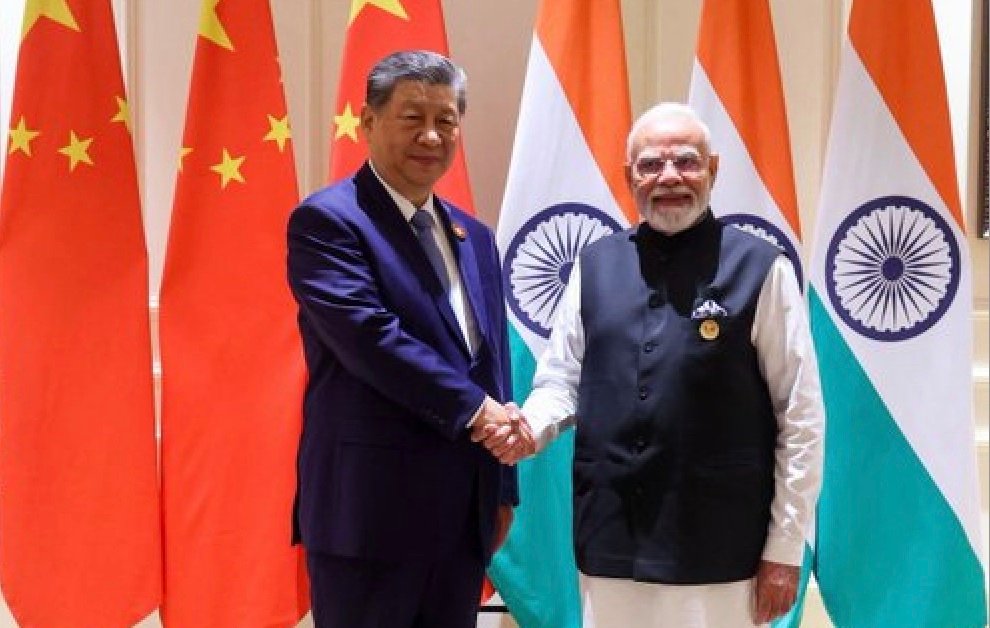
But the significance of his visit went far beyond protocol, handshakes and summit photographs. The real story unfolded when Prime Minister Narendra Modi and Xi Jinping sat across the table for their bilateral meeting in New Delhi.
Their meeting, which lasted more than 50 minutes, came after years of military tensions, diplomatic uncertainty and economic complications between the two Asian powers.
The meeting should neither be exaggerated as a dramatic breakthrough nor dismissed as diplomatic theatre.
It should be understood for what it is:
A cautious opportunity to rebuild stability.
And BRICS may have provided the most important platform for making that opportunity possible.
From confrontation to conversation
India-China relations have travelled a difficult road since the Galwan Valley clash of 2020.
Trust suffered.
Military deployments increased along the disputed Himalayan frontier.
India tightened scrutiny of Chinese investments and technology.
People-to-people exchanges were affected.
Business ties became more complicated.
Yet diplomacy continued.
The two countries reached a disengagement agreement in October 2024, followed by further troop withdrawals from several confrontation points. Since then, efforts have gradually moved towards stabilizing the relationship.
That is why Xi’s arrival in New Delhi matters.
His visit represents the movement from military tension to political engagement.
The Modi-Xi conversation is therefore not about forgetting the past. It is about preventing the past from controlling the future.
Modi’s message: cooperation without ignoring differences
Prime Minister Modi’s position appears clear: India and China can expand cooperation, but that cooperation must be built on mutual respect, mutual sensitivity and mutual interest.
This is an important formulation.
India is not approaching China from a position of either confrontation or accommodation.
It is approaching China from a position of confidence.
That distinction matters.
A strong India does not need permanent confrontation with China.
At the same time, better relations cannot come at the cost of India’s security interests.
The objective is therefore managed competition with expanding cooperation.
That may be the most realistic framework for the relationship.
Xi’s message: two major powers, one shared responsibility
Xi Jinping also framed the relationship in a broader global context.
India and China are two of the world’s most populous countries and major members of the Global South. According to reports on the meeting, Xi stressed that the two countries have a responsibility to work for peace, stability and development, while advocating cooperation through BRICS and a more representative international system.
This is where the Modi-Xi meeting intersects directly with the purpose of BRICS.
BRICS is becoming larger.
Its economic weight is increasing.
Its political influence is expanding.
And its members increasingly want a greater voice in global governance.
India and China are two of its most important pillars.
If these two countries remain locked in confrontation, BRICS’ ability to function as an effective Global South platform is weakened.
If they can manage their differences, BRICS becomes stronger.
That is the larger strategic significance of the New Delhi meeting.
The border remains the core test
No serious analysis of India-China relations can avoid the border question.
The Himalayan boundary remains disputed, and substantial military deployments continue even as relations have stabilized compared with the worst period after 2020.
This means the Modi-Xi meeting cannot be interpreted as the end of strategic competition.
It is better described as an attempt to put guardrails around that competition.
The principle is simple:
Differences are inevitable. Conflict is not.
If both sides can maintain peace along the border, restore military-to-military communication and improve mechanisms for managing incidents, the political space for economic and diplomatic cooperation will expand.
Without border stability, every other area of the relationship remains vulnerable.
Trade: opportunity with caution
Economically, the relationship is too important for either side to ignore.
China was India’s largest source of imports in FY2025-26, with bilateral trade involving about $132 billion in imports from China, according to Reuters’ review of the relationship. Chinese industrial goods and components are deeply embedded in several Indian manufacturing supply chains.
But India has also become much more conscious of economic security.
The lesson of recent years is that economic interdependence must not become strategic vulnerability.
India wants investment and technology, but it also wants resilient supply chains, domestic manufacturing and national-security safeguards.
Therefore, the next phase of India-China economic relations should not simply be about “more trade.”
It should be about better-balanced, transparent and mutually beneficial trade.
India’s message should be clear:
China is an important economic partner, but India’s strategic autonomy remains non-negotiable.
Why BRICS is the bridge
The most interesting element of the meeting is that it took place against the backdrop of the BRICS Summit.
That is significant because BRICS gives India and China a platform where bilateral disagreements can be placed within a broader conversation about global challenges.
Both countries have common interests in several areas:
– reform of global institutions;
– greater representation for developing economies;
– stronger South-South cooperation;
– trade and investment;
– technology;
– AI governance;
– energy security;
– development finance;
– climate and sustainability;
– and a greater role for the Global South.
They do not agree on everything.
They do not need to.
The strength of BRICS lies precisely in its ability to bring countries with different political systems and strategic interests together around areas of common interest.
The Modi-Xi meeting demonstrates that principle in practice.
The world is changing—and Asia cannot afford permanent instability
The meeting also comes at a time when the international environment is becoming increasingly uncertain.
Wars in West Asia and Ukraine, global trade tensions, energy insecurity and strategic competition are putting pressure on developing economies. The BRICS Summit itself has been dominated by questions of peace, energy, trade and the future of global governance.
For India and China, continued confrontation would carry a heavy cost.
Both countries need economic growth.
Both need energy.
Both need stable trade routes.
Both need investment.
Both need technological development.
And both have enormous domestic development priorities.
Permanent confrontation is therefore not an economically rational long-term strategy.
Competition will continue.
But competition can coexist with communication.
India’s strategic autonomy on display
There is another message coming from New Delhi.
India is demonstrating that it can maintain dialogue with multiple major powers simultaneously.
India can engage the United States.
India can maintain strategic ties with Russia.
India can deepen relations with Europe, Japan and the Gulf.
India can engage Iran.
And India can talk directly to China.
This is not diplomatic confusion.
It is strategic autonomy in a multipolar world.
The Modi-Xi meeting reinforces that approach.
India is not choosing a camp.
India is choosing its interests.
A new Asian equilibrium?
The larger question is whether this meeting can contribute to a new equilibrium in Asia.
India and China will continue to compete.
They will compete economically.
They will compete technologically.
They will compete for influence across the Global South.
They will have disagreements over the border and regional security.
None of that is going to disappear overnight.
But responsible competition is different from uncontrolled confrontation.
A stable India-China relationship could have consequences far beyond the two countries.
It could improve the functioning of BRICS.
It could contribute to Asian economic stability.
It could reduce pressure on global supply chains.
It could create new opportunities for South-South cooperation.
And it could give developing countries greater room to pursue their own economic priorities.
The real test begins after the handshake
The photographs from New Delhi will eventually disappear from the front pages.
The real question is what happens afterwards.
Will military communication improve?
Will border tensions remain controlled?
Will direct flights and people-to-people exchanges expand?
Will business visas become easier?
Will legitimate business and investment flows increase?
Will trade become more balanced?
Will both sides cooperate in multilateral forums?
And most importantly, can India and China develop a mechanism where disagreements are addressed before they become crises?
These are the measures by which the Modi-Xi meeting should ultimately be judged.
Not a reset—but a reopening
The biggest mistake would be to call this meeting a complete “reset”.
Trust cannot be restored through one meeting.
A single conversation cannot resolve decades of strategic competition.
But diplomacy does not require instant solutions.
Sometimes its greatest achievement is simply creating the political space for the next conversation.
That is what New Delhi has achieved.
Modi and Xi have reopened the door.
Whether that door leads to a durable stabilization of India-China relations will depend on what both governments do next.
For India, the message should remain firm and confident:
Peace at the border, balance in trade, cooperation where interests converge and strategic autonomy where interests differ.
That is not a compromise.
That is mature diplomacy.
BRICS’ bigger lesson
The Modi-Xi meeting may ultimately prove to be one of the most consequential moments of the New Delhi BRICS Summit—not because India and China suddenly became friends, but because two major powers demonstrated that dialogue remains possible despite strategic differences.
That is precisely the kind of diplomacy the world needs.
BRICS cannot become effective if its largest members are permanently divided.
Nor can Asia afford a future defined only by confrontation.
The New Delhi meeting therefore carries a message that extends beyond India and China:
Competition does not have to become conflict.
And in a world increasingly divided by wars, tariffs, sanctions and strategic rivalry, that may be the most important diplomatic lesson to emerge from the BRICS Summit in New Delhi.
The handshake is not the destination. It is the beginning.
Disclaimer: The opinions and views expressed in this article/column are those of the author(s) and do not necessarily reflect the views or positions of South Asian Herald.