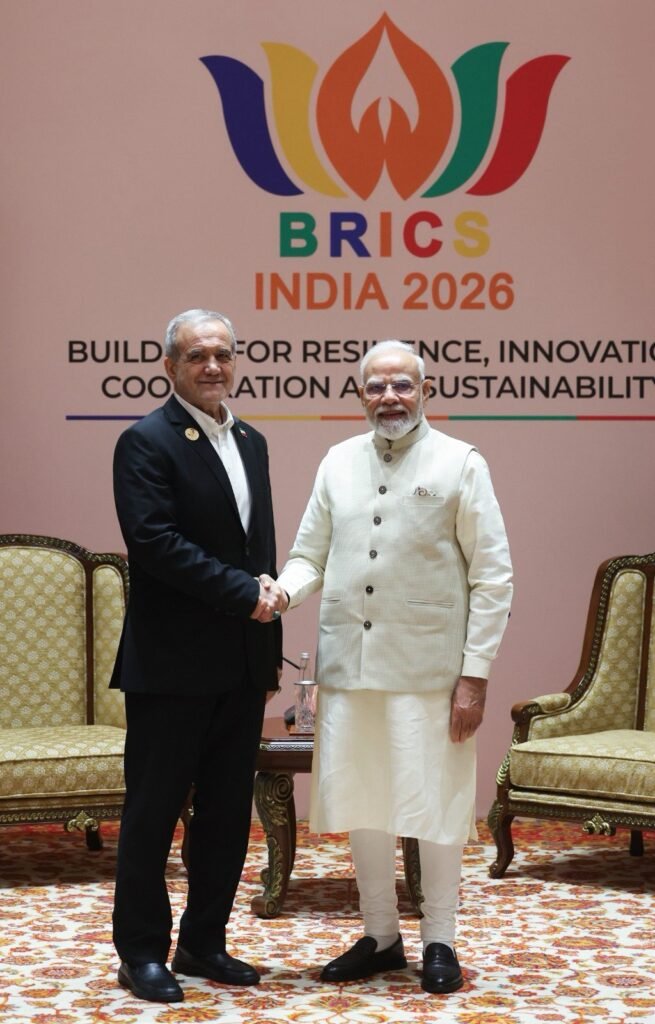
Prime Minister Narendra Modi’s meeting with Iranian President Masoud Pezeshkian, coming barely a day before BRICS leaders are expected to negotiate a final summit declaration, has sharpened the central diplomatic question hanging over the New Delhi gathering: how far is the expanded bloc prepared to go in criticizing the United States and its allies over the West Asia conflict?
Modi’s public message after Friday’s meeting was carefully calibrated. He spoke of a “long-term and win-win strategy” for India-Iran relations and said the two leaders had discussed the “prevailing situation in the region,” while reiterating that India remained committed to the pursuit of “enduring peace.”
The language, however, was less revealing for what it said than for what it did not.
There was no public condemnation of the United States, Israel or Iran. Instead, India returned to the diplomatic vocabulary it has increasingly deployed as the conflict has widened: dialogue, diplomacy, lasting peace, freedom of navigation, protection of commerce and the safety of seafarers.
Advertisement
That formulation could provide New Delhi with a template for the far more difficult negotiations now expected at the BRICS summit.
The meeting with Pezeshkian was Modi’s second in less than two weeks, following their discussions on the sidelines of the Shanghai Cooperation Organization summit in Bishkek on August 31. It was also Pezeshkian’s first visit to India as Iranian president.
But the bilateral encounter has implications extending well beyond India-Iran relations.
A BRICS test over the United States?
The New Delhi summit brings together a BRICS expanded to include Iran and the United Arab Emirates, two countries now standing on sharply different sides of the West Asian crisis. Their differences have reportedly complicated efforts to reach consensus during ministerial meetings preceding the leaders’ summit.
The conflict has therefore transformed the language of the final declaration into a potentially consequential test of BRICS cohesion.
At the SCO summit in Bishkek, India joined other members in a declaration that condemned military strikes by the United States and Israel on Iran. The question now is whether BRICS — a grouping that includes both Iran and the UAE and also counts China and Russia among its most influential members — can produce equally strong language.
That may prove considerably harder.
For India, the difficulty is acute. New Delhi has longstanding relations with Iran, including strategic interests linked to Chabahar port and connectivity to Afghanistan and Central Asia. Yet it also has deep economic, strategic and diaspora ties with the United States, Israel and the Gulf Arab states.
A direct BRICS condemnation of Washington would therefore place India in an uncomfortable position.
Conversely, a declaration that avoids mentioning the United States and Israel could be seen by Tehran as falling short of the political solidarity Iran expects from a grouping that increasingly presents itself as a voice of the Global South and a counterweight to Western dominance.
The likely outcome, diplomats and analysts may be watching, is an effort to construct language strong enough to address Iran’s concerns while broad enough to preserve consensus.
Modi’s message may offer the compromise formula
The Modi-Pezeshkian meeting offers some clues about how such a compromise could be framed.
According to the Indian readout, Modi reiterated that all issues should be resolved through “dialogue and diplomacy.” He also stressed the need to ensure lasting peace and stability, safeguard freedom of navigation and commerce, and protect the safety and well-being of seafarers.
Those issues are not abstract for India.
The widening conflict has directly affected Indian nationals working aboard commercial vessels. At least 10 Indian seafarers are among 16 Indians reported killed in attacks connected to the West Asia conflict, according to the information cited in the reports surrounding the meeting.
India has protested attacks involving merchant vessels with Indian crew members and has raised concerns with both Iranian and U.S. authorities.
The disruption has also struck at India’s economic interests.
The Strait of Hormuz is one of the world’s most strategically important maritime chokepoints, and any prolonged disruption threatens energy supplies, freight costs and commodity flows. India remains heavily dependent on imported crude oil and has important commercial interests across the Gulf.
The consequences extend to fertilizers and other essential imports.
A BRICS declaration that focuses on civilian protection, the security of maritime trade, freedom of navigation, international commerce and dialogue could therefore allow India to address the conflict without necessarily endorsing an explicitly anti-American formulation.
Such language could also be easier for the UAE to accept than a declaration centered exclusively on condemnation of Washington.
Iran’s presence makes silence difficult
Yet Iran’s membership of BRICS has changed the political arithmetic.
Tehran is no longer merely an external regional crisis affecting the grouping. It is now a member state whose president is sitting at the negotiating table.
Pezeshkian’s participation in the summit comes despite the difficult circumstances confronting Iran, and Modi specifically thanked Tehran for its continued high-level engagement with BRICS.
That acknowledgement suggests New Delhi is keen to prevent the West Asia conflict from overshadowing India’s broader objectives as summit host.
India has sought to project BRICS as a platform for resilience, innovation, cooperation and sustainability among countries of the Global South. Its priorities include reform of global institutions, greater representation for emerging economies, trade, technology, financial cooperation and development.
But geopolitics may intrude.
A summit declaration that says little about the conflict could expose BRICS to criticism that its political ambitions exceed its ability to act collectively. A declaration that strongly condemns the United States could, meanwhile, reinforce Western perceptions that BRICS is evolving from an economic and diplomatic forum into an explicitly geopolitical bloc.
India has little interest in either outcome.
New Delhi’s preference has traditionally been to preserve BRICS as a forum of strategic autonomy rather than turn it into a formal anti-Western alliance.
That distinction will matter during the negotiations.
India’s tightrope walk
The challenge for Modi is that India’s room for maneuver has narrowed.
New Delhi cannot ignore Iran. Its relationship with Tehran carries strategic importance extending from energy security to the Chabahar port project and India’s access to Central Asia.
At the same time, India cannot ignore the Gulf.
The UAE and other Gulf countries are major economic partners, investors and destinations for millions of Indians. Any escalation that destabilizes the region carries immediate consequences for India’s energy security, trade and expatriate community.
Nor can New Delhi disregard the United States.
India and Washington have deep strategic and economic ties despite growing friction on trade and other issues. A sharply worded BRICS attack on the United States could complicate an already sensitive relationship.
This makes India’s preferred diplomatic vocabulary — dialogue rather than confrontation, peace rather than alignment, maritime security rather than military blame — particularly useful.
The question is whether Iran will accept it.
Will BRICS call out Washington?
The most closely watched section of the final declaration may therefore be the language on West Asia.
There are three broad possibilities.
First, BRICS could explicitly condemn the United States and Israel, following the precedent set by the SCO declaration in Bishkek. That would represent the strongest political outcome for Iran but could complicate consensus and place India in a difficult position.
Second, the declaration could condemn military attacks without naming specific countries. This would allow BRICS to register political opposition to escalation while avoiding a direct confrontation with Washington.
Third, and perhaps most consistent with India’s diplomatic messaging, the leaders could focus on an immediate de-escalation, dialogue and diplomacy, protection of civilians, freedom of navigation, security of commercial shipping and the safety of seafarers.
Such wording would be deliberately less confrontational. But it could be the price of consensus.
The meeting between Modi and Pezeshkian suggests India is already laying the groundwork for precisely such a formula.
More than a wording dispute
The argument over a few paragraphs in a summit declaration would nevertheless carry wider significance.
BRICS is attempting to demonstrate that its expansion has made it more representative of the developing world. But expansion has also imported new regional conflicts and rivalries into the organization.
Iran and the UAE are the clearest example.
The grouping’s ability to manage their differences will determine whether expansion produces greater geopolitical influence or simply greater diplomatic paralysis.
The New Delhi summit will therefore be judged not only by the initiatives it announces on trade, finance or Global South cooperation, but also by whether its members can find common ground on a conflict involving two of them.
For India, the stakes are even higher.
As host, New Delhi will want a declaration. Failure to reach consensus would overshadow the summit and raise questions about BRICS’s capacity to function after expansion.
But a declaration that is seen as excessively ideological or explicitly anti-American could undermine India’s effort to preserve strategic autonomy.
Modi’s conversation with Pezeshkian may thus have been more than another bilateral meeting on the margins of an international summit.
It may have been part of the diplomatic preparation for the most difficult negotiation yet to come.
The final BRICS declaration will show whether the grouping can speak with one voice on the West Asia crisis — and, more importantly, whether that voice is prepared to directly name the United States.
For New Delhi, the preferred answer may be clear: strong enough language to acknowledge the conflict and its consequences, but not so confrontational that BRICS becomes defined by opposition to Washington.
Whether Iran, the UAE and the other BRICS members agree could determine the political success of the summit.