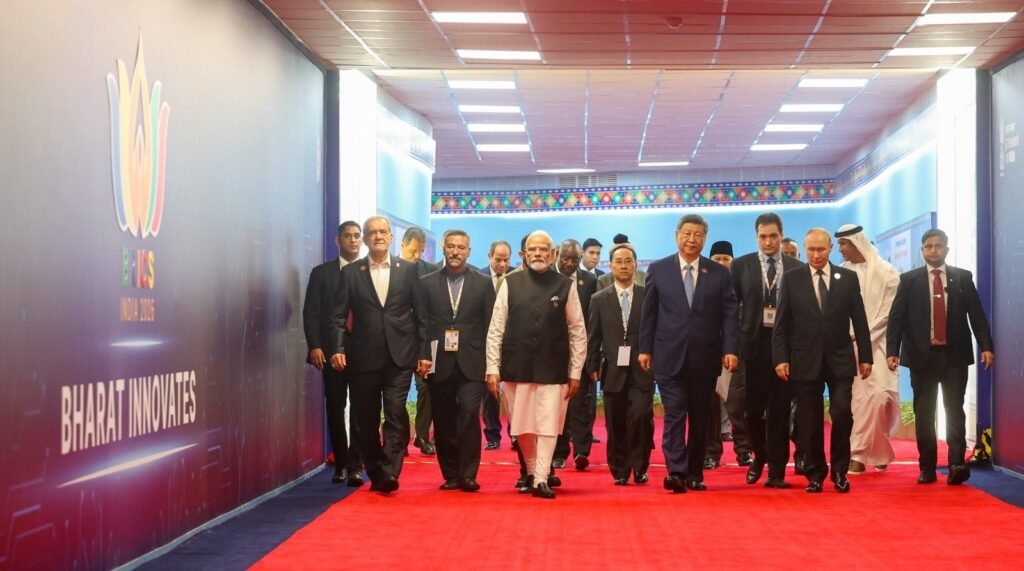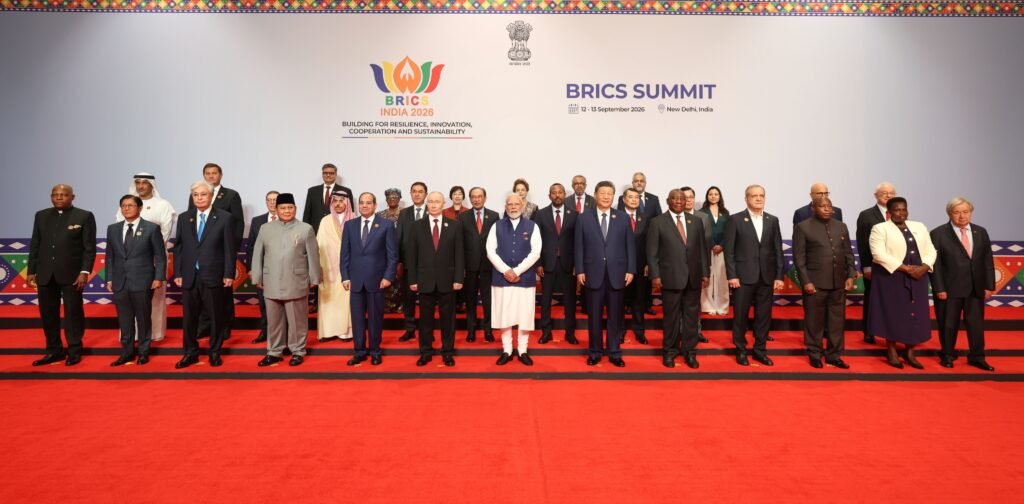
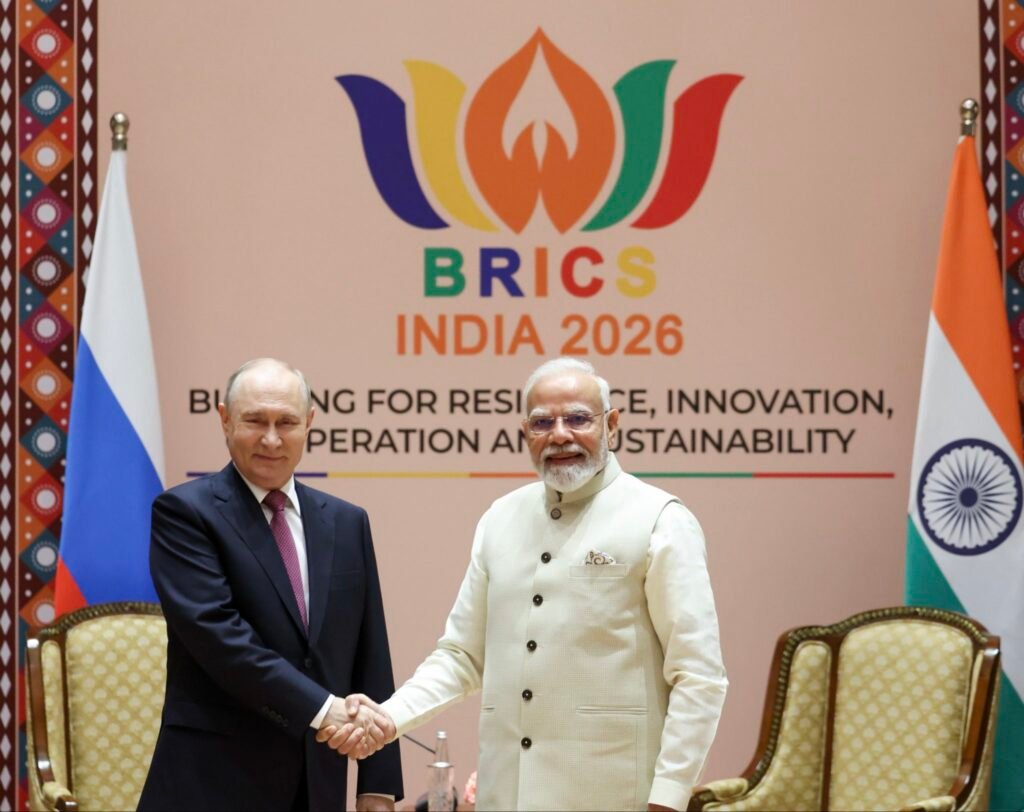
Prime Minister Narendra Modi and Russian President Vladimir Putin reviewed the expanding economic and strategic relationship between their countries on Friday, while also discussing conflicts in West Asia and the Black Sea region, as New Delhi prepared to host the 18th BRICS Summit.
The meeting, held on the margins of the summit, was the second between the two leaders this year and came less than two weeks after they met in Bishkek on the sidelines of the Shanghai Cooperation Organization summit.
The discussions underscored the breadth of the India-Russia relationship at a time of heightened geopolitical uncertainty, with the two countries seeking to deepen cooperation in trade, energy, defense, space, industrial development and skilled-worker mobility.
Modi reiterated India’s position that dialogue and diplomacy remained the only way to resolve conflicts, and said New Delhi was ready to assist efforts aimed at restoring peace.
Advertisement
The two leaders exchanged views on developments in West Asia and the Black Sea region, conflicts that have disrupted maritime trade and raised concerns about the safety and security of Indian seafarers, according to India’s Ministry of External Affairs.
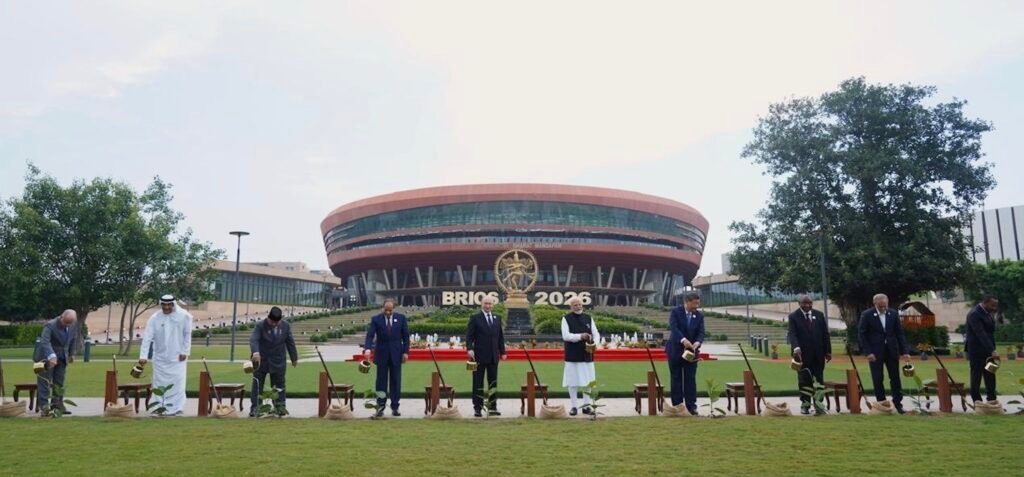
The meeting came as BRICS leaders gathered in New Delhi against a backdrop of wars, trade disruptions, growing protectionism and a wider debate over the restructuring of global economic and political institutions.
Trade Push Moves to Centre Stage
Economic cooperation featured prominently in Friday’s discussions, with the two leaders reviewing progress across political, economic, defense, energy, space, skill mobility and people-to-people exchanges.
They also visited INNOPROM India, Russia’s international industrial exhibition, which was being held in India for the first time from September 9 to 11.
The leaders said the exhibition could help expand trade and industrial cooperation by creating greater opportunities for companies from the two countries to develop commercial partnerships and explore new markets.
The joint visit to the exhibition reflected a growing effort to move the bilateral relationship beyond traditional strategic pillars such as defense and energy towards broader industrial and commercial cooperation.
Bilateral trade between India and Russia currently stands at around $60 billion, and the two countries have set an ambitious target of increasing it to $100 billion by 2030, according to information cited in the material accompanying the meeting.
Commerce and Industry Minister Piyush Goyal said reaching that target would require sustained double-digit growth and stronger participation by businesses from both countries.
The challenge, however, is not simply to increase the overall value of trade. India and Russia will also need to diversify the composition of commerce, expand market access and build industrial partnerships capable of generating more balanced and sustainable trade flows.
Potential areas identified for deeper engagement include railways, tunnelling, steel value chains and business-to-business partnerships. Other areas that have been discussed ahead of the talks include civil nuclear cooperation, critical minerals, mobility, opportunities for skilled Indian workers in Russia and fertilizer joint ventures.
The material, however, indicated that these areas were subjects for discussion and did not amount to announcements of concluded agreements.
Partnership Tested by Geopolitical Uncertainty
India and Russia described their relationship as a Special and Privileged Strategic Partnership, saying it had continued to demonstrate resilience despite geopolitical uncertainty.
The two leaders agreed to remain engaged to further strengthen the relationship, which has traditionally rested on close political and defense ties but has acquired a stronger economic dimension in recent years.
Energy has become an increasingly important component of the relationship, while the expansion of trade has created a new imperative to develop infrastructure, payment mechanisms, logistics networks and business partnerships capable of supporting larger commercial flows.
Friday’s meeting also highlighted the importance both countries attach to multilateral cooperation, particularly through BRICS.
Modi and Putin exchanged views on India-Russia engagement within the grouping during India’s 2026 chairship. The BRICS platform has gained greater geopolitical relevance as emerging economies seek a larger voice in global governance and push for reforms of international institutions.
For India, the challenge is to maintain strategic relationships across competing geopolitical blocs while continuing to advocate dialogue in conflicts that have divided major powers.
Modi’s comments on West Asia and the Black Sea reflected that balancing act.
According to the Ministry of External Affairs, the prime minister reiterated that dialogue and diplomacy were the way forward in resolving conflicts and that India stood ready to assist peace efforts.
The reference to maritime trade and Indian seafarers also highlighted the economic consequences of geopolitical instability for a country heavily dependent on international trade and maritime supply routes.
A Second Meeting in Less Than Two Weeks
Friday’s discussions followed the leaders’ August 31 meeting in Bishkek during the Shanghai Cooperation Organization summit.
Before that, Modi and Putin had met in New Delhi during the 23rd India-Russia Annual Summit in December 2025.
At their Bishkek meeting, the two leaders had welcomed the outcome of the 27th India-Russia Inter-Governmental Commission on Trade, Economic and Cultural Matters, held in Moscow on August 24.
The frequency of the engagements suggests an effort by both governments to maintain high-level political momentum as they seek to translate strategic commitments into expanded economic cooperation.
The leaders’ visit to INNOPROM India was particularly symbolic in that context.
Rather than limiting their engagement to diplomatic statements, Modi and Putin interacted with participants at an exhibition designed to bring together manufacturers, technology companies, buyers and potential commercial partners.
The focus on industrial cooperation could become increasingly important if the two countries are to bridge the gap between their current trade levels and the $100 billion target.
Culture and Diplomacy
The meeting also carried a cultural dimension.
Modi presented Putin with a Russian translation of the Thirukkural, the classical Tamil work attributed to poet and philosopher Thiruvalluvar.
The work, comprising 1,330 couplets, explores themes including virtue, wealth, statecraft and love.
In a post on X, Modi said the Russian translation carried “the eternal wisdom of the great Thiruvalluvar across languages and borders.”
The gesture added a people-to-people element to a day otherwise dominated by discussions on strategic affairs, trade and industrial cooperation.
Putin Invites Modi to Russia
Putin invited Modi to Russia for the 24th India-Russia Annual Summit, and the Indian prime minister accepted the invitation.
The dates of the summit will be decided through diplomatic channels, the Ministry of External Affairs said.
The next annual summit could provide an important opportunity to assess whether Friday’s discussions have produced measurable progress, particularly on the ambitious trade agenda.
For now, the Modi-Putin meeting has placed the economic relationship alongside the traditional strategic foundations of India-Russia ties.
As the BRICS Summit opens in New Delhi, the two countries are signaling that their partnership is being recalibrated for a period in which geopolitics, trade security, industrial capacity and alternative economic relationships are becoming increasingly interconnected.
The task ahead will be to convert political goodwill and ambitious targets into concrete investment, industrial projects and more diversified trade.
That, more than the symbolism of another high-level meeting, may determine the next phase of the India-Russia partnership.