Join WhatsApp Channel

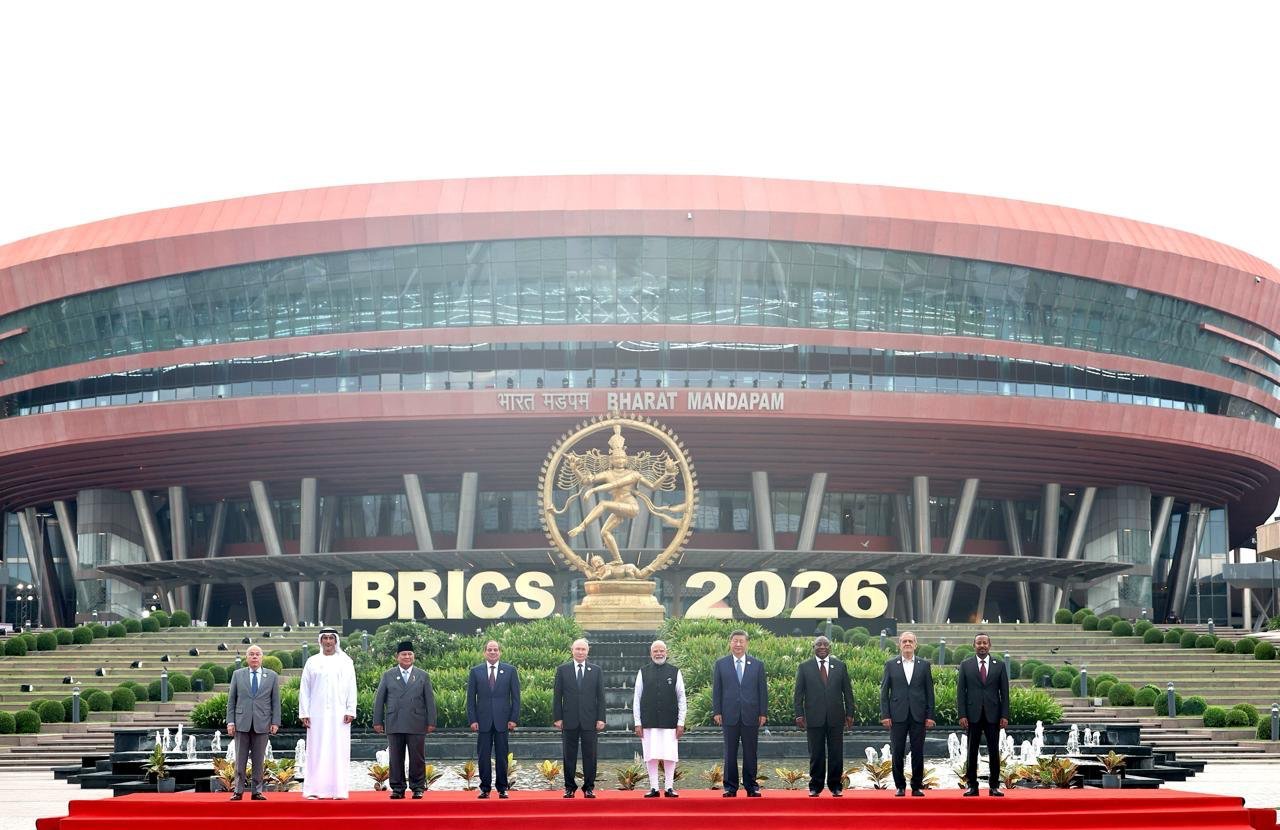
BRICS leaders on Saturday adopted a broad economic and political declaration challenging unilateral tariffs, sanctions and the governance structure of the global financial system, while stopping short of endorsing a common currency or a formal alternative to the U.S.-led international economic order.
The New Delhi Declaration 2026, adopted at the 18th BRICS Summit, calls for greater representation of emerging and developing economies in the International Monetary Fund and World Bank, restoration of the World Trade Organization’s dispute-settlement system and stronger cooperation on cross-border payments, local-currency trade, energy security and supply chains.
For Washington, however, the significance of the declaration lies less in any immediate threat to the dollar or U.S. financial institutions than in the direction of travel.
BRICS — now a much larger grouping of emerging economies — is attempting to build enough alternative infrastructure in trade, payments, development finance and commodities to reduce its members’ vulnerability to unilateral policy decisions taken by major Western powers.
The strategy does not amount to an immediate economic break with the United States. BRICS members remain deeply integrated into U.S., European and global markets.
But the declaration suggests that the grouping increasingly wants options: alternative payment channels if sanctions disrupt conventional transactions; additional sources of development finance if global capital becomes expensive; more resilient supply chains if tariffs fragment trade; and greater use of national currencies if dollar-based transactions become more costly or politically vulnerable.
Prime Minister Narendra Modi, opening the economic plenary under India’s 2026 BRICS theme of “Building for Resilience, Innovation, Cooperation and Sustainability,” framed the issue as one of representation rather than confrontation.
“We must transform this ‘pyramid of privilege’ into a ‘platform of partnership,’ where every country has a voice, every member has a stake, and human development remains at the heart of every effort,” Modi said.
“Countries that drive global economic growth should also have an appropriate role in shaping global economic governance,” he said.
A challenge to unilateral trade policy
The declaration’s strongest language concerns trade protectionism.
BRICS leaders expressed “serious concerns” over the increasing use of unilateral tariffs and non-tariff measures, arguing that they distort trade and are inconsistent with WTO rules.
The issue has direct relevance for the United States, which has increasingly used tariffs and other trade measures as instruments of economic and national-security policy.
BRICS did not single out Washington in the declaration’s principal trade language, but its criticism of unilateral tariff actions and coercive economic measures comes against a backdrop of increasingly contentious U.S.-China trade relations, disputes over industrial subsidies and technology controls, and a broader shift away from the lower-tariff global trading system that prevailed for much of the post-Cold War period.
The bloc also called for the immediate restoration of the WTO’s two-tier, binding dispute-settlement mechanism, including the appointment of new members to the Appellate Body.
The demand is significant because the WTO’s dispute-settlement system has been effectively impaired for years, leaving countries without the full judicial mechanism that was intended to provide predictability to global trade.
For BRICS, restoring the WTO remains preferable to allowing major powers to determine trade rules through unilateral measures.
But the declaration also reveals that the bloc is preparing for a world in which the WTO may remain weakened.
Building a backup system
Alongside its defense of multilateral trade, BRICS is developing a growing network of institutions and initiatives intended to make intra-BRICS commerce more resilient.
The grouping is advancing cooperation on global value chains, commodities, critical minerals, special economic zones and supply-chain integration. It is also pursuing initiatives involving a BRICS Grain Exchange and other mechanisms designed to strengthen commodity security.
The strategy is not necessarily to replace established Western markets and exchanges.
Instead, BRICS is seeking redundancy.
That could become increasingly important for countries concerned about sanctions, export restrictions, shipping disruptions or sudden changes in market access.
For the United States, the development matters because American economic influence has historically rested not only on the size of the U.S. economy but also on the centrality of U.S.-linked financial markets, institutions and trading systems.
If BRICS succeeds in creating viable alternatives, that influence could gradually become less exclusive even if the dollar remains the dominant global currency.
Energy security takes priority
Energy is another area where the declaration could complicate the global policy debate.
BRICS leaders warned about the vulnerability of critical energy infrastructure, maritime trade routes and supply chains to geopolitical tensions and armed conflict.
The declaration stresses that reliable and affordable energy remains essential to economic development and calls for energy transitions that account for the circumstances of developing economies.
That position is likely to resonate with countries that argue that wealthy economies cannot impose identical decarbonization requirements on economies still expanding electricity access, manufacturing capacity and transportation networks.
BRICS also criticized climate-related trade measures that members view as protectionist, including mechanisms such as the European Union’s Carbon Border Adjustment Mechanism.
The broader message is that climate policy cannot, in BRICS’ view, become a mechanism for transferring the cost of decarbonization disproportionately onto developing economies.
At the same time, the grouping is not rejecting the energy transition.
Members are pursuing cooperation on smart grids, hydrogen and low-emission technologies while maintaining access to conventional energy sources.
The result is a dual-track strategy: protect energy security today while developing technologies intended to reduce carbon intensity tomorrow.
IMF and World Bank face renewed pressure
BRICS also renewed its campaign to reform the institutions at the center of the post-World War II economic system.
The declaration argues that the IMF and World Bank need to become more representative of the current global economy, in which emerging markets account for a much larger share of output and growth than they did when the institutions were created.
“With the growing share of EMDEs in global output and growth, reform of global economic governance remains a consistent BRICS priority,” the declaration says.
The bloc called for the Bretton Woods institutions to become more inclusive, representative, accountable and responsive to developing economies.
For Washington, this is potentially more consequential than BRICS’ currency debate.
The United States has traditionally exercised substantial influence within the IMF and World Bank, including through its voting power and role in their governance structures.
A successful BRICS campaign for greater representation of emerging economies would not necessarily weaken those institutions, but it could alter the balance of influence within them.
The issue is likely to remain contentious because any substantial redistribution of voting power creates winners and losers among existing shareholders.
No common BRICS currency — for now
Despite years of speculation about de-dollarization, the declaration does not establish a BRICS currency.
Instead, members are focusing on less dramatic but potentially more practical measures: greater use of national currencies in bilateral trade and improved interoperability between payment and messaging systems.
The BRICS Payment Task Force is working on mechanisms intended to make cross-border transactions faster, cheaper and more secure.
This approach is considerably more realistic than attempting to create a common currency among economies with different monetary policies, capital-account regimes, inflation rates and financial systems.
It also means the dollar is unlikely to face an immediate replacement threat from BRICS.
The more plausible scenario is gradual diversification.
If Indian, Brazilian, Chinese, Russian or other BRICS companies can settle more transactions directly in national currencies, demand for dollars for certain categories of trade could decline at the margin.
But international currencies derive their strength from deep capital markets, liquidity, convertibility, institutional credibility and widespread private-sector use. Government agreements alone cannot manufacture those conditions.
For now, BRICS appears to recognize that reality.
The New Development Bank becomes more important
The grouping is also seeking to expand the role of the New Development Bank, which BRICS views as an important source of infrastructure and development finance.
The bank’s growing emphasis on local-currency financing could allow developing economies to reduce some of their exposure to dollar-denominated borrowing.
BRICS is also advancing a multilateral guarantees initiative intended to reduce risks associated with infrastructure and sustainable-development projects and attract more private capital.
If successful, such mechanisms could matter more to developing economies than declarations about a new financial order.
The practical question is whether BRICS institutions can offer financing that is cheaper, faster and more accessible than existing alternatives.
A divided bloc with a common interest
The declaration also reflects the complicated politics inside BRICS.
India and Brazil have generally sought strategic autonomy rather than an explicitly anti-American economic alliance. Russia and Iran have stronger incentives to reduce exposure to Western sanctions and financial systems. China has the economic scale to promote alternative institutions but remains deeply embedded in global trade and investment networks.
Those differences make a unified BRICS economic bloc difficult.
They also explain why the declaration relies heavily on voluntary cooperation and national circumstances rather than binding commitments.
That flexibility may be a weakness when the bloc seeks to create common institutions, but it is also what allows countries with very different foreign-policy priorities to cooperate.
What it means for Washington
The most immediate lesson for the United States is that BRICS is not creating a rival economic system overnight.
It is building hedges against dependence.
That distinction matters.
The dollar remains deeply embedded in global trade, finance and reserves. U.S. capital markets remain central to international investment, while American technology companies and financial institutions retain enormous global reach.
But economic power can erode at the margins long before it disappears at the center.
If BRICS members increasingly settle trade in local currencies, finance infrastructure through the NDB, develop alternative commodity platforms and strengthen supply chains that are less exposed to Western chokepoints, the United States could gradually lose some of the leverage that comes from the absence of alternatives.
That does not mean BRICS will replace the dollar or the Bretton Woods institutions.
It means U.S. policymakers may eventually face a world in which countries have more choices.
The New Delhi Declaration is therefore less a declaration of economic war on Washington than a warning about the consequences of fragmentation.
BRICS is defending the WTO while preparing for its weakness, supporting global markets while developing alternative channels, and discussing de-dollarization while avoiding the risks of a common currency.
Its strategy is evolutionary rather than revolutionary.
For the United States, that may make it more consequential, not less.
A dramatic BRICS break with the existing system would be easy to identify and counter. A gradual accumulation of alternative payment systems, financing institutions, commodity platforms and trading arrangements is harder to confront because each individual initiative may appear modest.
Taken together, however, they could slowly reshape the choices available to emerging economies.
The real question after the New Delhi summit is therefore not whether BRICS can overthrow the U.S.-led economic system.
It is whether it can make that system less indispensable.