A rapid succession of U.S. immigration and visa policy changes is reshaping the landscape for Indian professionals, students and their families, raising the prospect of higher costs, tighter scrutiny and less room for procedural error at virtually every stage of the immigration process.
From a proposed $103,265 fee for new cap-subject H-1B petitions to the imminent replacement of the “duration of status” system for international students, the changes come as the Trump administration pursues a broader tightening of legal immigration.
For South Asians — particularly Indians, who have historically formed the largest group of H-1B workers and a major share of international students in the United States — the cumulative effect could be substantial.
The policy changes affect not only workers seeking H-1B visas, but also H-4 spouses, F-1 students, Optional Practical Training (OPT) beneficiaries, visitors and employment-based green-card applicants.
Advertisement
The emerging message from Washington is increasingly clear: immigration benefits remain available, but the financial, procedural and compliance risks of obtaining and retaining them are rising.
$103,265 H-1B fee proposal raises stakes
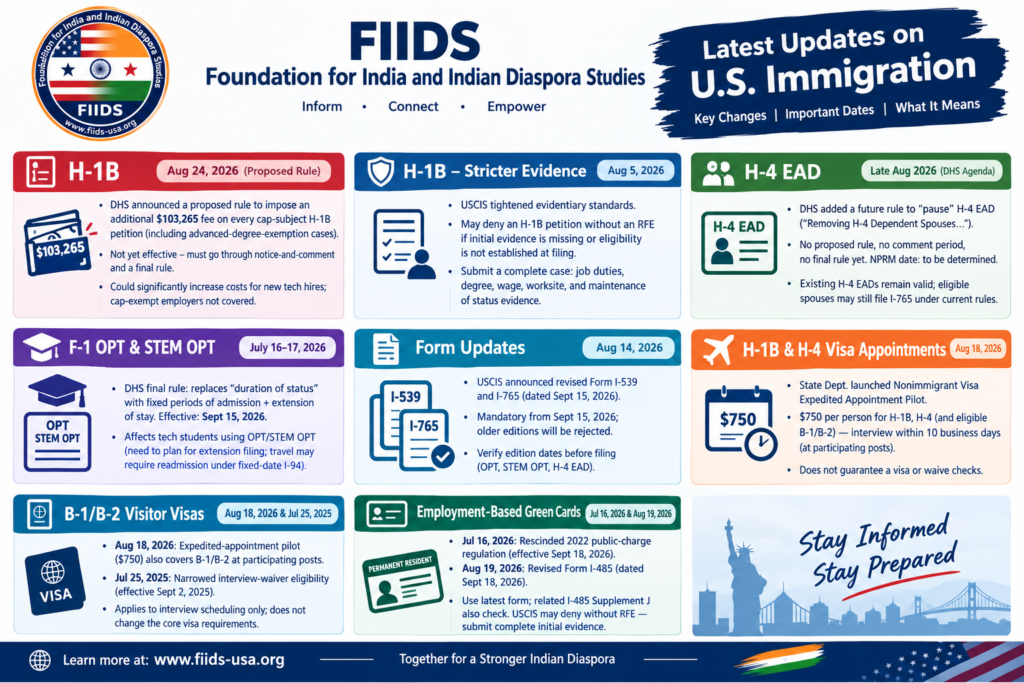
The most consequential proposal for Indian technology professionals is a Department of Homeland Security plan to impose an additional $103,265 fee on H-1B petitions subject to the annual numerical cap, including petitions filed under the advanced-degree exemption.
The proposal, announced in late August, remains subject to the rulemaking process and is not yet in effect. If implemented, however, it would represent one of the most dramatic increases in the cost of sponsoring high-skilled foreign workers.
DHS estimates that, based on 85,000 cap-subject H-1B petitions annually, the proposed fee could generate approximately $8.8 billion a year. The agency says the revenue would help recover costs associated with administering the broader U.S. immigration system.
The proposal has particular implications for Indians because they have long dominated the H-1B program, especially in information technology, engineering and other specialized occupations.
A six-figure government fee could fundamentally alter the economics of recruitment. Large technology companies may be better able to absorb the cost, but smaller companies, startups, universities and employers in sectors such as healthcare could find sponsorship substantially more difficult.
For Indian professionals, the immediate issue is uncertainty. The proposal does not yet change the law, but employers making hiring decisions today must consider the possibility that the cost of sponsoring future H-1B workers could rise sharply.
The proposed fee is also separate from other H-1B fees and comes against the backdrop of litigation and policy disputes surrounding an earlier $100,000 payment requirement.
Less room for error in H-1B filings
Another change could have a more immediate effect on employers and applicants.
USCIS has moved toward a stricter approach to incomplete H-1B filings, potentially allowing cases with deficiencies to be denied without the agency first issuing a Request for Evidence (RFE) or a Notice of Intent to Deny (NOID).
For employers and immigration lawyers, the practical implication is that the traditional expectation of receiving an opportunity to correct deficiencies may no longer be as reliable.
That could increase pressure on companies to ensure that wage information, job descriptions, supporting evidence and filing documentation are complete at the time a petition is submitted.
For Indian professionals, particularly those changing employers or seeking to preserve their immigration status while navigating a complex employment-based green-card system, procedural mistakes could therefore carry greater consequences.
H-4 EAD remains valid — but uncertainty is growing
For thousands of Indian families, perhaps no issue is more important than the future of employment authorization for certain H-4 spouses.
DHS has included the possible elimination of H-4 employment authorization in its future regulatory agenda, raising concern among family’s dependent on two incomes.
But an important distinction remains: there is currently no final rule ending H-4 EAD eligibility, and existing employment authorization remains valid.
Any attempt to eliminate the program would require a formal regulatory process, including a proposed rule and, potentially, a lengthy legal battle.
Still, the prospect has created fresh uncertainty for families in which an H-4 spouse has built a professional career, purchased a home or made long-term financial commitments in the United States.
The issue has a particularly strong South Asian dimension because many Indian H-1B workers face exceptionally long waits for employment-based green cards. H-4 employment authorization has consequently become an important mechanism enabling spouses to maintain careers while families remain in temporary immigration status.
F-1 students face the end of ‘duration of status’
International students are also preparing for a major structural change.
Beginning September 15, DHS is scheduled to replace the longstanding “duration of status” framework with fixed periods of admission for students and other affected nonimmigrant categories.
The change represents a fundamental shift in how international students manage their lawful presence.
Under the duration-of-status system, students generally remained in lawful status while pursuing an approved course of study and complying with immigration requirements. A fixed admission system introduces a more clearly defined expiration date and could require students to navigate extensions of stay.
DHS published the final rule in July, making the change effective September 15.
For Indian students, who form one of the largest international student populations in the United States, the consequences could extend beyond the classroom.
Students planning to move from an F-1 visa to OPT or STEM OPT, and eventually to an H-1B, will need to pay closer attention to admission periods, extension requirements and travel schedules.
The traditional pathway — F-1 student to OPT, STEM OPT and then H-1B — has become one of the principal immigration routes for highly skilled Indian professionals.
Any additional administrative requirement or disruption in that chain could complicate career planning.
USCIS has also introduced new editions of immigration forms, including Form I-539, used for applications to extend or change nonimmigrant status, and Form I-765, the application for employment authorization.
Applicants who use outdated editions after the transition dates risk rejection, underscoring a broader theme emerging from recent immigration policy: paperwork compliance is becoming increasingly consequential.
Visa scrutiny extends into applicants’ online lives
Indian professionals and students seeking visas abroad also face expanded scrutiny.
The State Department expanded online-presence review for H-1B applicants and their H-4 dependents beginning in December 2025. Applicants are instructed to adjust the privacy settings of their social-media profiles to “public” to facilitate screening.
The policy means visa applicants should assume that their publicly available digital footprint could become part of the consular review process.
The State Department says the screening is part of broader security and eligibility vetting.
For applicants, however, the practical effect is another layer of uncertainty in a process already complicated by visa appointment delays and administrative processing.
$750 expedited appointment pilot has limited reach
The State Department has also introduced a pilot program allowing eligible applicants to pay $750 for an earlier visa interview appointment, potentially within 10 business days.
However, an important clarification is necessary: the current official pilot applies to B-1/B-2 visitor visa applicants at participating U.S. embassies and consulates, not generally to H-1B or H-4 applicants.
The program is voluntary, available only at selected locations and does not guarantee either visa approval or faster visa adjudication. It provides an earlier interview appointment only.
The program could nevertheless be relevant to South Asian families and business travelers where available, particularly for those facing long waits for visitor visa interviews.
Narrower interview-waiver rules also continue to affect visa renewals, meaning more applicants may have to appear for in-person interviews.
Green-card applicants face a tougher public-charge framework
Employment-based immigrants are also confronting changes.
DHS has rescinded the 2022 public-charge regulation, effective September 18, restoring broader discretion for immigration authorities to examine relevant factors when determining whether an applicant is likely to become a public charge.
USCIS says the rescission allows officers to consider pertinent facts on a case-by-case basis rather than operating under the narrower framework established by the Biden-era regulation.
The change may affect some adjustment-of-status applicants, although its consequences will depend on individual circumstances and how USCIS applies the revised framework.
For Indian professionals already caught in long employment-based green-card queues, the development adds another layer of uncertainty to an immigration process that can stretch across years.
New I-485 form adds another compliance deadline
USCIS will also require a new edition of Form I-485, Application to Register Permanent Residence or Adjust Status, from September 18.
Older editions submitted or postmarked on or after the effective date will not be accepted, according to USCIS.
The change may appear technical, but it reflects a broader pattern: immigration applicants are increasingly exposed to rejection or delay when procedural requirements are not met precisely.
A broader shift in the immigration environment
Taken individually, each policy change addresses a different part of the immigration system. Taken together, they point to a broader transformation.
The proposed H-1B fee could make foreign recruitment dramatically more expensive. Stricter filing practices could reduce opportunities to correct mistakes. Fixed admission periods could add administrative obligations for students. Expanded social-media screening could lengthen or complicate consular processing. And changes to public-charge rules could increase uncertainty for some green-card applicants.
For South Asians, particularly Indians, the cumulative effect may be greater because of their deep exposure to virtually every stage of the U.S. high-skilled immigration system.
Indian students are among the largest international student groups. Indian professionals have historically been the largest beneficiaries of the H-1B program. Indian families account for a substantial share of H-4 households. And Indians face some of the longest waits in employment-based green-card categories.
The immediate lesson for applicants is that not every announcement represents a change in law. The $103,265 H-1B fee, for example, remains a proposal, while the possible elimination of H-4 EADs has not yet reached the proposed-rule stage.
But the direction of travel is unmistakable.
For Indian and other South Asian immigrants, the American immigration journey is increasingly becoming more expensive, more procedurally demanding and more dependent on meticulous compliance — from the first day a student enters the United States to the years-long wait for permanent residency.