As a host of Global South leaders, ranging from Russia’s Vladimir Putin and China’s Xi Jinping to Indonesia’s Prabowo Subianto and Ethiopia’s Abiy Ahmed fly into a security gridlocked BRICS Summit at New Delhi, many are wondering what India will gain out of a summit, which many in the West see as a challenge to the US’ hegemony in the world. Indian diplomats however see the event as a preserve which gives India, a rising middle power, room to maneuver between competing centers of power.
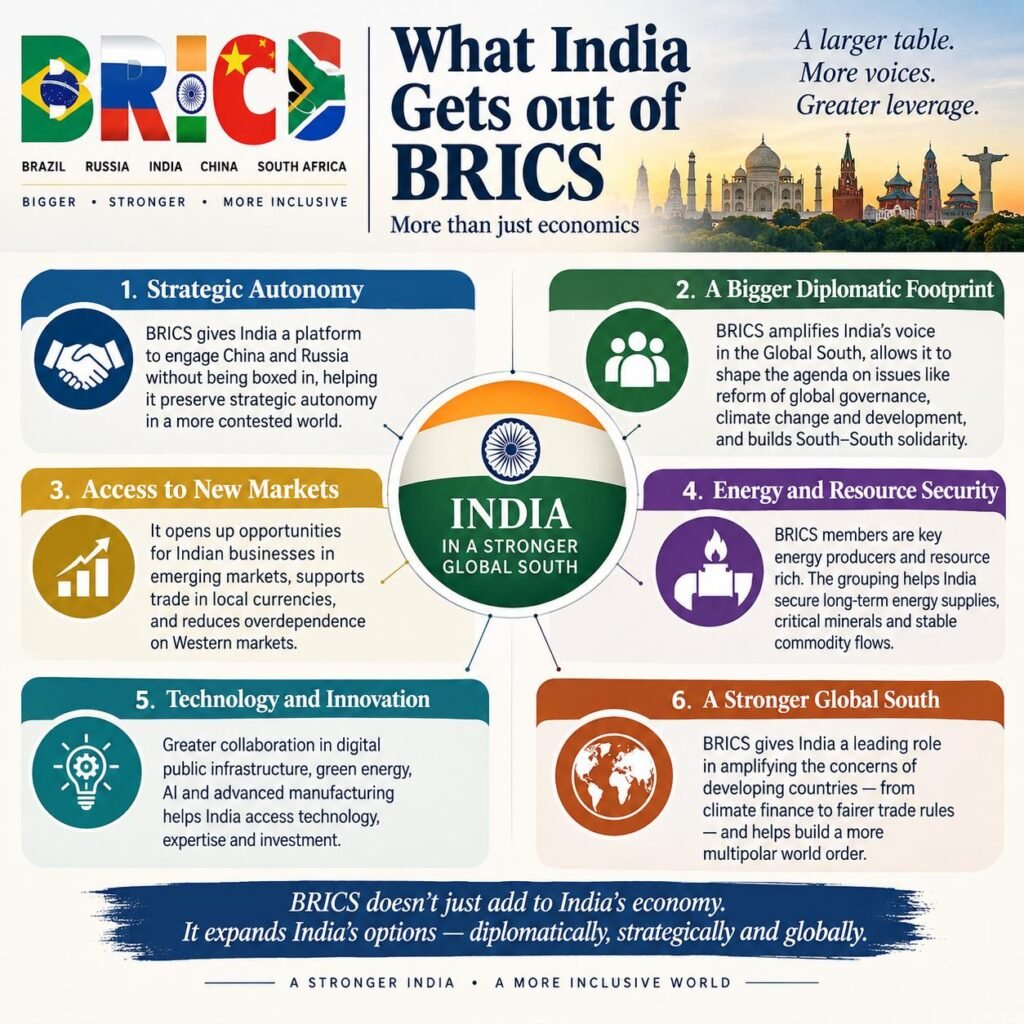
The presence of China, Russia and the expanded group of emerging-market economies allows New Delhi to engage Beijing and Moscow without committing India to any specific anti-Western alignment. “What I am seeing is that we are building more options for trans-border payments and also facilitating trade in national currencies,” Pinak Ranjan Chakravarty, former Secretary (Economic Relations) in the Ministry of External Affairs, told UNI, adding “It seems to be part of a broader hedging policy against global uncertainties.”
India has committed too strongly, both economically as well as through strategic partnerships, with the US, Europe, Japan and the Quad, to risk anything more than its traditional close relations with Russia and a cautious reopening towards China, point out analysts. The summit’s most consequential diplomatic opportunity for Indians looking to another decade of peaceful growth, may therefore be the Narendra Modi-Xi Jinping bilateral meeting.
Even as India and China remain strategic competitors, with the unresolved border disputes, both have begun to show an interest in preventing competition from becoming permanently disruptive. While the talks may not and cannot yield either a grand bargain or even completely resolve the underlying rivalry between the two Asian giants, nevertheless incremental progress, both on border management, and trade or the restoration of economic links, would be of immense value for New Delhi and Beijing. “While we may not make immediate gains, though progress has been indicated, meaningful conversations at the highest level between Beijing and New Delhi reassure global businesses and much of the global South, tired as it is of conflicts,” said Chakravarty.
Advertisement
Russia presents a different calculation, as Moscow remains important to India’s defense and energy security, even as its dependence on China has increased since the invasion of Ukraine. New Delhi too has little interest in allowing the Russia-China relationship to become the only channel through which Moscow engages Asia. The Modi-Vladimir Putin meeting on Friday has provided India an opportunity to reinforce its defense, energy and payments ties with Russia while demonstrating that Western pressure has not removed Moscow from India’s strategic calculus. BRICS also allows India to amplify its claim to represent the interests of the Global South.
New Delhi has increasingly sought to position itself as a bridge between the established industrial powers and developing economies. The agenda includes familiar demands for greater representation in institutions such as the International Monetary Fund and World Bank, as well as reform of the United Nations Security Council. Ministry of External Affairs mandarins pointed out to UNI, that “there is also a broader strategic attraction in diversifying trade and supply chains.” A more functional BRICS could open more markets for Indian companies in the Gulf, Africa, Latin America and Asia, while reducing dependence on any single financial system or trading partner.
“Monetary co-operation, agriculture, food security, logistics and technology are likely to remain part of this discussion,” they said. Indian diplomats do not expect the grouping to become a defense alliance, a coherent anti-western bloc or a near-term replacement for the dollar-based international financial system. Its members have sharply divergent interests. India and China remain strategic rivals. Russia’s priorities are dominated by its war in Ukraine. Gulf members have their own calculations. And most BRICS economies remain deeply integrated with the US and European markets and financial systems. “While the summit in some ways does resemble a jamboree and there are obvious contradictions, the fact that a final communique is almost ready even before the summit really took off is a positive,” said Sreeradha Dutta, professor of international relations at OP Jindal University and former fellow at IDSA.
The West has criticized the ongoing 18th BRICS summit as an outsized international body whose members have little agreement on what the grouping should ultimately become. They rightly point out that some members see it as a counterweight to Western economic and political power; others, including India, are more interested in reforming the existing international system than overthrowing it. That ambiguity is not necessarily New Delhi’s weakness, rather that is precisely what makes BRICS so useful to India as it looks for room to maneuver and organizations to hedge against global disruptions. (UNI)