Join WhatsApp Channel

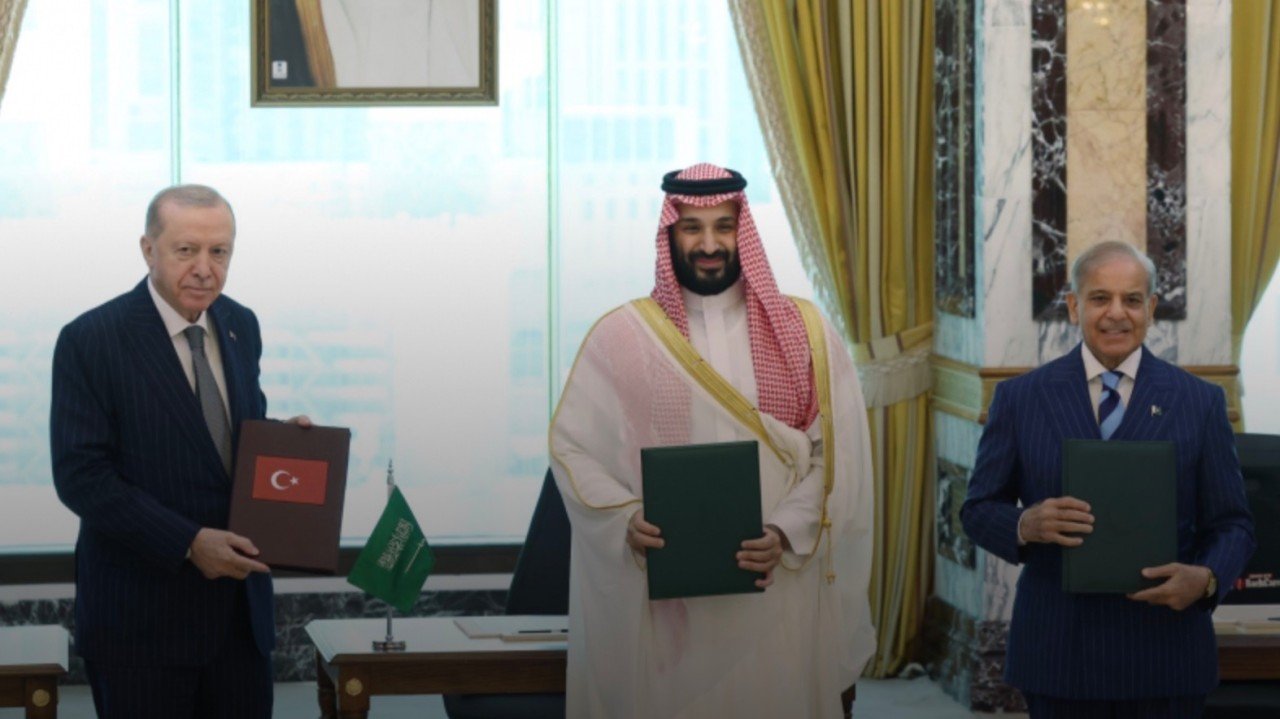
An exaggerated sense of finality surrounds some discussions of the defense accord signed by Saudi Arabia, Turkey and Pakistan in Mecca on August 7. The agreement does not abruptly dismantle the U.S.-dominated order in the Middle East, nor does it immediately establish a NATO-like alliance. Nevertheless, it signals a more substantial shift. The primary regional powers are no longer willing to rely exclusively on Washington for their security.
That distinction is important. Security in the Middle East was predicated for decades on an implicit understanding. The United States supplied the principal military protection, while its regional allies typically aligned their strategic interests with Washington. Saudi Arabia was a pivotal supporter within this construct. American military capabilities, intelligence, weaponry and diplomatic initiatives maintained a relationship resilient through conflicts, revolutions and substantial disagreements.
New Model
The Mecca agreement represents a change in this model. Saudi Arabia, Turkey and Pakistan now regard an armed attack on any one of them as an attack on all. Turkish officials compare this arrangement to NATO’s Article 5. However, it lacks NATO’s integrated command, institutional framework and military interoperability. While its immediate military implications remain uncertain, its political message is clearer.
Saudi Arabia is managing its strategic choices. But this does not signal a departure from its relationship with Washington. Riyadh remains heavily reliant on the United States for military supplies, intelligence, technological advancements, investments and diplomatic support. Riyadh, however, is showing a decreasing willingness to rely exclusively on a single external power for its security. This is a prudent response to the region’s heightened unpredictability.
Weaknesses in the existing security order have been unveiled during recent upheavals. Gulf nations have come to acknowledge that American protection cannot guarantee safety. Iran’s missile and drone capabilities have exposed the vulnerability of even well-defended Gulf regions. On the other hand, successive U.S. administrations have sought to reduce their commitments in the Middle East and focus more on other regions.
The lesson that regional governments appear to draw is not that America holds no significance, but rather that they cannot rely exclusively on America. This is the fundamental message of Mecca.
The agreement signals a transition toward what may be called the regionalization of Middle Eastern security. Countries within the region are increasingly establishing their own military, diplomatic, and strategic alliances rather than relying solely on external powers.
Saudi Arabia provides financial resources, occupies a strategic geographic position and is expanding its diplomatic influence. Turkey has one of the region’s most formidable militaries and maintains a more autonomous foreign policy. Pakistan contributes military expertise, possesses a nuclear deterrent and maintains long-standing historical relations with Saudi Arabia.
The three nations have distinct interests. Turkey advances its ambitions, Pakistan assesses its strategic requirements and Saudi Arabia maintains strong relations with the United States. The agreement does not appear to be directed specifically at Iran. It does not resemble a new Cold War alliance. Rather, it represents a form of strategic hedging. The Middle East is gradually becoming a region where countries aim to engage with multiple partners while minimizing dependence on any single entity.
Saudi Arabia’s approach is noteworthy. It has concurrently bolstered its alliance with Washington, broadened economic and diplomatic relations with China, sustained communication with Iran and reinforced ties with Turkey and other regional allies. This is not indicative of inconsistency. Rather, it exemplifies the foreign policy of a regional power that perceives the international system as too unpredictable to depend exclusively on a single partner.
This pattern is evident in other regions. Turkey remains a NATO member while adopting a more independent foreign policy. The Gulf states maintain strong security ties with the United States while also deepening their economic ties with China. Saudi Arabia seeks recognition not only as an ally of the United States but also as a regional power with independent influence. As a result, the Middle East increasingly reflects the characteristics of the global system, namely, a multipolar, transactional and less hierarchical structure.
This does not suggest that the United States is disengaging. Washington continues to have the most significant military influence beyond the region. It maintains unique capabilities, including military bases, intelligence networks, advanced weaponry and diplomatic influence, not easily matched by regional nations.
But military dominance does not necessarily transform into political dominance. The United States may continue to be the most influential external power, but its influence over the regional security architecture may wane. This distinction is of utmost importance.
Under the existing framework, Washington serves as arbitrator of the Middle East’s strategic equilibrium. The emerging order presumes that regional powers would maintain this balance independently.
The Mecca Agreement could prove significant even without becoming a fully operational military alliance. Its influence will depend on what happens next. If other major Muslim nations, such as Egypt, join the agreement, it could serve as a foundation for a broader regional security network. Additionally, its significance would be significantly enhanced if it includes provisions for intelligence sharing, military cooperation, joint exercises and collective planning.
Even without formal institutionalization, the political precedent is unequivocal. Regional states are beginning to assert that, although they will cooperate with Washington, they are also planning for a future in which Washington may not always be present.
This development does not signify the end of the American order itself but rather the end of its preeminence. The natural inclination in Washington might be to evaluate new regional security arrangements using conventional alliance criteria, such as determining who supports or opposes the United States and whether these developments pose a threat to American influence. Such an approach overlooks the paramount question of why America’s allies are increasingly inclined to diversify their security alliances.
If it intends to retain a central position in the Middle East, Washinton must recognize that military presence and bilateral alliances alone can no longer sustain influence. Governments in the region are increasingly pursuing strategic autonomy, economic development and diplomatic flexibility.
The United States must either consider emerging regional arrangements as threats and attempt to uphold the previous hierarchy. Or it must accept that the Middle East is evolving and aim to remain the essential partner within a more diverse system.
Defining Characteristic
The second approach appears more credible. The Middle East is not transitioning into a post-American era. Rather, it is becoming less exclusively influenced by the United States. The Mecca agreement exemplifies this development. Saudi Arabia continues to align with Washington, Turkey maintains its support for NATO, and Pakistan is not forming an anti-American coalition. Instead, these three nations are collaboratively building a new security framework among themselves.
The defining characteristic of the Middle East’s future may not be America’s withdrawal but the rise of regional powers more confident in shaping their strategic landscape.
Disclaimer: The opinions and views expressed in this article/column are those of the author(s) and do not necessarily reflect the views or positions of South Asian Herald.
Related posts:
 South Asia Notes: US-Iran Conflict Spawns a New Challenge for India
 Ceasefire and Corridor: Gaza Truce Revives the India–Middle East–Europe Plan
 Why Bangladesh’s Pivot Toward Türkiye Could Redefine South Asia’s Geopolitical Landscape
 Turkey’s Growing Engagement in Bangladesh Adds a New Layer to South Asia’s Strategic Balancing