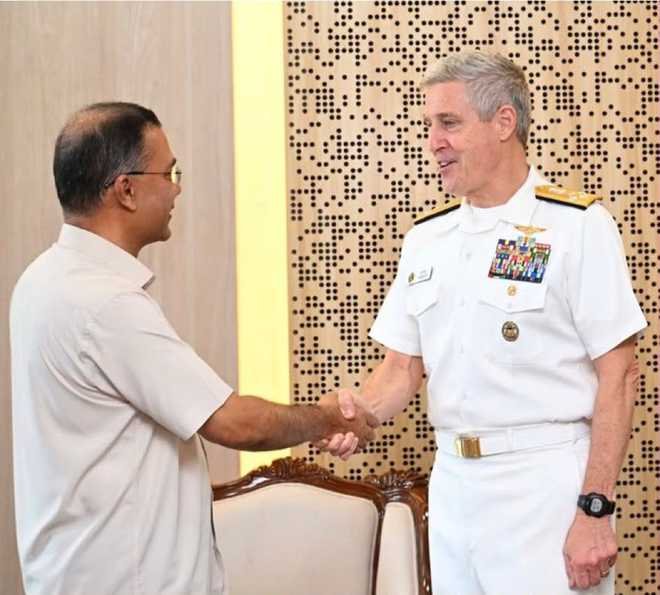
The United States on August 4 announced that it would hold its next naval exercise CARAT in Bangladesh later this year in November.
The crucial naval exercise Cooperation Afloat Readiness and Training (CARAT) which involves the US Navy and Southeast Asian navies besides Bangladesh and Sri Lanka will be held in the Bay of Bengal area off the coast of Bangladesh and Myanmar, said sources in Dhaka.
The move announced by United States Pacific Fleet chief Admiral Stephen T. Koehler after a courtesy call on Bangladesh’s Premier Tarique Rahman, comes close on the heels of the US Army’s Pacific Command and the Bangladesh Army’s joint jungle warfare exercise ‘Tiger Lightning 2026,’ a bilateral training from July 19 to July 31, 2026, at the Jalalabad Cantonment in Sylhet, Bangladesh.
Soldiers from Bangladesh Army’s Para Commando Brigade and from the US Army’s Pacific command and the Oregon Army National Guard were involved in that fortnight long exercise, very near the Assam border.
Advertisement
Tuesday’s meeting between Admiral Koehler and Premier Rahman also reviewed progress on the proposed General Security of Military Information Agreement (GSOMIA) that is proposed to be signed between Bangladesh and the United States.
The signing of GSOMIA is expected to set a legal framework to securely share and protect classified military intelligence between both nations, and will be their first step before Washington is able to sell advanced defense equipment to the US including jet aircraft.
The US is believed to have offered F/A-18 Super Hornet fighter jets and AH-64E Apache attack helicopters to Bangladesh, as well as Lockheed-built TPY-4 ground-based air defense radars and NASAMS air defense missiles. Bangladesh is looking into UAVs like the MQ-9 Reaper.
Till now Bangladesh has depended on China for 70-80 per cent of its military hardware.
The US is also negotiating the signing of another military pact, ACSA, a logistical support pact that would enable American warships and fighter aircraft to use Bangladeshi ports and airfields for maintenance and refueling, “facilitating better joint disaster response and maritime monitoring in the Bay of Bengal.”
The Bangladesh side reiterated that it “attaches great importance to its relationship with the United States and expressed interest in expanding bilateral cooperation into broader and more contemporary areas,” officials in Dhaka said.
Earlier last week, Bangladesh had been offered a place in the Pax Silica economic security architecture designed to reshape the global supply chains underpinning artificial intelligence, semiconductors and critical minerals, away from China.
US Special Envoy for South and Central Asia Sergio Gor had during his recent visit to Dhaka, proposed that Bangladesh join the US-led Pax Silica initiative at a meeting with Prime Minister Tarique Rahman last week.
Significantly, Gor had also met Indian High Commissioner Dinesh Trivedi in Dhaka a day earlier. Since India is already a full-fledged member of Pax Silica, a pact which seeks to establish a strategic economic supply chain avoiding China, top sources in Dhaka said it is “more than likely that the issue was discussed with the Indians before the offer was made to Dhaka” in a bid to wean it away from Beijing’s influence about which both Delhi and Washington are concerned.
It is well known that Pax Silica is not a simple conventional free-trade agreement, rather it is an economic-security framework in which participating countries, USA, India, Japan, UK, Australia, and South Korea, are consciously building a new supply chain for trade and investment in the world of critical minerals and AI where China will not play a role. (UNI)