 Join WhatsApp Channel

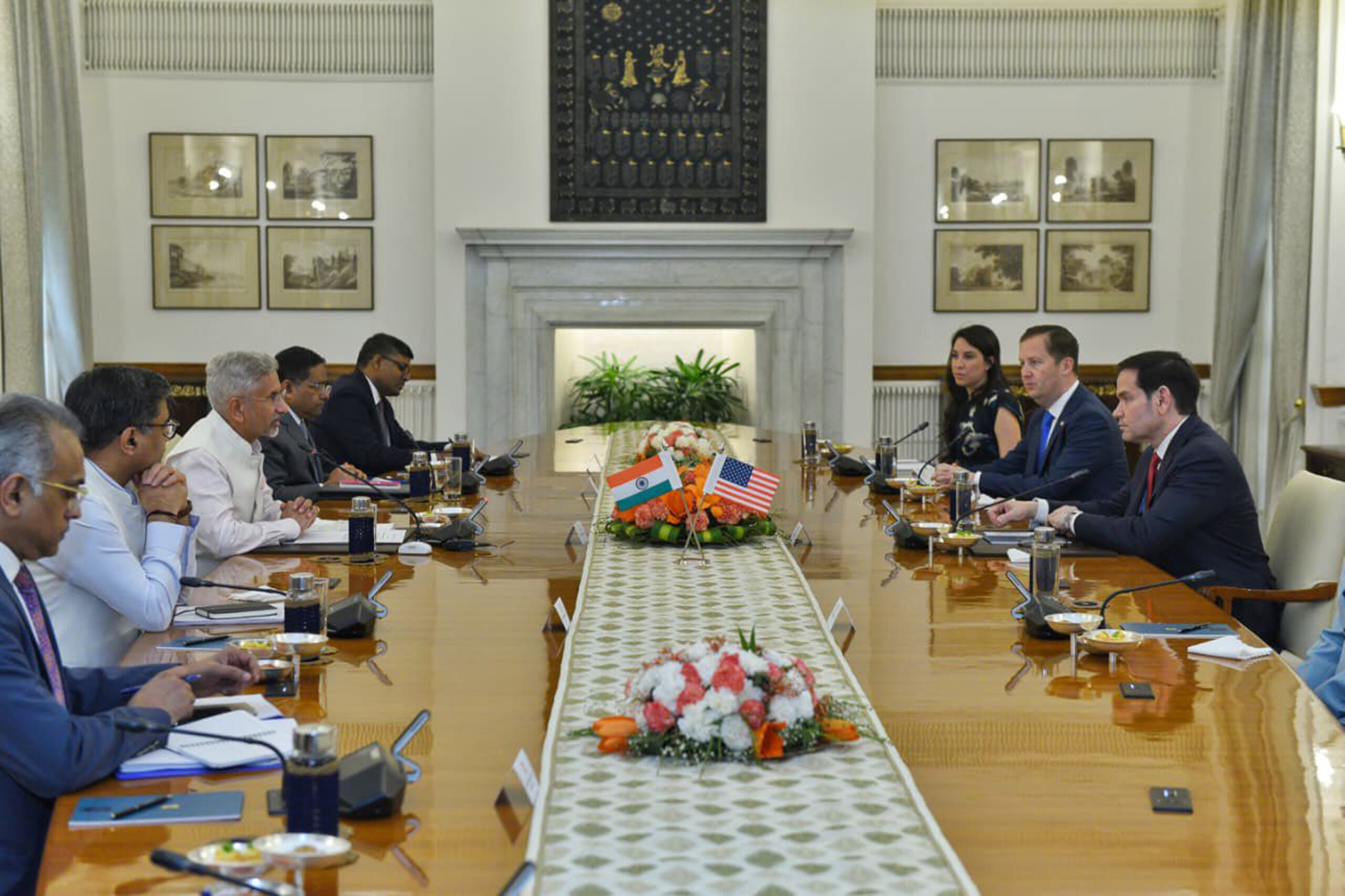
India and the United States signaled fresh “momentum” in their expanding strategic partnership, with US Secretary of State Marco Rubio expressing confidence that the two sides would conclude a bilateral trade agreement “soon,” while External Affairs Minister S Jaishankar underscored New Delhi’s policy of maintaining strong ties across multiple global power centers.
Following wide-ranging talks in New Delhi, the two leaders highlighted growing cooperation in trade, defense, energy, critical minerals, technology, and counter-terrorism, reflecting the broadening scope of a relationship that both sides described as increasingly consequential for regional and global stability.
“We hope to seal a trade agreement with India soon,” Rubio said, while reaffirming that India remains one of America’s most important strategic partners and a key actor in addressing major international challenges. Jaishankar, meanwhile, said India’s foreign policy is guided by a doctrine of “multi-alignment,” enabling it to pursue strong partnerships with the United States, Europe, Russia, West Asia, and other stakeholders without viewing global affairs through a zero-sum lens.
Both countries have pushed in more efforts to deepen commercial engagement as global supply chains undergo significant realignment.
Rubio described India as one of Washington’s most important strategic partners and rejected suggestions that bilateral ties required a “reset” or “reinvigoration” following recent trade frictions and tariff-related debates.
“This is not about restoring or reinvigorating. I’ve seen people use that terminology. This is about continuing to build on what is already a very solid and strong strategic partnership—one of the most important ones that we have, and one of the most important ones in the world,” he said.
Emphasizing the strategic depth of the relationship, Rubio said India-US ties were fundamentally different from many other international partnerships because they were rooted in shared democratic values and converging long-term interests.
“We are the two largest democracies in the world, and so that alone is a baseline for incredible cooperation. We have so many common interests that it makes all the sense in the world for us to continue to build upon,” he said.
Calling India a critical global player, Rubio noted that only a handful of countries possess the economic, diplomatic, and strategic weight necessary to shape outcomes on major international issues.
“There are very few countries in the world that actually have the ability to do something about the big issues on a global scale. There are a handful of countries that have the economic and diplomatic power to be influential on strategic issues from a global perspective, and India is one of them,” he said.
“We have to justify to the American people every decision we make, and our counterparts here in India have to do the exact same thing,” Rubio said. “That begins to align our interests immediately.”
Rubio underscored growing cooperation in energy security and critical minerals, describing resilient supply chains as a strategic necessity.
“Our partnership is not limited to regional issues,” he said. “Both countries are strategic allies on the idea that access to critical minerals and supply chains is essential in the 21st century.”
On counter-terrorism, Rubio highlighted shared concerns over global terrorist networks.
“Both of our countries have suffered, both directly and indirectly, because of global terrorist networks. There is a strong counter-terrorism alignment as a result of that,” he said.
Addressing the situation surrounding Iran and maritime security in the Strait of Hormuz, Rubio reiterated support for freedom of navigation and unimpeded global commerce. He said progress had been made in discussions concerning Iran, while maintaining Washington’s long-standing position that Iran must never acquire nuclear weapons.
Responding to concerns over recent changes affecting J-1, F-1, and H-1B visas, Rubio said reforms to the US immigration system were global in nature and not directed at India.
Acknowledging India’s contribution to the US economy, he said Indian companies had invested more than USD 20 billion in the United States.
“The modernization of our migration system into the United States is not India-specific; it is global and is being applied across the world,” Rubio said.
Speaking alongside Rubio, Jaishankar said India’s foreign policy is based on managing multiple strategic relationships without viewing international affairs as a “zero-sum game.”
“We don’t look at it as a zero-sum game. We have to manage and take care of all these accounts,” he said.
The minister noted that India maintains strong ties simultaneously with the United States, Israel, Iran, Gulf countries, Russia, Europe, and Ukraine.
“Today’s India has that range of interests which require us to manage multiple accounts,” he said, describing the approach as one of multi-alignment.
Jaishankar said India’s priorities in West Asia include regional stability, protection of the Indian diaspora, energy security, and ensuring safe maritime commerce.
Jaishankar highlighted the renewal of the 10-year India-US major defense partnership framework and the signing of a roadmap on underwater domain awareness.
He said both sides were also working toward finalizing an interim trade arrangement as a step toward a comprehensive Bilateral Trade Agreement.
“The final text of an interim agreement is being worked on,” he said, adding that further delegations would continue discussions in the coming months.
Referring to civil nuclear cooperation, Jaishankar said recent legislative developments, including the SHANTI Act, had opened new possibilities for collaboration.
Jaishankar said energy cooperation had become a major pillar of the bilateral relationship, noting a significant increase in imports from the United States over the past year.
“There has been a very significant uptake in the energy imports from the United States. It’s not new, but it has really picked up in the last year,” he said.
Calling the current period an era of “de-risking,” Jaishankar stressed the need for diversified energy sources.
“For us, the US has emerged as a significant and reliable source of energy. Diversifying energy sources is at the heart of our energy security,” he said.
Rubio also sought to allay concerns over Washington’s engagement with Pakistan, insisting that US relations with other countries would not come at the expense of its strategic partnership with India.
“We have relations, and we work at the tactical level with countries all over the world. So does India. That’s what responsible nation-states do,” he said.
“But I don’t view our relation with any country in the world as coming at the expense of our strategic alliance with India.”
The US Secretary of State said India-US relations had “not lost momentum,” and would become stronger in the years ahead despite occasional differences over trade and regional diplomacy.
His remarks are expected to reassure New Delhi amid growing debate over Washington’s outreach to Islamabad, while reinforcing the broader strategic convergence that continues to shape India-US ties across trade, defense, technology, energy, and Indo-Pacific security.
Related posts:
 Rubio’s Four-Day India Tour Carries Strategic Significance
 PM Modi, US Secy of State Rubio Hold Strategic Talks as India-US Partnership Gains Momentum
 Secretary Marco Rubio Welcomes Quad Foreign Ministers in DC for High-Level Diplomatic Talks
 Indian American Republicans Welcome President-elect Trump’s Pick of Marco Rubio as Secretary of State
