Join WhatsApp Channel

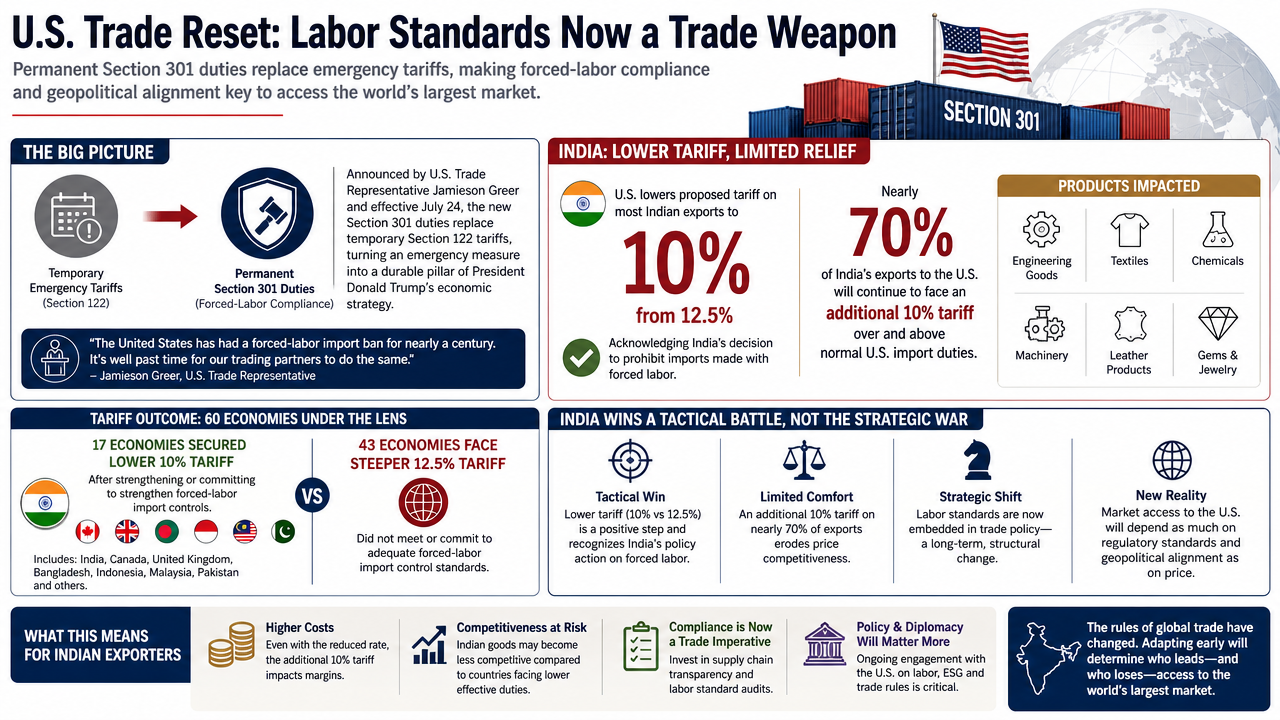
The United States has fundamentally rewritten the rules of global trade, replacing temporary emergency tariffs with permanent Section 301 duties linked to forced-labor compliance, signaling that future access to the world’s largest market will increasingly depend as much on regulatory standards and geopolitical alignment as on price competitiveness.
For India, the headline is reassuring but the underlying message is sobering.
Washington has lowered the proposed tariff on most Indian exports to 10% from 12.5%, acknowledging New Delhi’s recent decision to prohibit imports made with forced labor. But nearly 70% of India’s exports to the United States—from engineering goods and textiles to chemicals, machinery, leather products and gems and jeweler—will continue to face an additional 10% tariff over and above normal U.S. import duties.
The new Section 301 duties, announced by U.S. Trade Representative Jamieson Greer and effective July 24, replace the temporary Section 122 tariffs that had been imposed earlier this year, transforming what was initially presented as an emergency trade measure into a more durable pillar of President Donald Trump’s economic strategy.
More significantly, they establish a new precedent: labor standards have become a trade weapon.
“The United States has had a forced-labor import ban for nearly a century. It’s well past time for our trading partners to do the same,” Greer said while announcing tariffs on imports from 60 economies following months of investigations, public hearings and consultations.
India Wins a Tactical Battle, Not the Strategic War
India was among 17 economies—including Canada, the United Kingdom, Bangladesh, Indonesia, Malaysia and Pakistan—that secured the lower 10% tariff after either strengthening or committing to strengthen their forced-labor import controls.
The remaining 43 economies face a steeper 12.5% duty.
For Indian exporters, however, the lower rate offers only limited comfort.
Products already covered under Section 232 national security tariffs—including steel, aluminum, copper and certain auto components—will continue attracting duties of 25% to 50%, while only selected pharmaceutical products, agricultural inputs, medical supplies and strategic raw materials remain exempt.
Industry Sees Opportunity Amid Disruption
Industry believes India’s relative position has improved despite the new tariff.
Federation of Indian Export Organizations (FIEO) President S. C. Ralhan said India had avoided being singled out and instead secured a comparatively favorable position because of the government’s policy response on forced labor.
He said competitors such as China, Thailand, Türkiye, Brazil and South Africa now face the higher 12.5% tariff, creating opportunities for Indian exporters to gain market share in sectors where even a small tariff differential can influence sourcing decisions.
However, Ralhan cautioned that India’s principal competitors in labor-intensive industries—including Bangladesh, Cambodia, Pakistan, Sri Lanka, Indonesia and Malaysia—remain in the same 10% tariff category, meaning Indian exporters cannot rely on tariff advantages alone. Instead, he urged exporters to focus on supply-chain compliance, productivity, innovation and value addition to strengthen their competitiveness.
A Tariff Looking for a Justification?
Trade experts are less convinced that the tariffs are really about forced labor.
Ajay Srivastava, founder of the Global Trade Research Initiative (GTRI), argues that the United States has produced no credible evidence that India imports goods produced through forced labor.
He notes that India amended its Foreign Trade Policy in June to prohibit imports made with forced or compulsory labor—precisely the policy change Washington had sought—yet the tariff remains.
In Srivastava’s assessment, the measure appears less about correcting a proven labor-rights problem and more about preserving the Trump administration’s tariff wall after the expiry of the temporary Section 122 duties.
The implication, he argues, is that tariffs are evolving from responses to specific trade distortions into permanent instruments of industrial policy and strategic leverage.
The Bigger Story Lies Ahead
The Section 301 action could prove to be the opening chapter of a much broader restructuring of global trade.
The Trump administration is expected to conclude another Section 301 investigation into excess manufacturing capacity, which could trigger additional tariffs across multiple industrial sectors. Washington has also shown an increasing willingness to deploy tariffs to pursue wider strategic objectives, including energy security, supply-chain resilience and geopolitical priorities.
That means compliance is rapidly becoming the new passport to global commerce.
Exporters will increasingly need to prove traceability across supply chains, demonstrate adherence to labor and environmental standards and navigate an expanding web of regulatory requirements that extend well beyond customs duties.
For India, the immediate challenge is managing a permanent 10% tariff. The larger challenge is adapting to a trading system where market access will increasingly be determined not only by cost and quality, but by policy alignment, regulatory credibility and strategic trust.
The latest U.S. decision therefore represents more than another tariff announcement. It marks the arrival of a new trade order—one in which tariffs are no longer temporary negotiating tools but enduring instruments of economic statecraft, and where competitiveness will be measured as much by compliance as by manufacturing efficiency.