Join WhatsApp Channel

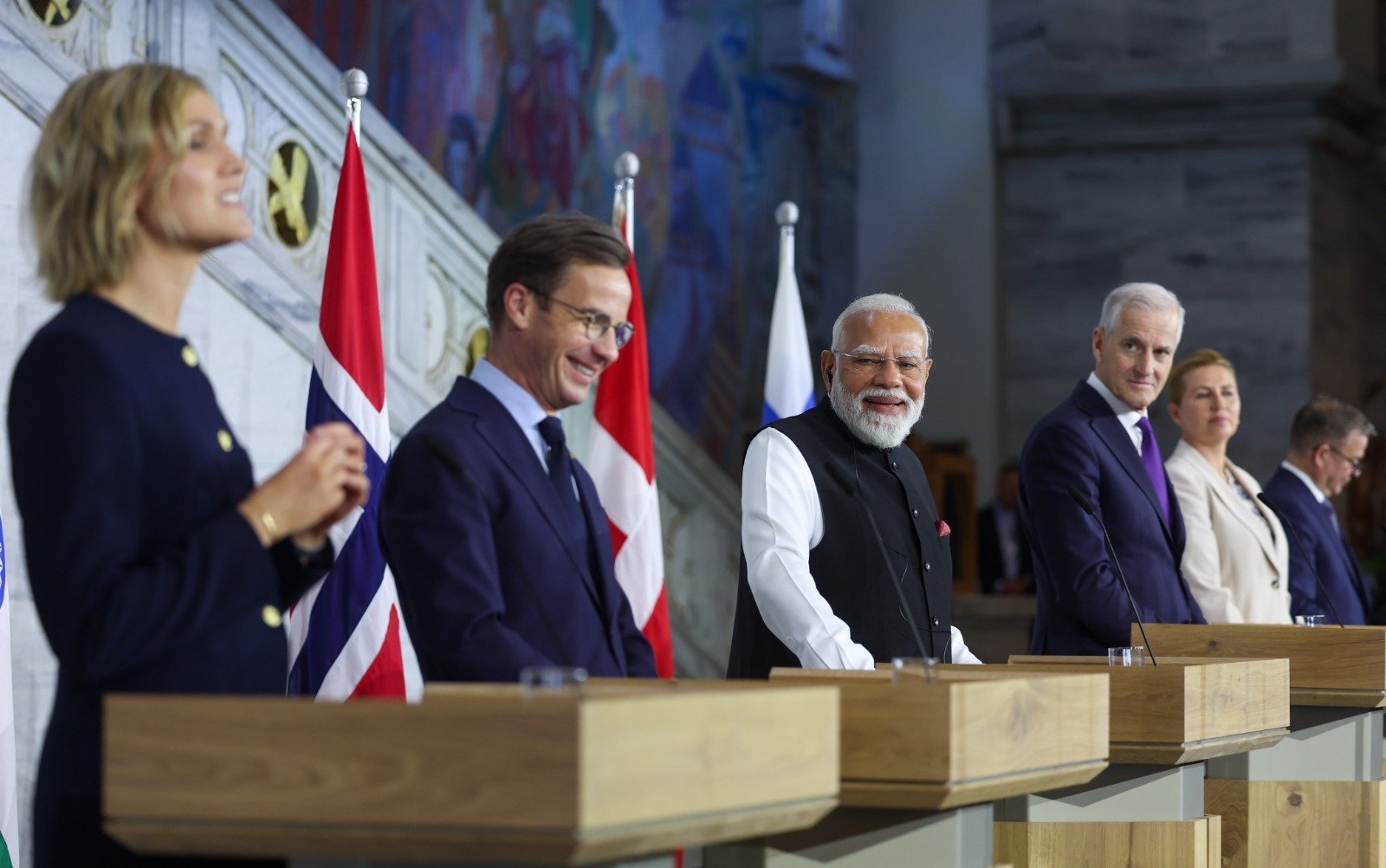
In global politics, there are moments when diplomacy ceases to be ceremonial and becomes transformational. India’s expanding engagement with the Nordic countries appears to be one of those moments. What unfolded at the Third India–Nordic Summit in Oslo in May 2026 was not simply another multilateral gathering filled with carefully crafted communiqués and symbolic handshakes. It represented something much larger: the visible emergence of a long-term geopolitical strategy through which India is attempting to reposition itself within the evolving architecture of global power.
For South Asia, this development carries profound implications.
India’s growing partnerships with Sweden, Norway, Finland, Denmark, and Iceland are not confined to trade or bilateral cooperation. They are part of a deeper strategic realignment centered on advanced technology, clean energy, digital governance, Arctic research, resilient supply chains, maritime security, and green industrial transformation. In many ways, the Nordic region offers India precisely what it seeks for the next phase of its rise: technological sophistication without strategic dependency, innovation ecosystems rooted in institutional trust, and partnerships aligned with democratic governance.
This is where the story becomes critically important for the rest of South Asia.
Too often, regional observers analyze India’s foreign policy through a narrow lens focused only on China, Pakistan, or the Indo-Pacific rivalry. But India’s Nordic outreach signals a broader ambition. New Delhi is no longer merely balancing regional power equations; it is attempting to integrate itself into the most advanced innovation and sustainability networks of the twenty-first century. That transition could fundamentally alter the balance of economic and technological power across South Asia.
The Nordic countries, despite their relatively small populations, collectively possess extraordinary influence in sectors that will define the future global economy. Sweden remains a leader in telecommunications, green manufacturing, and industrial innovation. Finland is advancing aggressively in quantum technologies and next-generation digital systems. Denmark has become a global reference point in renewable energy and climate adaptation. Norway controls enormous sovereign wealth resources while shaping the future of green shipping, ocean governance, and Arctic research.
India understands that the future hierarchy of nations will not be determined solely by military power or GDP size. It will increasingly depend on technological depth, green transition capacity, digital infrastructure, and strategic resilience. Its partnerships with Nordic countries reflect that understanding.
The implications for South Asia are substantial because regional influence today is no longer measured only through territorial or military dominance. Technological ecosystems now shape geopolitical influence as decisively as armies once did.
If India succeeds in building long-term innovation corridors with Nordic countries in artificial intelligence, 6G telecommunications, semiconductor supply chains, clean hydrogen, cyber security, and quantum computing, it could create a technological asymmetry within South Asia that neighboring countries may struggle to match. The India–EFTA Trade and Economic Partnership Agreement, with projected investments of around $100 billion and the promise of one million jobs over fifteen years, is not merely an economic arrangement. It is part of a broader industrial and strategic transformation that may accelerate India’s rise into the ranks of advanced technological powers.
For countries such as Bangladesh, Sri Lanka, Nepal, and Pakistan, this reality presents both a challenge and an opportunity.
Bangladesh, in particular, stands at a critical crossroads. Over the past two decades, the country has achieved impressive economic growth and social development. Yet the next phase of national advancement will require far more than export-led industrialization based on low-cost labor. Climate vulnerability, automation, digital competition, and global supply-chain restructuring are rapidly changing the foundations of economic competitiveness.
The Nordic model offers lessons that South Asia urgently needs to study. Nordic success is not built solely on wealth. It rests on institutional credibility, investment in human capital, research-driven innovation, transparent governance, and long-term policy consistency. These are precisely the areas where many South Asian states continue to face structural weaknesses.
The crucial question, therefore, is whether countries like Bangladesh can engage the Nordic region directly and strategically rather than observing India’s growing influence from the sidelines.
There is no structural reason why Bangladesh cannot become an active participant in emerging green and digital partnerships. The country possesses significant advantages: a young population, growing digital adoption, strategic geographic positioning, and increasing relevance in climate diplomacy. Bangladesh could potentially position itself as a regional hub for green manufacturing, climate adaptation technologies, renewable energy integration, and digital services. But this requires strategic clarity and diplomatic ambition.
Simply relying on China’s infrastructure financing or remaining economically dependent on traditional export sectors will not be sufficient in the coming decade. Nor will passive alignment under India’s regional shadow create sustainable strategic autonomy.
South Asia as a region suffers from a persistent geopolitical limitation: the inability to think collectively about long-term transformation. SAARC remains effectively paralyzed, while BIMSTEC has yet to evolve into a truly effective regional platform. Regional integration remains weak, trust deficits remain deep, and strategic planning often remains reactive rather than visionary.
Against this backdrop, India’s Nordic engagement could either deepen regional inequalities or become a catalyst for broader regional modernization.
Much depends on how neighboring countries respond.
If South Asian governments interpret India’s strategic rise solely as a competitive threat, they may isolate themselves from emerging networks of technology, sustainability, and investment. But if they approach the situation pragmatically, India’s growing integration with Nordic innovation ecosystems could create spillover opportunities for regional cooperation in renewable energy, climate resilience, digital infrastructure, and maritime connectivity.
The maritime dimension alone deserves far greater attention. The Nordic countries are deeply invested in sustainable ocean economies, green shipping technologies, and maritime governance. South Asia, surrounded by the Bay of Bengal and the Indian Ocean, remains one of the world’s most climate-vulnerable maritime regions. Cooperation involving India and Nordic partners in blue economy development, port modernization, green shipping corridors, and marine sustainability could reshape regional economic connectivity.
Security dynamics also matter.
The Nordic region has undergone a historic transformation following Finland and Sweden’s accession to NATO. Europe’s northern flank is now fully integrated into Western security architecture. India is not a NATO ally, nor is it likely to become one. Yet through expanding defense-industrial cooperation, cyber security partnerships, and maritime coordination with Nordic states, India is gradually strengthening its functional links with Western strategic networks.
This carries an important geopolitical signal for South Asia.
India is steadily increasing its relevance not only within the Indo-Pacific but also within broader transatlantic strategic thinking. That enhanced positioning could influence everything from defense technology access to intelligence cooperation and cyber resilience. Smaller South Asian states cannot afford to ignore these evolving realities.
Another often-overlooked dimension is the Arctic.
India’s Arctic engagement, particularly through its research station in Svalbard and observer status in the Arctic Council, reflects a sophisticated understanding of interconnected climate geopolitics. The Arctic is no longer a distant frozen frontier isolated from South Asian concerns. Melting Arctic ice directly affects global weather systems, sea-level rise, and monsoon behavior all of which have enormous consequences for agriculture, food security, and climate migration across Bangladesh, India, Pakistan, and Sri Lanka.
India recognizes that climate politics is becoming inseparable from strategic politics.
Many South Asian countries, however, still approach climate change primarily as a developmental or humanitarian issue rather than a geopolitical one. That conceptual gap could become increasingly costly in the future.
Perhaps the most significant lesson from India’s Nordic strategy is the importance of strategic patience and institutional consistency. India’s rise in global diplomacy did not emerge overnight. It reflects years of investment in economic reform, digital infrastructure, technological ambition, and geopolitical diversification. The Nordic partnerships are a continuation of that long-term approach.
For the rest of South Asia, the challenge is not simply how to respond to India’s growing influence. The deeper challenge is whether regional states can develop coherent strategic visions of their own.
The twenty-first century will likely be shaped by countries capable of combining technological innovation, climate resilience, institutional trust, and geopolitical flexibility. The Nordic countries mastered this formula decades ago. India is now attempting to adapt parts of that model to its own scale and ambitions.
South Asia’s smaller nations still have time to position themselves within this changing landscape. But time is narrowing rapidly.
History rarely waits for those who hesitate.
Disclaimer: The opinions and views expressed in this article/column are those of the author(s) and do not necessarily reflect the views or positions of South Asian Herald.
Related posts:
 D.C. Dispatch: Arctic Fault Lines Linking Climate Commerce and Security from Polar Ice to South Asian Shores
 India Stresses Maritime Security and Anti-Terrorism as Pillars of National Strategy
 Beyond a Courtesy Call: Paul Kapur’s Dhaka Visit and Bangladesh’s Rising Strategic Weight in South Asia
 Erik Solheim Discusses Multipolar World Order and Global Sustainability