 Join WhatsApp Channel

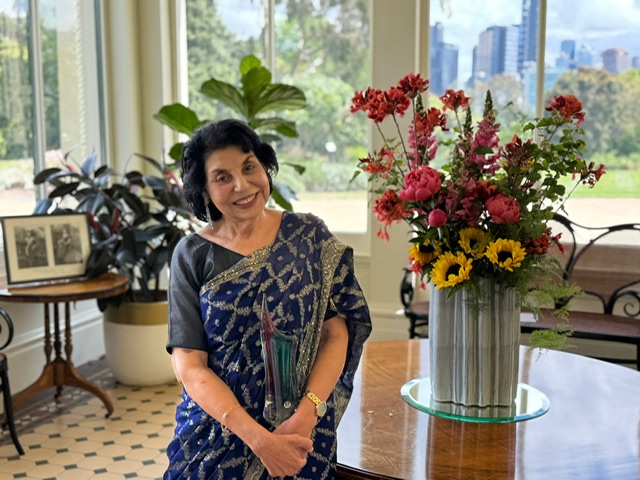
At the 70th session of the Commission on the Status of Women (CSW) in United Nations, New York, a stark warning emerged from the global stage: for many migrant women experiencing domestic violence, the risk is not only harm, but suicide.
Professor Manjula O’Connor, an Australian psychiatrist and leading researcher in migrant women’s mental health, used the UN platform to highlight what she described as an under-recognized and escalating crisis, the link between domestic violence, coercive control, and suicidal distress.
In an exclusive interview with South Asian Herald on April 8, 2026, O’Connor has reinforced that warning, stating that the risks remain urgent and insufficiently addressed.
“This is not just a mental health issue, it is a structural trap,” she said, pointing to the layered realities faced by migrant women, including visa dependency, financial coercion and social isolation.
A Global Warning from the UN Stage
At the CSW, one of the world’s most significant forums on gender equality, O’Connor drew attention to patterns emerging across migrant communities, particularly among women navigating violence within transnational family structures.
Her clinical findings align with global evidence. Research published in Australasian Psychiatry shows that suicide is up to seven times more likely among victims of family violence, with high levels of suicidal ideation and attempts recorded among immigrant women.
Crucially, the research found that even when mental health symptoms improve, suicidal thoughts often persist, a signal, O’Connor said, that the issue extends beyond clinical diagnosis.
“The issues for immigrant women are complex, visa dependency, economic coercion and dowry extortion often trap them in abusive situations,” she said.
What Is Dowry and When Does It Become Abuse?
O’Connor emphasized that dowry, often misunderstood outside South Asia, is not simply gift-giving. “Gifts are something given voluntarily and within one’s means,” she said. “Dowry, in contrast, involves oversized financial demands, often multiple times the annual income of a bride’s family, and is frequently driven by coercion, expectation and threat.”
She stressed that the issue is not about culture but about coercion. “When there is a looming threat of violence if demands are not met, that is not a gift, that is coercion,” she said.
What may be described as “gifts” in some contexts, she added, can in practice constitute abuse when linked to control, financial extraction or ongoing demands across families and borders.
A 2026 paper published in the British Journal of Psychiatry similarly identifies dowry abuse as a “lesser-known form of family violence” with serious mental health consequences, including anxiety, depression and suicidality.
Australia: Dowry Abuse Now Recognized in Law
Australia has taken a significant step in formally recognizing dowry-related coercion within its legal framework.
Amendments under the Family Law Amendment Bill 2024 identify coercion related to dowry, including demands for money, assets or financial compliance, as a form of abuse within property settlements.
The provisions include coercing a family member to provide money or assets as dowry or concealing such transactions. O’Connor, who has led advocacy efforts through the Australasian Centre for Human Rights and Health, said the reform followed years of campaigning and submissions to federal and state inquiries.
“No one believed we would get dowry abuse included in the Federal Family Law Act,” she said.
She added that the change allows dowry-related assets, including cash and jewelry, to be formally considered in property settlements, giving women a pathway to claim what was taken from them.
Reality On the Ground
Despite legal progress, O’Connor said there is no evidence of a decline in such cases. Patterns observed in clinical practice suggest that abuse often intensifies after migration, particularly in transnational marriages where expectations of financial exchange continue.
In one de-identified case, a migrant woman was confined, deprived of communication, and subjected to violence after failing to meet dowry demands, before eventually escaping and seeking help.
“If women leave, they are vulnerable because of lack of adequate support for their particular needs by the systems,” she said.
A Systemic Gap: Not an Isolated Issue
O’Connor’s research highlights that outcomes are closely tied to autonomy. Women who gain financial independence or access to education show significant reductions in suicidal ideation, while those who remain in dependent environments continue to experience distress, even when receiving treatment.
This reflects broader systemic gaps, she said, where clinical systems focus on symptoms, legal systems struggle to capture non-physical abuse, and migration frameworks reinforce dependency.
A Call to Communities and Policymakers
O’Connor called for greater awareness within communities and institutions. “We need to break the silence, particularly within community and faith institutions,” she said.
She also pointed to a deeper contradiction within migrant communities. “I am incredibly proud of our Indian minds and the high-achieving migrants we are,” she said. “We lead major global companies, we are among the best in IT, engineering and medicine, and our incomes are often higher than the national average. And yet our domestic violence rates are high as well, I cannot understand this dichotomy.”
The warning, delivered on a global stage and reinforced at home, leaves little ambiguity. As Australia moves to recognize coercive control and dowry-related abuse within its legal system, the challenge now lies not in defining the problem, but in confronting it.
Related posts:
 Film Review: The Bluff is Like a Hindi Movie Disguised as Hollywoodian Thriller
 Silent Classrooms, Loud Cries: The Legal Vacuum in India’s Student Mental Health System
 Bipartisan Stop Institutional Child Abuse Act Passed Unanimously in the US Congress Heads to President’s Desk for Approval
 A South Asian Perspective: It is Time to Prioritize Mental Health in the Workplace
