 Join WhatsApp Channel

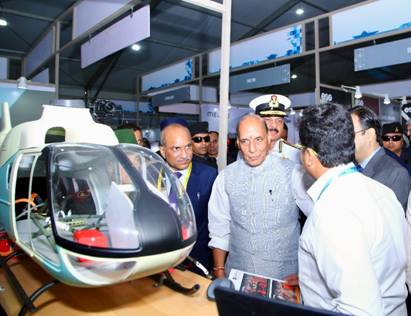
India must move in “mission mode” to become a global hub for drone manufacturing within the next few years, Defence Minister Rajnath Singh said on Thursday, underlining the strategic urgency driven by evolving geopolitical tensions and the changing nature of warfare.
Addressing the National Defence Industries Conclave 2026 in the capital, Singh called for the rapid development of a fully indigenous drone ecosystem, stressing that self-reliance must extend beyond final assembly to critical components such as engines, software, batteries and materials.
“From the drone’s molds to its software, engines and batteries, everything must be manufactured in India,” he said, noting that many global drone manufacturers still depend heavily on imports, particularly from China.
The two-day conclave, organized by the Department of Defence Production, comes against the backdrop of conflicts such as the Russia-Ukraine war and tensions in West Asia, which Singh said have underscored the decisive role of drones and counter-drone systems in modern warfare.
He emphasized that achieving strategic autonomy in defence manufacturing will require coordinated participation from large industries, MSMEs, start-ups and innovators, backed by sustained policy support from the government. The Centre, he added, remains committed to supporting private sector participation in defence production.
As part of the event, Singh launched the 14th edition of the Defence India Start-up Challenge (DISC-14) and the fourth edition of ADITI challenges under the Innovations for Defence Excellence (iDEX) framework. A total of 107 problem statements—82 under DISC-14 and 25 under ADITI—were unveiled to drive innovation across the armed forces, the Indian Coast Guard and the Defence Space Agency.
In addition, a new initiative featuring 101 innovation challenges from Defence Public Sector Undertakings (DPSUs) was introduced to promote design-led innovation among MSMEs and start-ups, with support in funding, mentorship, testing infrastructure and supply chain integration.
Highlighting the progress of iDEX since its launch in 2018, Singh said 676 start-ups, MSMEs and individual innovators have joined the defence innovation ecosystem. So far, 548 contracts have been signed and 566 challenges launched.
Of these, 58 prototypes worth about ₹3,853 crore (approximately $460 million) have received procurement clearance, while 45 contracts valued at ₹2,326 crore (around $280 million) have already been signed.
“These figures show that innovation is gradually translating into tangible technologies and products,” he said, adding that the role of start-ups and MSMEs in defence manufacturing is steadily strengthening.
Singh also stressed the growing importance of advanced technologies such as artificial intelligence, robotics, automation and additive manufacturing in reshaping global production systems. He pointed to emerging tools like “digital twins”—virtual replicas of physical systems—as critical for improving decision-making and managing complex defence platforms.
Calling for deeper integration within the industrial ecosystem, he said MSMEs must pursue both horizontal collaboration across sectors and vertical integration with larger firms and advanced technology domains. “It is when both occur simultaneously that a robust innovation ecosystem is established,” he noted.
The minister highlighted government efforts to strengthen MSMEs through a three-pronged approach focusing on equity, liquidity and professional support, announced in the latest Union Budget. These measures aim to enhance competitiveness in both domestic and global markets.
India’s MSME base has expanded significantly over the past decade, growing from about 4.67 crore enterprises in 2012-13 to nearly 8 crore currently, reflecting a surge in entrepreneurship and formalization through digital platforms such as Udyam and Udyam Assist.
Secretary (Defence Production) Sanjeev Kumar said the conclave is aimed at integrating MSMEs into the defence value chain—from design and development to manufacturing—while promoting advanced technologies. He added that the 200 problem statements unveiled during the event would open new avenues for innovation and skill development.
The Ministry also showcased reforms to strengthen domestic defence manufacturing, including simplified approvals, improved quality processes and expanded access to testing facilities of DPSUs and DRDO. A digital database, Srijan Deep, listing over 40,000 defence-related firms, has also been created to boost research and development.
On the sidelines, Singh released five publications outlining policy frameworks, export opportunities and ease-of-doing-business measures for the sector, while an exhibition featuring Indian and global firms highlighted advancements in automation, artificial intelligence, robotics and smart materials.
Senior military officials, including Chief of Defence Staff Anil Chauhan, were present at the conclave.
Related posts:
 Canada’s First Drone Soccer Team Heads to Korea for Inaugural FIDA World Cup
 Diplomacy: India and the South Caucasus
 India Steps Up Indigenous Defense Tech with ULPGM-V3 Missile and BEL Radar Pact
 Bangladesh’s $67 B Budget Focuses on Inflation Control and Renewable Energy, Faces IMF and Transparency Hurdles
