 Join WhatsApp Channel

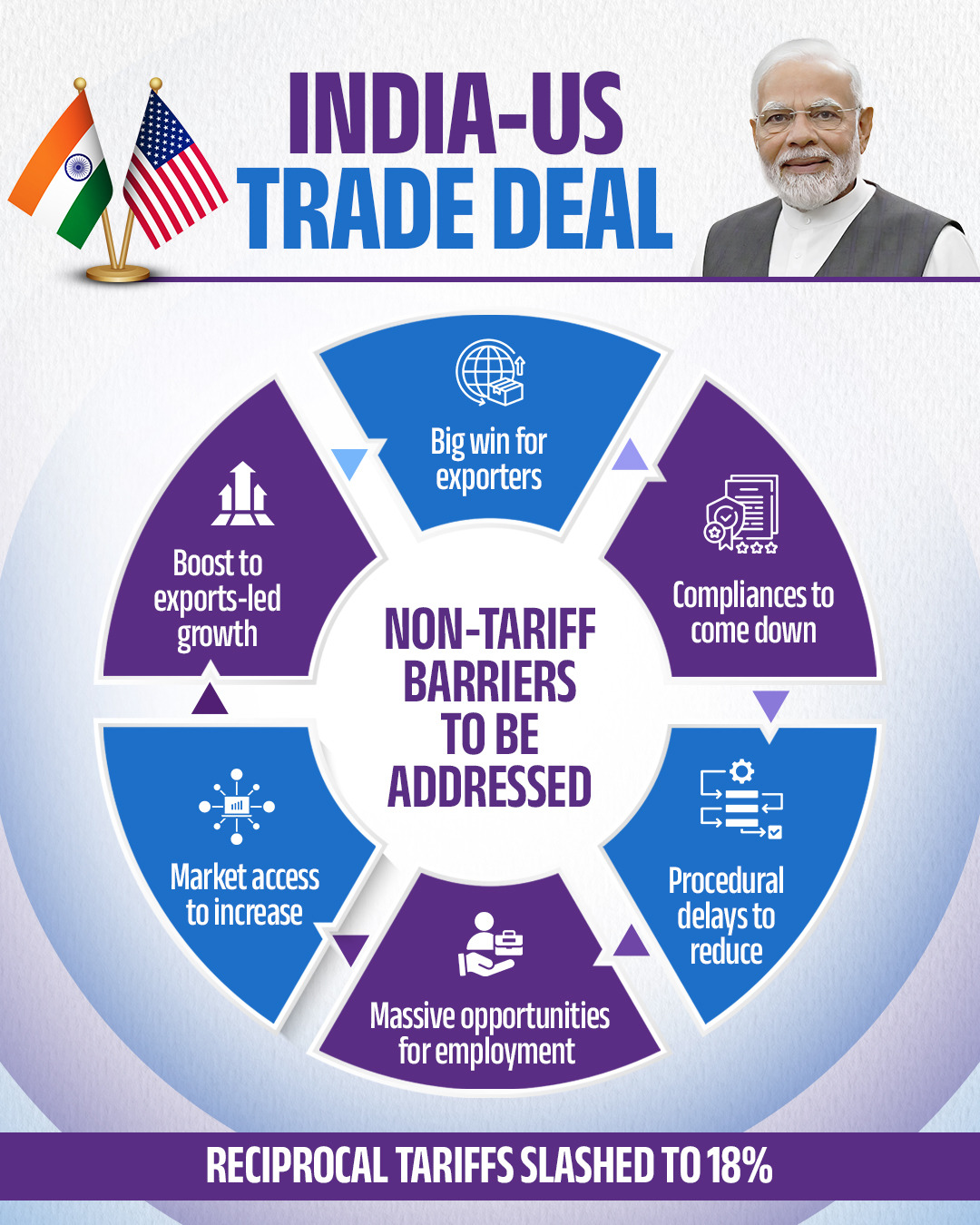
The frantic push to conclude the first phase of an India-US trade agreement by mid-July is being presented as a breakthrough in bilateral economic relations. Commerce Minister Piyush Goyal speaks of a “vibrant” first tranche. American negotiators describe the talks as constructive. President Donald Trump says a deal is within reach.
Yet the timing raises a more important question: why is Washington suddenly in such a hurry?
Trade agreements of this magnitude normally take years to negotiate. They involve complex issues ranging from tariffs and market access to digital trade, agriculture, intellectual property and investment rules. Yet both governments appear determined to meet an unusually compressed timeline.
The answer may have less to do with economics than with politics.
For Trump, the July deadline sits at the intersection of three powerful forces shaping American policy today: the approaching mid-term election cycle, intensifying geopolitical competition with China, and the growing political influence of the Indian-American diaspora.
The White House understands that the 2026 mid-term elections have effectively already begun. While voting remains more than a year away, political narratives are being constructed now. Trump faces pressure to demonstrate that his aggressive tariff policies are producing tangible results rather than merely creating uncertainty in global markets.
A trade agreement with India offers precisely the kind of headline victory he needs.
After months of threatening tariffs against allies and competitors alike, Trump can present an India deal as evidence that his confrontational approach works. The message to American voters would be simple: tariffs forced trading partners to the negotiating table and delivered better terms for the United States.
This narrative is particularly important because Trump’s broader trade strategy faces increasing scrutiny. His administration continues to battle criticism over inflationary pressures, supply-chain disruptions and legal challenges to some tariff measures. Securing an agreement with one of the world’s fastest-growing major economies would allow him to claim momentum at a moment when many of his economic policies remain contested.
But electoral calculations are only one part of the story.
The geopolitical environment has become equally significant.
The United States today faces simultaneous challenges in Europe, the Middle East and the Indo-Pacific. The Ukraine conflict remains unresolved. Tensions with China continue to define strategic thinking in Washington. Supply chains are being redrawn. Critical technology competition is intensifying. The global trading system itself is fragmenting into rival blocs.
Against this backdrop, India has emerged as perhaps the most important swing power in the international system.
Unlike traditional American allies, India refuses to become part of a formal bloc. It maintains strategic autonomy, purchases Russian energy, participates in BRICS, engages with the Global South and simultaneously deepens cooperation with the United States through the Quad and other strategic arrangements.
For Washington, drawing India closer economically has become a geopolitical imperative.
The trade agreement therefore serves a larger strategic purpose. It is not simply about reducing tariffs on textiles, agricultural products or industrial goods. It is about anchoring India more firmly within a US-led economic architecture at a time when global power balances are shifting.
The urgency reflects growing concern in Washington that China continues to expand its influence across Asia, Africa and Latin America despite American efforts to contain it. A successful trade deal with India would allow the Trump administration to showcase the world’s largest democracy as a key economic partner in its broader Indo-Pacific strategy.
Yet perhaps the most underappreciated factor behind the July deadline is domestic American demography.
The Indian-American community has become one of the most affluent, educated and politically influential diaspora groups in the United States. Once concentrated primarily in professional sectors, it now exercises increasing influence across politics, technology, finance, academia and public policy.
In critical swing states such as Pennsylvania, Michigan, Georgia, Arizona and Texas, Indian-American voters are becoming a constituency that neither party can afford to ignore.
Trump’s outreach to Prime Minister Narendra Modi over the years has never been solely about foreign policy. It has also been about domestic electoral arithmetic. Events such as “Howdy Modi” demonstrated the growing political significance of Indian-American voters and donors.
A trade agreement allows Trump to reinforce that outreach.
At a time when immigration restrictions, H-1B visa uncertainties and concerns among skilled Indian professionals have generated unease within parts of the diaspora, a successful trade deal offers a positive counter-narrative. It enables the administration to argue that relations with India remain strong despite disagreements on immigration and other issues.
This political calculation becomes particularly relevant because Indian-Americans increasingly occupy influential positions not only as voters but also as campaign contributors, corporate executives and opinion-makers.
Seen through this lens, the July deadline begins to look less like a commercial necessity and more like a political objective.
The problem for India is that Washington’s political timetable does not necessarily align with New Delhi’s economic interests.
Trade agreements should be designed to survive electoral cycles. They should provide long-term certainty, predictable market access and durable commercial benefits. They should not be driven by the immediate political needs of one government or one leader.
That is why India must approach the negotiations with caution.
The temptation to declare victory and conclude a deal quickly will be strong. Diplomatic momentum is building. Both governments want an announcement. Markets welcome certainty.
But New Delhi must remember that political urgency in Washington is not the same as economic urgency in India.
If the United States is rushing because Trump wants a pre-midterm political success, India should ask what concessions are being sought in exchange for that success.
If the agreement is intended to reinforce America’s geopolitical strategy against China, India must ensure that its own strategic autonomy is not compromised.
And if the deal is partly aimed at appealing to influential diaspora constituencies in the United States, New Delhi should recognize that domestic American politics can change far faster than trade commitments.
The central issue, therefore, is not whether a deal can be signed by July.
The real question is whether India gains enough from the agreement to justify the concessions it may be asked to make.
History is full of trade agreements signed under political pressure and celebrated as diplomatic breakthroughs, only to reveal their shortcomings years later.
India cannot afford such a mistake.
The July deadline may matter greatly to Donald Trump. It may fit neatly into his electoral calculations, geopolitical ambitions and domestic political strategy. But India must negotiate not for the next American election cycle, nor for the next presidential headline. It must negotiate for the next decade.
Disclaimer: The opinions and views expressed in this article/column are those of the author(s) and do not necessarily reflect the views or positions of South Asian Herald.
Related posts:
 Beyond Tariffs: U.S.-India Trade Talks Test New Delhi’s Strategic Trade Vision
 Tariffs, Trust, and the Trump Factor: India Braces for High-Wire Trade Diplomacy
 Between Opportunity and Entrapment: Bangladesh Must Tread Carefully on the EU Partnership Deal
 President Trump Says India Trade Deal Intact After Supreme Court’s Decision Striking Down Global Tariffs
