Join WhatsApp Channel

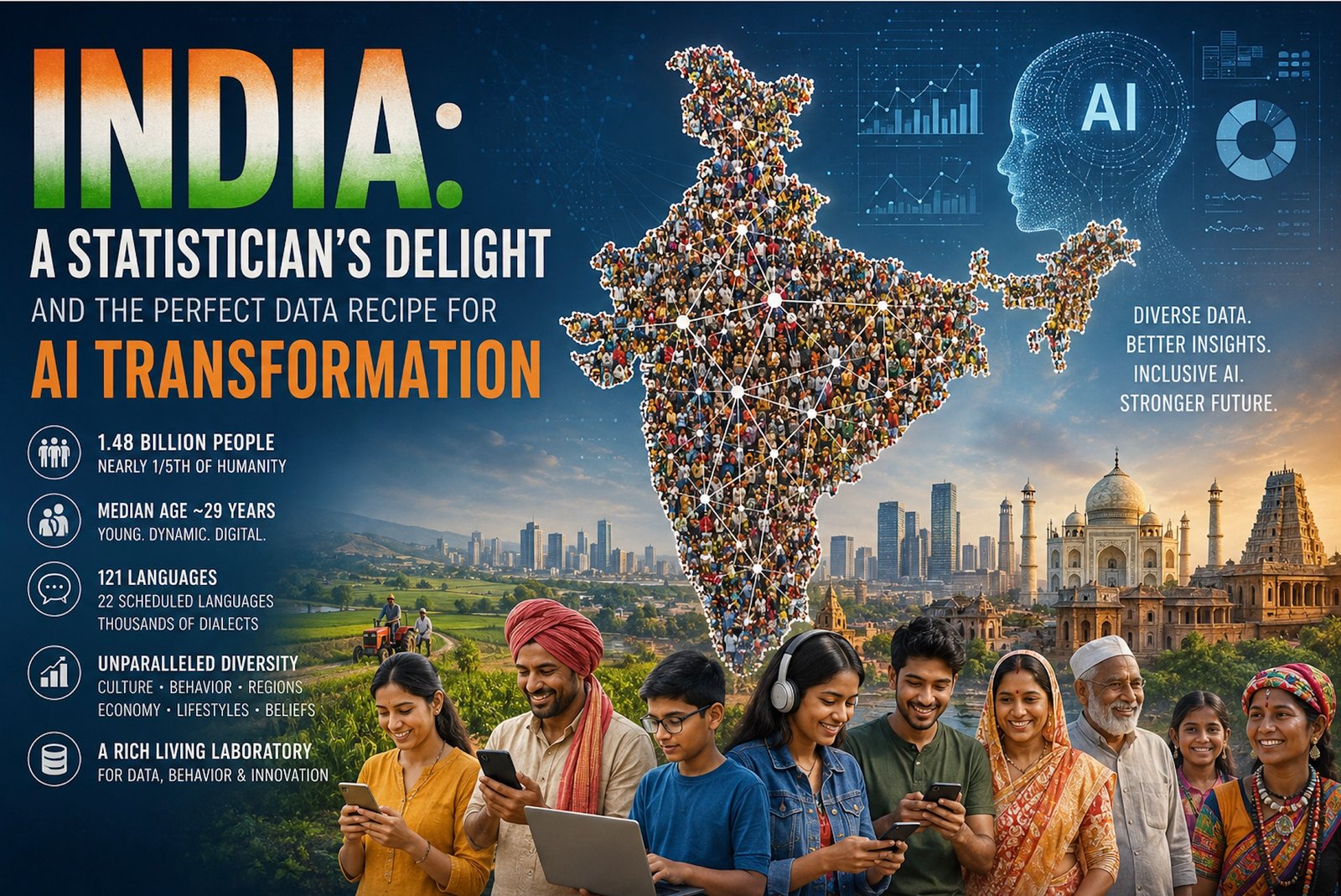
India has always been described through emotion: color, culture, food, festivals, language, spirituality, markets, music, democracy, and human energy. But in the age of artificial intelligence, India deserves another description: a statistician’s delight.
For global AI research companies, India is not merely a market. It is one of the world’s richest living laboratories for data, behavior, culture, language, economics, governance, and human diversity. With an estimated population of about 1.48 billion people in 2026, India is the world’s largest population base and represents nearly one-fifth of humanity. Its median age is around 29 years, giving it one of the most powerful combinations of scale, youth, and digital adoption in the world.
The future of AI will not be built only on algorithms. It will be built on diverse, high-quality, representative data. And that is where India becomes extraordinary.
India is a country where hundreds of millions of people interact daily across languages, dialects, religions, regions, occupations, income groups, climates, food habits, fashion styles, and social customs. The 2011 Census recorded 121 languages spoken by 10,000 or more people, including 22 Scheduled Languages, and India’s linguistic ecosystem includes thousands of mother-tongue expressions when raw linguistic affiliations are considered.
For AI researchers, this is not just cultural richness. It is a data opportunity of global importance.
India as the World’s Human Diversity Dataset
Artificial intelligence systems today struggle with bias, representation, context, language nuance, and cultural understanding. A model trained only on narrow Western datasets cannot fully understand the world. It may understand English grammar, but it may not understand Indian English. It may translate words, but it may miss emotion, hierarchy, respect, festivals, food, or social meaning. It may identify clothing, but it may not distinguish between a sari, salwar kameez, kurta, sherwani, dhoti, mundu, lehenga, or regional textile traditions.
India offers AI a chance to learn complexity.
In India, diversity is not theoretical. It is visible every day. A wedding in Tamil Nadu looks different from a wedding in Punjab. A festival in Bengal carries a different visual and musical identity from one in Gujarat. Food in Hyderabad, Lucknow, Kerala, Rajasthan, Nagaland, Goa, and Kashmir reflects completely different histories, ingredients, cooking techniques, and community traditions. The same country contains classical music, folk music, devotional music, film music, tribal rhythms, Carnatic traditions, Hindustani traditions, and contemporary fusion.
For AI research, each of these is a vertical. There can be AI research on Indian languages, regional accents, culinary diversity, dress culture, music and dance forms, festivals, rituals, tourism, health patterns, agriculture, mobility, public services, small businesses, and digital behavior. India is not one dataset. India is a federation of datasets.
Digital India Has Created a New Data Civilization
India’s uniqueness is not only its population. It is the combination of population and digital public infrastructure.
As of March 2026, more than 144 crore Aadhaar numbers had been generated, and Aadhaar was used for over 2,707 crore authentication transactions in 2024–25. This means that India has built one of the world’s largest digital identity infrastructures.
Similarly, India’s Unified Payments Interface has become a global benchmark in digital payments. UPI annual transaction volume grew from just 2 crore transactions in FY 2016–17 to more than 24,162 crore transactions in FY 2025–26, with transaction value rising to approximately ₹314 lakh crore.
This is transformational. Every small merchant, street vendor, student, farmer, professional, and household using digital payments becomes part of a new economic behavior map. Properly governed, anonymized, and ethically structured, such data can help AI systems understand consumption, credit behavior, financial inclusion, small-business growth, rural demand, and urban transformation.
India’s internet base is equally compelling. Reports in early 2026 estimated India had around 958 million active internet users in 2025, while other digital market estimates placed internet users above one billion by late 2025. This means India is not only a population giant; it is a digital interaction giant.
Why India Is a Natural AI Research Platform
The most valuable AI models of the future will need three things: scale, diversity, and context. India offers all three.
Scale is obvious. A country of nearly 1.5 billion people gives researchers a massive range of real-world use cases.
Diversity is India’s defining advantage. AI systems can be tested across multiple languages, scripts, cultural references, food habits, clothing patterns, economic categories, and regional behaviors.
Context is India’s hidden strength. Indian life is deeply contextual. A word may change meaning depending on region. A gesture may mean different things in different communities. A festival may change consumption patterns. A monsoon may affect agriculture, logistics, health, and retail. A family purchase decision may involve multiple generations. This level of human complexity is exactly what next-generation AI must learn.
India can become the place where AI moves from being merely intelligent to being culturally aware.
The Vertical Opportunities for AI in India
The opportunities are not limited to one industry.
In language AI, India can help build multilingual and dialect-sensitive models that work across Hindi, Telugu, Tamil, Kannada, Bengali, Marathi, Malayalam, Gujarati, Punjabi, Urdu, Odia, Assamese, and many other languages.
In healthcare AI, India’s population scale can support research on preventive care, rural health delivery, telemedicine, disease pattern recognition, maternal care, elderly care, and multilingual health communication.
In agriculture AI, India’s varied soil, climate, crop, rainfall, and farming practices can support models for crop prediction, pest detection, water usage, supply chains, and farmer advisory systems.
In culture and creative AI, India can become a global research ground for music, dance, film, textiles, cuisine, tourism, crafts, festivals, and heritage preservation.
In financial AI, the scale of UPI, Aadhaar-enabled services, digital banking, and fintech adoption can support research in fraud detection, credit inclusion, small-business finance, and real-time commerce.
In governance AI, India’s experience with public digital infrastructure can help the world understand how AI can improve service delivery, citizen engagement, transportation, welfare, education, and public policy.
The Ethical Foundation Must Come First
However, India’s data opportunity must not become data exploitation.
AI research in India must be built on consent, privacy, anonymization, security, transparency, and public trust. The goal should not be to extract data from India. The goal should be to build AI with India, for India, and from India’s strengths.
India should insist on responsible AI frameworks where citizens are protected, local languages are respected, communities are represented fairly, and economic value is shared. AI companies must not see India only as a testing ground. They must see India as a knowledge partner.
India’s diversity should not be reduced to raw data. It should be elevated into responsible intelligence.
From Indian Railways to AI: The Power of Scale
Having worked in technology environments connected with Indian Railways and IRCTC, I have seen firsthand what Indian scale means. Indian Railways is not merely a transport system. It is a daily movement of people, commerce, geography, language, and aspiration. IRCTC is not merely a ticketing platform. It represents digital behavior at national scale.
India has always operated at a complexity level that few countries can match. What AI companies are now trying to understand — high-volume transactions, multilingual users, peak-load systems, identity, mobility, public trust, and citizen-scale technology — India has been living for decades.
That is why India is not late to the AI revolution. India is structurally prepared for it.
India’s Moment in Global AI
The next phase of global AI will require more than computing power. It will require human variety. It will require datasets that reflect the real world, not just a narrow slice of it. It will require multilingual intelligence, cultural intelligence, ethical intelligence, and population-scale validation.
India has all the ingredients: a young population, a massive digital user base, deep cultural diversity, large-scale public digital infrastructure, multiple languages, regional complexity, a fast-growing innovation ecosystem, and a democratic society with real-world pluralism.
That is why India is a statistician’s delight.
More importantly, India may be the perfect recipe for AI transformation — not because it is simple, but because it is complex. And the future of AI will belong to those who can understand complexity, responsibly.
India’s data story is not just about numbers. It is about humanity at scale. And if global AI is to truly serve the world, it must learn from India.
Disclaimer: The opinions and views expressed in this article/column are those of the author(s) and do not necessarily reflect the views or positions of South Asian Herald.
Related posts:
 In Conversation with Rajesh Mehta: Abhishek Singh, CEO, IndiaAI Mission on India’s Global AI Vision
 From Data Sovereignty to Ethics, India Outlines Global AI Governance Vision
 Inside India’s Big AI Moment: Power, Purpose, and a Bid to Shape the Future
 India Set to Host Global Data Summit as Academic Engagement Gains Momentum