There is a moment in Tamil political folklore that everyone in the state can still feel, even if they weren’t alive to witness it. The year was 1967. C. N. Annadurai — playwright, orator, architect of Dravidian dreams — swept the Congress out of Tamil Nadu with a rhetoric so powerful it felt less like an election and more like a reckoning. The Tamil people, he declared, were done being governed by others’ languages, others’ gods, others’ priorities. It was a civilizational statement, not merely a political one.
Fifty-eight years later, Tamil Nadu has made another one.
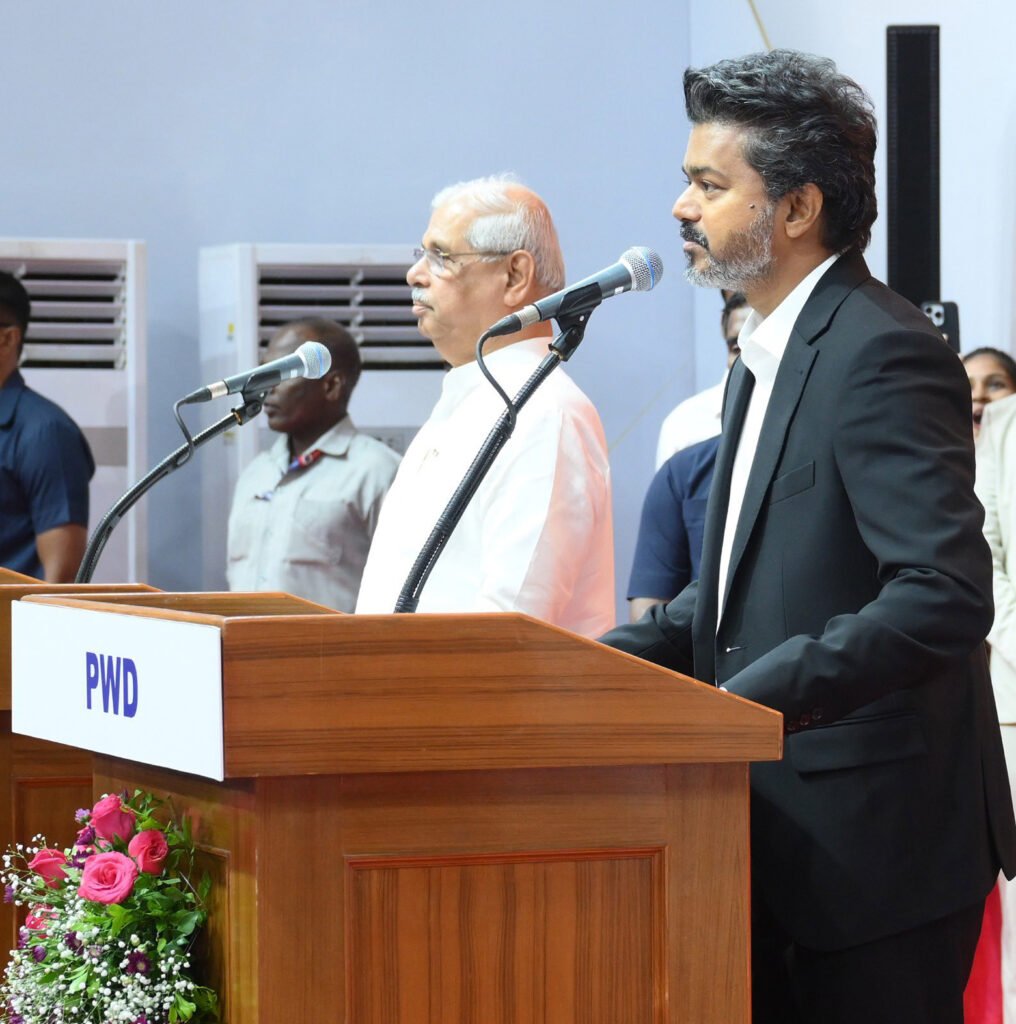
When Vijay — born Joseph Vijay Chandrasekhar, known to a billion people simply as Thalapathy, the Commander — was sworn in as Chief Minister of Tamil Nadu, the symbolism was almost too large to process. A film superstar, barely two years into formal politics, had dismantled the most durable political structure in modern Indian democratic history. The Dravidian duopoly — the DMK and the AIADMK, those two iron fortresses built across seven decades by towering figures — had finally, improbably, been breached.
But to call this merely a political upset is to misread the earthquake entirely.
Advertisement
What happened in Tamil Nadu was not a palace coup by celebrity. It was a generational declaration. And to understand it, you have to understand what changed — not just in politics, but in the Tamil people themselves.
The World That Built the Dravidian Fortress
The Dravidian movement was born out of a specific wound. Post-Independence India was organised in ways that felt, to Tamil speakers, like a continuation of old hierarchies in new clothing — the dominance of upper-caste Hindu culture, the imposition of Hindi, the northern orientation of national power. The response was fierce, principled and extraordinarily effective.
M. Karunanidhi forged his authority in the crucible of that struggle — a scriptwriter who turned ideology into art, a street agitator who became an administrator, a man who understood that Tamil pride was both a political weapon and a genuine civilisational identity. M. G. Ramachandran, or MGR as every Tamil simply knew him, occupied a different throne: the messiah of the poor, the man who fed their children through the noon meal scheme, who built welfare into the very architecture of government. And J. Jayalalithaa — brilliant, ruthless, impeccably dressed — mastered the mechanics of power with an administrative intensity that even her bitterest opponents quietly respected.
These were not merely politicians. They were mythological figures in a living political religion.
Their parties controlled everything — not just the government, but the texture of daily Tamil life. The DMK and AIADMK ran trade unions and student organizations, local body networks and welfare delivery chains. They were the intermediary between the citizens and the state. You went to your local party cadre when you needed a ration card, a hospital bed, or a job in the municipality. Politics was a service economy built on loyalty, and it worked — for decades.
But all ecosystems age. And the world that produced those giants no longer exists.
The New Tamil: Born Digital, Hungry for Dignity
Walk into any engineering college in Coimbatore, any startup cluster in Chennai’s Old Mahabalipuram Road corridor, any textile mill town in Tirupur where young workers scroll LinkedIn between shifts, and you will meet a Tamil Nadu that Karunanidhi’s scripts never imagined.
This generation — the eighteen to forty cohort that swung the 2026 election decisively — grew up in a world shaped not by Dravidian pamphlets but by broadband connections. Their first political memories are not of street processions but of viral videos. Their grievances are not encoded in the language of caste oppression and linguistic pride alone — they speak also of traffic jams, of engineering degrees that lead nowhere, of watching contemporaries in Bengaluru or Pune get opportunities that Tamil Nadu’s patronage-heavy economy somehow fails to produce.
They are aspirational in a way their parents’ generation could not afford to be. Their parents wanted safety — a government job, a ration card, a welfare cheque that arrived on time. This generation wants elevation. They want to matter in the global economy, not just survive within the local one.
And crucially: they carry an extraordinary awareness of their own dignity.
The smartphone gave them that. When you can see — in real time — how other young people live, what other governments deliver, what other economies produce, you develop a very precise sense of what you are being denied. Corruption no longer appears as an unfortunate cost of doing business. It appears as a personal insult. Dynastic politics no longer appears as a natural feature of democracy. It appears as theft — of opportunity, of representation, of the future itself.
Into that psychological landscape walked Vijay.
The New Cinema-to-Politics: A Completely Different Alchemy
It would be tempting to file Vijay’s rise under the familiar heading of Tamil cinema’s relationship with political power. But that would be dangerously lazy analysis.
MGR’s cinematic persona was built on a specific architecture: he was always the protector of the poor, the incorruptible hero who fought the powerful on behalf of the powerless. His films were political manifestos in disguise. By the time he entered electoral politics, Tamil audiences had spent decades absorbing his screen mythology as lived moral truth. His welfare politics was, in many ways, the cinematic fantasy made administrative reality.
Jayalalithaa entered under MGR’s shadow, inheriting not just his party but his mythological weight, and spent years translating that inheritance into her own form of authoritative governance.
Vijay’s cinema operated differently. His blockbusters — Mersal, Master, Vikram Vedha in spirit if not production — are not simple tales of a pure hero protecting the poor from a corrupt villain. They are angrier, more complex, more structurally aware. His screen characters interrogate systems. They don’t merely rescue individuals — they challenge institutions.
A Vijay film in the 2010s was, in many ways, a fantasy of accountability — the dream of someone powerful enough and principled enough to make the system answer.
His voters did not project welfare mythology onto him. They projected systemic change.
That is a fundamentally different demand. It is the demand not of people who want to be given something, but of people who want the machinery itself to work fairly. Not charity — justice. Not paternalism — competence.
Transformational, Not Transactional
The distinction that political analysts are scrambling to articulate is this: Tamil Nadu’s previous politics — for all its genuine social justice achievements — was ultimately transactional. The party delivered welfare; the voter delivered loyalty. The relationship was one of dependency, carefully maintained by both sides because it served both sides.
Vijay’s mandate is being read as something different — something that demands not transactions but transformation.
His voters are not asking: what will you give me? They are asking: what kind of state will you build? They want an industrial ecosystem that actually creates private-sector jobs at scale. They want universities that connect to global research networks. They want a bureaucracy that processes applications without demanding a party worker’s signature. They want air quality and metro connectivity and startup investment and — this is perhaps the most historically unprecedented demand — they want a government that tells them the truth.
The old Dravidian model was supremely skilled at one thing: consolidating power through networks of mutual benefit. The new demand is for governance that doesn’t require you to be in anyone’s network at all. Universal systems. Meritocratic institutions. Rules that apply equally.
This is a far more demanding brief than any Chief Minister of Tamil Nadu has ever received.
The Burden of the Unprecedented
And so Vijay inherits something that has no precedent in Tamil political history: power without an institutional machine to run it through, a mandate for transformation without the administrative infrastructure transformation required, and a coalition whose members agree on little beyond the desire to displace the old order.
The Dravidian parties had decades to build their apparatus. Vijay has the urgency of a generation that has already waited too long.
His first choices will be watched with extraordinary attention. Whom does he appoint to run Finance? Who gets Industries, Education, Technology? Does he build a cabinet of policy professionals and technocrats, or does he reward the loyalists who built his movement?
Does he push power downward into local bodies and district administrations, or does it concentrate in the Chief Minister’s Office as it has under every Tamil Nadu government in living memory?
Every decision is a signal. And this electorate is extraordinarily sophisticated at reading signals.
The Threshold
Tamil Nadu stands today at a threshold it has not approached since 1967. Then, a new generation declared that the politics of the colonial era could not govern an independent Tamil future. Today, a new generation has declared that the politics of the welfare era cannot govern an aspirational Tamil future.
The Dravidian era was not a failure. Its legacy — universal literacy, a functioning healthcare system, the noon meal programme that fed millions, the dismantling of explicit caste hierarchy from public institutions — is written into the state’s social fabric permanently. That is not nothing. That is, in fact, remarkable.
But legacies can become fortresses, and fortresses can become prisons.
Tamil Nadu’s youth did not tear down the Dravidian fortress out of contempt for what it built. They tore it down because they needed to build something it was never designed to build.
The applause that carried Vijay to power is now silent.
In that silence, one of India’s most complex, most educated, most economically consequential states waits to learn whether it has elected a transitional figure or a transformational one.
The Dravidian era took decades to build and one election to end.
What comes next will define Tamil Nadu — and perhaps the future of aspirational democracy in India — for a generation.
Disclaimer: The opinions and views expressed in this article/column are those of the author(s) and do not necessarily reflect the views or positions of South Asian Herald.