Join WhatsApp Channel

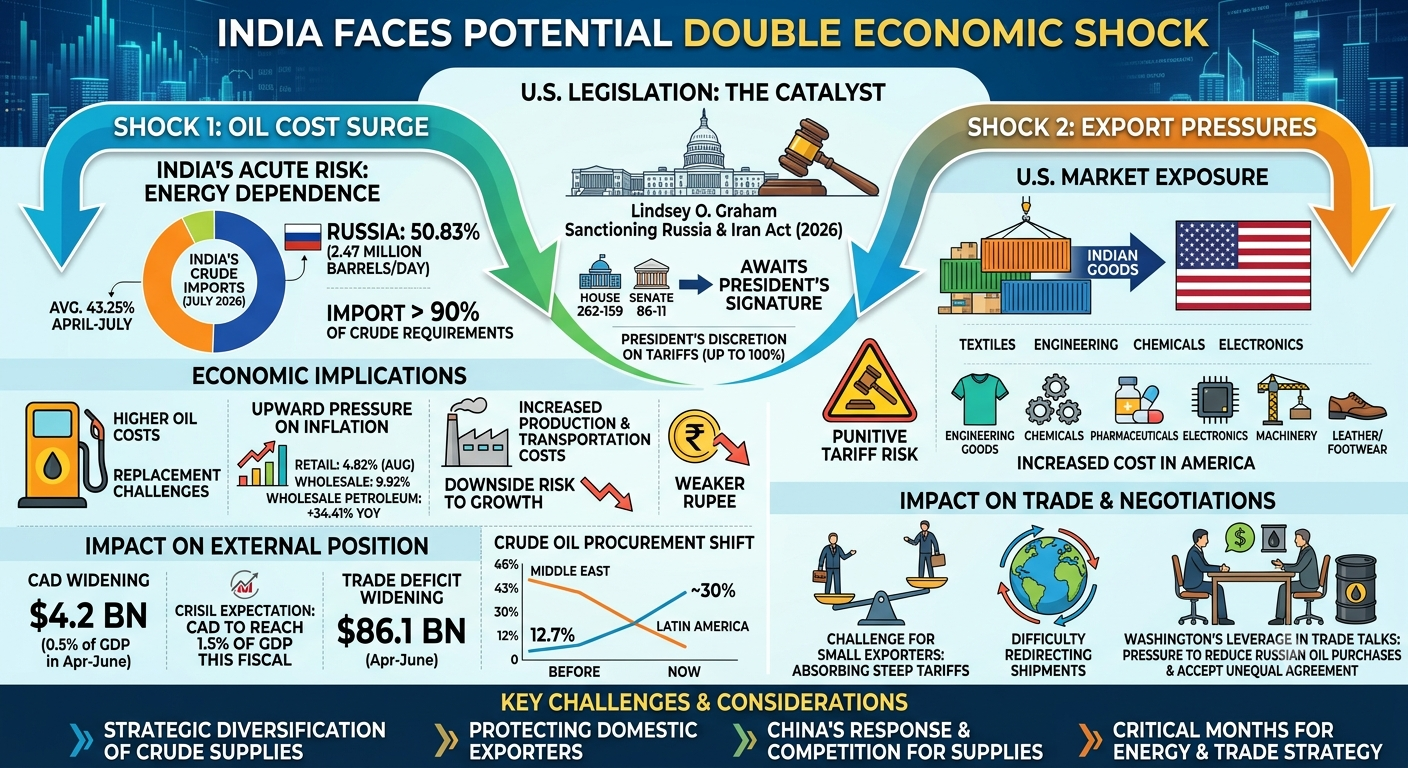
India faces a potential double economic shock after the U.S. Congress cleared legislation giving President Donald Trump authority to impose tariffs of up to 100 percent on major buyers of Russian energy, threatening to raise India’s oil costs while increasing barriers to exports to its largest overseas market.
The House of Representatives passed the Lindsey O. Graham Sanctioning Russia and Iran Act of 2026 by 262-159 on Wednesday, after the Senate approved it 86-11. The legislation still requires Trump’s signature and does not automatically impose a 100 percent tariff, leaving the president discretion over whether and how the powers are used.
For India, the risk is acute because Russian crude has become central to its energy mix. Russia supplied 50.83 percent of India’s crude imports in July, or about 2.47 million barrels per day, while its share averaged 43.25 percent between April and July. India imports more than 90 percent of its crude requirements.
The Ministry of External Affairs said Thursday that New Delhi had raised the issue with U.S. interlocutors.
“India remains firmly committed to ensuring energy security for its 1.4 billion people and will continue to pursue it through diversified sources of supply based on market dynamics,” the ministry said, adding that India would take “all necessary measures” to protect its trade and economic interests.
The threat comes as India’s external position is already under pressure. The current-account deficit widened to $4.2 billion, or 0.5 percent of GDP, in the April-June quarter from $3.4 billion a year earlier, while the merchandise trade deficit widened to $86.1 billion from $68.9 billion.
Crisil expects the current-account deficit to reach 1.5 percent of GDP this fiscal year, compared with 0.6 percent last year, as elevated commodity prices increase the import bill.
Oil shock
The immediate concern is the cost of replacing Russian crude.
Russian barrels displaced part of India’s earlier dependence on Middle Eastern suppliers after Western sanctions disrupted traditional trade flows. Between April and July, the Middle East accounted for about 30 percent of India’s crude imports, down from 43 percent a year earlier, while Latin America’s share rose to 12.7 percent.
India can source additional crude from Saudi Arabia, Iraq, the UAE, the United States, Brazil and other producers, but replacing more than 2 million barrels per day quickly could tighten global supplies.
Gaura Sen Gupta, chief economist at IDFC First Bank Economics Research, said she did not expect the maximum U.S. tariff measure to be implemented under current conditions.
“In our base case we don’t think it will be implemented as it would restart the tariff tensions between US and other countries,” she said.
“Given the current elevated levels of crude oil prices, we don’t think this measure will be implemented,” she added.
Sen Gupta said implementation would create “upside risk to CAD due to jump in global crude prices.”
Inflation and growth
Higher oil prices would increase transportation, petrochemical and manufacturing costs while a weaker rupee could further raise the local-currency cost of crude.
Retail inflation rose to 4.82 percent in August from 4.45 percent in July, while wholesale inflation climbed to 9.92 percent. Wholesale petroleum and natural gas prices rose 34.41 percent year-on-year.
“If import volumes decline, it would pose downside risk to growth as ability to source crude will get impacted,” Sen Gupta said. “Jump in global prices would impact company margins. Moreover the drag from net imports will rise.”
Aditi Nayar, chief economist at ICRA, said, “Any imposition of higher tariffs by the US, and the associated uncertainty, would cast a downside on Indian growth prospects.”
Export pressure
The second vulnerability is India’s exposure to the U.S. market. A punitive tariff linked to Russian energy purchases could raise the cost of Indian goods in America just as higher oil prices increase production and transport costs at home.
Textiles, engineering goods, chemicals, pharmaceuticals, electronics, machinery, leather and footwear could face pressure depending on the eventual tariff coverage.
For smaller exporters, absorbing a steep tariff could be difficult, while redirecting shipments to other markets would take time.
Ajay Srivastava, founder of the Global Trade Research Initiative, said the measure could increase Washington’s leverage in broader trade talks.
“Washington may use the tariff threat to pressure India to reduce Russian oil purchases and accept a deeply unequal trade agreement,” Srivastava said.
For New Delhi, the challenge is therefore to diversify crude supplies without triggering another oil-price shock while protecting exporters and preserving room for manoeuvre in trade negotiations.
China’s response will be crucial. If India and China simultaneously reduce Russian purchases, they could compete for replacement supplies, potentially pushing global prices higher.
The immediate question is not whether a 100 percent tariff will materialise, but whether Washington uses the new authority while India is already confronting higher oil costs, a widening external deficit and renewed inflation pressure.
A simultaneous energy and trade shock would transmit through the oil import bill, rupee, inflation, corporate margins and export demand, making the coming months critical for India’s energy procurement and trade strategy.