Join WhatsApp Channel

While national attention has centered on races for governor and Congress, the bigger story of the 2026 midterms may be unfolding in state legislatures, county governments and city halls, where South Asian Americans are contesting an unprecedented number of elections.
The growing bench extends across the country. In Georgia, Nabilah Parkes is seeking election as Lieutenant Governor, while candidates Akbar Ali, Jyot Singh, Rahul Garabadu, Saira Draper, Shelly Abraham and Tanjina Islam are running for legislative offices.
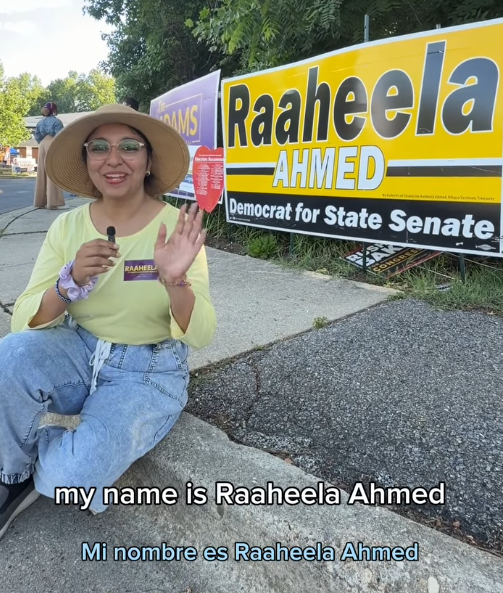
Elsewhere, Amar Mukunda and Raaheela Ahmed are contesting races in Maryland, Arvind Venkat in Pennsylvania, Darshana Patel, Fatima Iqbal-Zubair, Sara Deen and Sion Roy in California, Furhan Ahmad in New York, Nabeela Syed, Saba Haider and Sunjay Kumar in Illinois, Neal Walia in Colorado, Nikhil Goyal in Vermont, Nikhil Wagle in Iowa, and Pooja Sethi and Sandeep Srivastava in Texas.
Colorado attorney Hetal Doshi sought the Democratic nomination for Attorney General, while former Maine public health official Nirav Shah unsuccessfully pursued the Democratic nomination for governor after briefly exploring a Senate bid.
South Asian representation is also expanding rapidly in local government.
Candidates include Audrey Nath in Texas, California city council hopefuls Faizah Malik, Jennifer Chawla and Jag Nagendra, North Carolina county commissioner candidates Mona Singh and Steve Rao, Texas judicial candidates Juli Mathew and Manpreet Singh, and Justice of the Peace candidates Nasir Malik and Sophia Anwar.
Although these contests receive limited national attention, they are increasingly viewed as the training ground for future governors, members of Congress and cabinet officials. The depth of candidates entering politics today is far greater than in previous election cycles, reflecting the community’s expanding civic engagement and political confidence.
Driving this expansion is a stronger political infrastructure. Organizations such as the Indian American Impact Fund have invested heavily in recruiting candidates, fundraising, campaign training and voter mobilization, helping create a pipeline that stretches from local offices to statewide races.
The candidates themselves also reflect the changing profile of South Asian America. Physicians, lawyers, engineers, entrepreneurs, educators and public health professionals are increasingly seeking office, bringing professional expertise into debates over healthcare, education, technology and economic policy.
Regardless of the outcome on November 3, the 2026 elections demonstrate that South Asian Americans are no longer represented only by a handful of members of Congress. They are building a nationwide political ecosystem that reaches into state capitals, courthouses and city halls—creating a leadership pipeline likely to shape American politics well beyond this election cycle.