Tibetans in India are planning demonstrations across the country on August 20 to highlight what they describe as continuing human-rights violations in Tibet and to protest against a new Chinese law which they claim threatens their distinct linguistic, cultural and national identity.
The protests are expected to be held in several Indian cities, including New Delhi, Kolkata, Dharamshala, Chennai, and Bengaluru, among other centers.
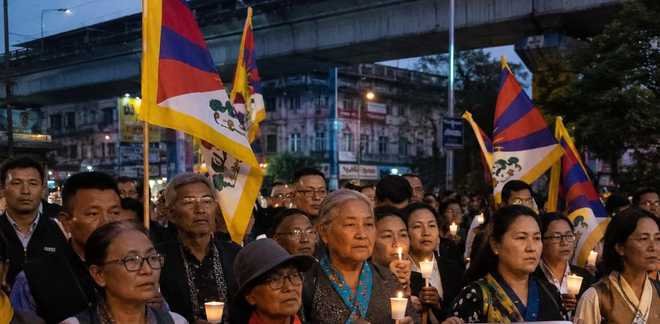
“In Kolkata, the protest will take the form of a candlelight vigil outside the Chinese Consulate General,” Tibetan Youth Congress coordinator for the Northeast Tsepel Tenzing told UNI.
The new Chinese law ‘Promoting Ethnic Unity and Progress’ brought in from July 1 this year, threatens to erase the language and culture of ethnic communities like the Tibetans, Mongols, and others by legalizing forced assimilation, penalizing any form of dissent by these ethnicities anywhere in the world, protesters claim.
Advertisement
Tenzing said the nationwide mobilization had been prompted in part by the self-immolation of Tibetan activist and former monk Lobga Rangzen outside the United Nations headquarters in New York on July 2.
Rangzen, also identified as Lobsang Palden, died after setting himself on fire while carrying a Tibetan flag. Tibetan organizations said he had undertaken the action to draw international attention to Tibet and demand independence.
The incident has since become a rallying point for Tibetan activists globally, with Tibetan communities planning demonstrations, candlelight vigils and other peaceful actions. India is host to nearly a million Tibetans, descendants of refugees who fled to India in the wake of the Chinese crackdown in the Himalayan state after the flight of the Dalai Lama in 1959 on horseback to India.
“China wants to treat us as a minority that can be erased. But we are the majority in Tibet, and Tibet is a free country. We want to underline that,” Tenzing told UNI.
“They are trying to take away our children, our boys and girls, to be taught in colonial boarding schools in Mandarin only, with no access to Tibetan language … it’s a bid to end Tibetan identity and culture,” he said.
Tenzing said the protests were also intended to draw attention to Tibetans who, he alleged, had disappeared or had been detained after speaking out against Chinese policies.
“Tens of thousands of Tibetans have vanished in recent times for daring to protest in some way or the other,” he said.
He cited the case of Tibetan protest singer A-Sang. The singer, also known as Tsukte, was taken away after singing a song, ‘Prince of Peace’, which was taken to be a tribute to the Dalai Lama, dubbed a traitor and “splitist” by the Chinese government.
“He sang about democracy and about Tibet, and then he vanished from public sight,” Tenzing said.
“Monks are continuing to protest in Tibet, but these are small, isolated incidents which are not being picked up by the media, specifically because the Chinese do not allow media access to Tibet,” he said.
Independent reporting has documented significant restrictions on access to Tibet, with foreign journalists facing restrictions on travel and reporting in Tibetan areas.
“We want to focus the world’s attention on the problems that are besetting our motherland, which is Tibet,” Tenzing said.
The August 20 demonstrations are expected to combine opposition to China’s new ethnic-unity law with broader demands concerning human rights, religious freedom, and the preservation of Tibetan language and culture.
The planned mobilization follows a series of protests by Tibetan communities in India and abroad. Hundreds of Tibetans, including monks, demonstrated at Bylakuppe in Karnataka on August 14, demanding an end to Chinese rule in Tibet. (UNI)