Join WhatsApp Channel

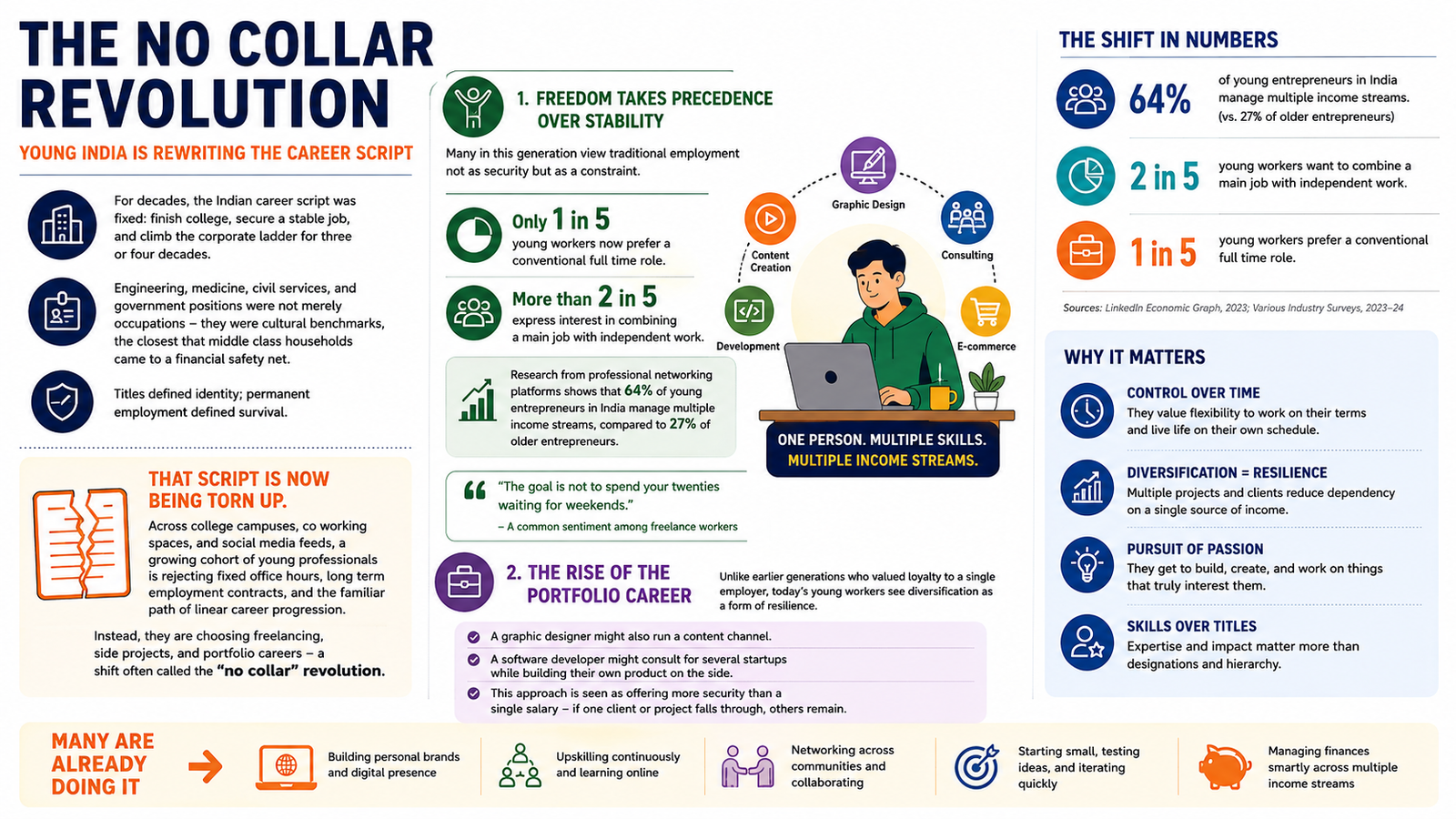
For decades, the Indian career script was fixed: finish college, secure a stable job, and climb the corporate ladder for three or four decades. Engineering, medicine, civil services, and government positions were not merely occupations – they were cultural benchmarks, the closest that middle‑class households came to a financial safety net. Titles defined identity; permanent employment defined survival.
That script is now being torn up. Across college campuses, co‑working spaces, and social media feeds, a growing cohort of young professionals is rejecting fixed office hours, long‑term employment contracts, and the familiar path of linear career progression. Instead, they are choosing freelancing, side projects, and portfolio careers – a shift often called the “no‑collar” revolution.
Freedom Takes Precedence Over Stability
Many in this generation view traditional employment not as security but as a constraint. Surveys indicate that only a small fraction of young workers now prefer a conventional full‑time role; a much larger share express interest in combining a main job with independent work. Research from professional networking platforms shows that a majority of young entrepreneurs in the country now manage multiple income streams, a proportion notably higher than among their older counterparts.
“The goal is not to spend your twenties waiting for weekends,” reflects a common sentiment among freelance workers. They would rather accept variable earnings in exchange for control over their schedules.
The Rise of the Portfolio Career
Unlike earlier generations who valued loyalty to a single employer, today’s young workers see diversification as a form of resilience. A graphic designer might also run a content channel; a software developer might consult for several startups while building their own product on the side. This approach is seen as offering more security than a single salary – if one client or project falls through, others remain.
Many are motivated by more than money. Self‑growth, financial independence, and the desire to build something of one’s own are frequently cited drivers. For creative professionals, the ability to pursue passion projects – even those that are not highly lucrative – is a key attraction of the freelance path.
The Numbers Behind the Shift
Official projections indicate that the country’s gig workforce is set to expand significantly over the next few years. Estimates suggest that the number of gig workers could more than triple within the decade, with the sector expected to account for a growing share of the non‑agricultural labour force. What was once considered a side hustle is rapidly becoming a primary career choice for many.
Data from global freelance platforms show that over half of young professionals have undertaken freelance work, with a large proportion working full‑time hours. This suggests that freelancing is no longer a temporary stopgap but a serious, sustained career option.
The Job Security Paradox
Yet the very flexibility that attracts young workers carries substantial risks. Official reports highlight persistent income volatility among gig workers, which creates difficulties in accessing formal credit. A notable portion of gig workers earn below a certain monthly threshold, and their earnings can fluctuate wildly from month to month. “There are good months and bad months – you have to keep hustling constantly,” is a recurring refrain. The uncertainty is especially acute for those just starting out, where earnings remain occasional and inconsistent.
Worker advocacy groups have long pointed to the challenges of algorithmic control, limited financial inclusion, and the absence of stable income. They argue that stronger labour protections are no longer optional but urgent.
The Social Security Gap
Recent legislation has for the first time formally recognised gig and platform workers in law, providing for social security measures such as life and disability cover, accident insurance, health and maternity benefits, and old‑age protection. However, the implementing rules condition access on completing a minimum number of days of engagement with a single platform or across multiple platforms annually – a threshold that many workers, given the volatile nature of their work, struggle to meet.
Critics warn that these conditions risk rendering a large majority of gig workers ineligible for benefits. Moreover, the legislative framework uses permissive language – it states that the government may create schemes, not that it shall. Months after the law came into effect, concrete central schemes have yet to materialise. This discretionary approach leaves the welfare architecture uncertain at best.
Why This Generation Is Choosing Flexibility
Why are young workers so willing to trade traditional job security for autonomy? The answer lies in what they have witnessed. They grew up watching loyal employees being laid off during economic downturns, tech sector slumps, and corporate restructurings. They saw parents stuck in traffic and office corridors longer than they spent at home – burnout dressed up as dedication, and engineers facing cyclical job losses.
For previous generations, prestige equalled safety; a respected job meant a respected life. But today’s young workforce has seen the underside of that arrangement. They are sceptical of the promise that a permanent contract guarantees stability. Instead, they are redefining security as the ability to adapt and stay employable, regardless of a single employer’s fortunes.
With the rise of artificial intelligence, the calculus has shifted further. Tools now allow independent workers to handle research, design, marketing, and customer support around the clock, reducing the need for large teams and making solo entrepreneurship more viable than ever.
What This Means for the Future
The no‑collar revolution is not a passing trend. It is reshaping the country’s labour market. Yet the systems designed to prepare and protect workers remain rooted in an era of permanent employment. Experts suggest several priorities: embedding digital and financial literacy into education; co‑creating skill‑building programmes with platforms; making social protection portable across different gigs; mandating data transparency for evidence‑based regulation; and giving worker collectives legal recognition.
Ultimately, this generation is moving away from the traditional notion of job security as permanence, embracing instead what might be called skill stability – the confidence that one’s abilities, not one’s employer, are the true asset.
For better or worse, India’s young workforce is redefining what a career looks like. The question is no longer whether the gig economy is here to stay – it is whether the country’s policy frameworks, social safety nets, and cultural expectations are ready to adapt.
Disclaimer: The opinions and views expressed in this article/column are those of the author(s) and do not necessarily reflect the views or positions of South Asian Herald.