The world remembers Gandhi as an apostle of peace, a leader of the freedom struggle and a social reformer. Far fewer people know that, briefly, he was also a teacher-and not in a metaphorical sense.
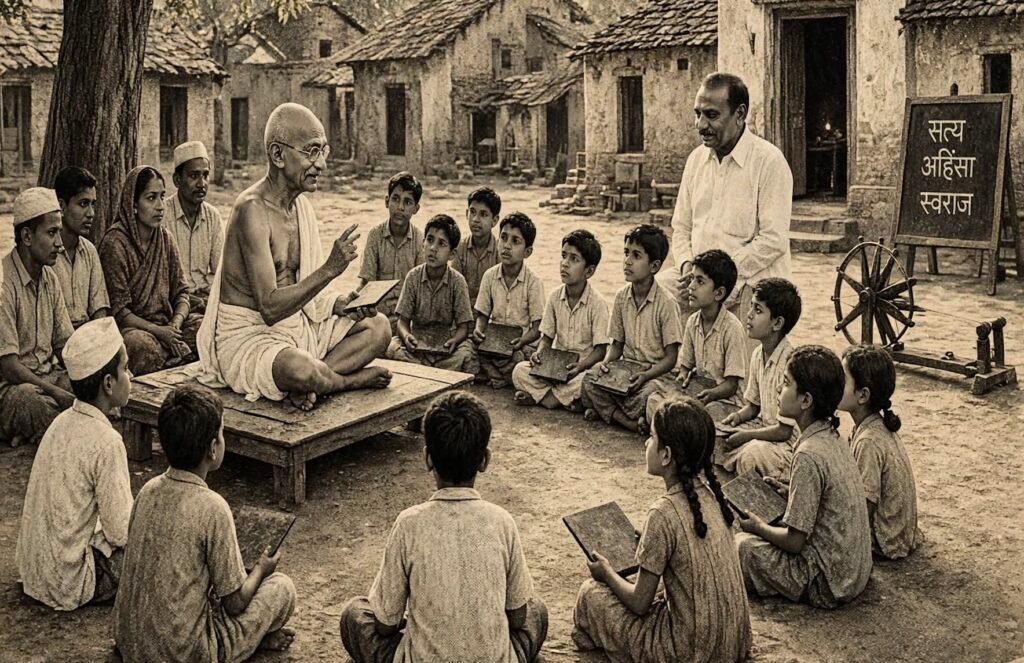
While living at the Valmiki Temple inside the Valmiki colony capital, he chose to teach English and Hindi to children and their parents. It was perhaps the first and only time he became a teacher in the true sense of the word.
Step into Bapu’s room and you see old sepia photographs of Gandhi with Lord and Lady Mountbatten, Acharya Kripalani, Frontier Gandhi, C Rajagopalachari, Sardar Patel, Maulana Azad and Pandit Nehru. One fading painting, however, tells the story of this venerable room. In it, several children talk to Bapu with animated faces. The painter’s name is missing, but the work still captures the mood of a space with a remarkable past.
The carpeted room holds a wooden desk at the center; the desk Gandhi used for writing. To the right is the bed he slept on. Close by stands his charkha-a small one. For the caretaker and priest of the temple, Krishan Vidhyarthi, everything remains where Gandhi left it.
Advertisement
Dr Om Prakash, a Dalit activist whose father and brother were Gandhi’s students, says: “Gandhi chose this place so that he could live with ‘untouchables’. In those days, a very large number of Valmiki families lived in jhuggis in the Valmiki Colony next to the temple. They worked as sweepers in Gole Market, Irwin Road (now Baba Kharak Singh Marg) and Connaught Place. He had deep empathy for my community.”
Many Valmiki families still live here, though now in decent flats. The jhuggis are long gone. In 1946, Gandhi asked the elders of the colony if he might stay with them for a couple of months. They welcomed him. He remained exactly 214 days, from 1 April 1946 to 10 June 1947.
He held classes every morning and evening without fail. He was so conscientious that he often delayed meetings with leaders of the freedom movement to finish teaching. The classes began before prayers; during lessons and prayers he would not receive guests. Louis Fischer, in his biography ‘The Life of Mahatma Gandhi’, recalled: “Once I reached the Valmiki Temple from my hotel, the Imperial, to interview him. But he met me only after the prayers.” Fischer spent more than a month in Delhi in 1946 gathering notes for the book.
“Once he moved to the Valmiki Colony, he began interacting with the families,” Krishan Vidhyarthi says. “He was shocked that they were all illiterate. Nobody had even seen a school. Then he asked residents to send their children to him; he would teach them. With Bapu’s offer, the elders began sending their children to his classes.” Vidhyarthi’s father and uncles attended those classes. Gandhi wanted them to learn to read and write basic English and Hindi.
Gandhi was a hard taskmaster. He would chide any student who came to class without bathing. Residents of the Valmiki Colony were not the only pupils. Children from Harcourt Butler School, Raisina Bengali School and the Delhi Tamil Education Association (DTEA) School also attended. The classes were open to all. It is said he knew every student by name.
Those students are no longer alive to tell their own stories, but their children still are. “It was a big blow when he was forced to shift from here to Birla House for security reasons,” Vidhyarthi says. “Our elders were devastated. Alas, he was killed where security was tight.”
Dr Om Prakash, who later taught at the Indian Law Institute, grew up on those memories. “I grew up listening to stories of Gandhi teaching at the Valmiki Temple from my father and other members of the family. My father had attended his classes; in those days our family also lived close to the temple. Thanks to Gandhi, many members of my family became a little literate. The best thing about those classes was that many father-son and mother-daughter pairs attended them religiously.”
When Bapu began teaching at the temple, children from Gole Market, Paharganj, Irwin Road and other nearby areas joined too. The class that started with about 30 students grew to around 75 in the morning and 75 in the evening. When numbers swelled, lessons moved into the open.
Meanwhile, it is a well-known fact that on his first visit to Delhi, from April 13 to 15, 1915, Gandhi stayed at the residence of S K Rudra, principal of St Stephen’s College, inside the campus at Kashmiri Gate. “Rudra became a friend of Mahatma Gandhi thanks to Deenbandhu C F Andrews, a teacher at St Stephen’s and an active member of the Delhi Brotherhood Society,” says Father George Solomon of the DBS, which has been doing social work in Delhi for more than 150 years. A photograph of that first Delhi visit hangs in the principal’s office at St. Stephen’s.
Disclaimer: The opinions and views expressed in this article/column are those of the author(s) and do not necessarily reflect the views or positions of South Asian Herald.