Join WhatsApp Channel

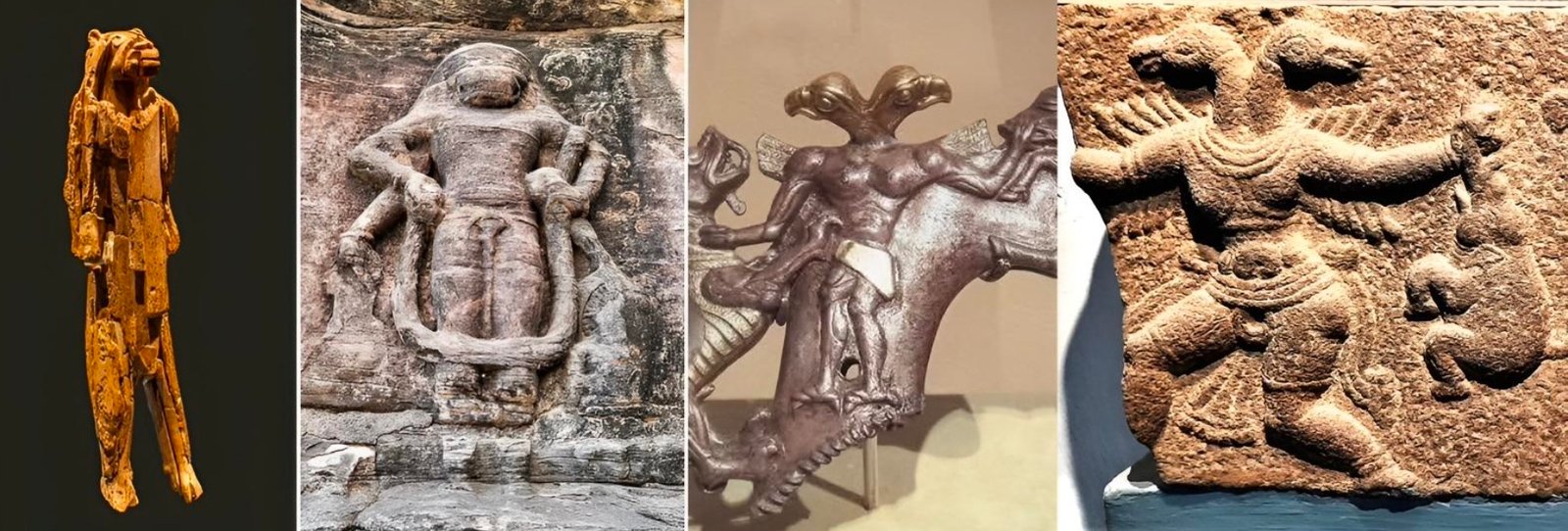
The Museum Ulm at the Baden-Wurttemberg state in Germany displays a fantastic exhibit of a man-lion. The icon’s German name is Löwenmensch, meaning ‘lion-person’ or ‘lion-human.’
The exhibit, just about 31.1 cm or 12.2 inches tall, is only 40,000 years old and is carved out of mammoth ivory using a flint stone knife. The zoomorphic icon – meaning part animal and part human – is one of the oldest-known examples of an artistic representation and the oldest surviving and confirmed statue discovered so far.
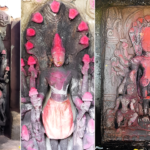
Fast forward to the 4th and 5th centuries CE in India. We begin to see images of an enthroned/seated and standing Narasimha, the much-celebrated man-lion in the context of Indian epics and Hindu religion.
The above images have been edited and joined for better viewing. There is no reason to believe that the German ‘Narasimha’ was a precursor to the Indian one but let us have that discussion a little later.
Shall we now move on to our second exhibit? This is a 4,500-year-old Indus Valley Civilization period seal in the National Museum in Delhi, India. The steatite seal depicts an individual wearing an elaborate headdress fitted with buffalo horns, surrounded by a variety of animals, including a stag, buffalo, rhinoceros, elephant and tiger. The relic is commonly referred to as the Pashupati or ‘Lord of the animals’ seal, while some scholars aver that the seated individual is proto-Shiva or protype of Lord Shiva.
Readers may recall a recent controversy erupting over this same seal after American historian Audrey Truschke described the central figure as “not Shiva and more likely adapted from proto-Elamite iconography.” While Elamite corresponds to far-west and south-west of modern-day Iran, we know that this seal was recovered from the Mohenjo-daro ruins in Pakistan’s Sindh province.
Compare the etching on the IVC-era seal to the image found on the Gundestrup cauldron, thought to date between 150 BCE and 1 BCE. The Gundestrup cauldron is a richly decorated silver vessel, discovered in 1891 near the hamlet of Gundestrup in Denmark, currently on display in the National Museum of Denmark in Copenhagen. Isn’t the resemblance uncanny?
The cauldron depicts a seated beardless male figure, wearing a cap with what seems like deer antlers. To the left of the man is a stag with antlers that are identical in size and shape to his cap. Surrounding the scene are other canine, feline, and bovine animals with some facing the male figure. Again, there’s no evidence to suggest that the IVC icon provided an early inspiration to the ‘Danish Pashupati.’
Let us now explore the third exhibit; loyal readers of South Asian Herald may readily identify the two icons featured below.
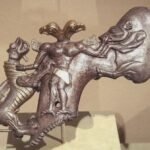
The first, with two eagle heads, is a divine or demonic anthropomorphic being, and represents one of the rarest and most remarkable works in Bronze Age metal from the Bactria-Margiana Archaeological Complex (BMAC), dated to 2100-1800 BCE. The extraordinary icon was discovered in the 1980s within the BMAC, corresponding to northern Afghanistan and southern Turkmenistan, and is now housed at The Metropolitan Museum of Art in New York.
The second image, also with two eagle heads and winged, is of Gandaberunda from the Chennai Museum. The icon is dated to the Vijayanagara period in South India, dated to circa 1400-1600 CE. Gandeberunda is a lesser-known avatar of Lord Vishnu.
Notwithstanding the striking similarity in iconography, we have no way of knowing if South Indian philosophers of the medieval age had known of a more-ancient belief-system and infused the same in the Gandaberunda narrative.
Astonishingly, this double-headed eagle icon goes back 4,000 years. Livehistoryindia.com informs us that the oldest known representation of the double-headed eagle was found in ate 3rd millennium BCE at the ancient Mesopotamian city of Lagash, in present-day Iraq. The icon represented the Mesopotamian god Ningirsu.
More than 1000 years later, the symbol was adopted by Hittites, who ruled over Anatolia in Turkey around 1600 BCE. The symbol graced many of their buildings, sculptures, and pottery. The most striking Hittite double-headed eagle, Livehistoryindia.com informs us, was found on the main gate of the ancient city of Alaca Höyük in Turkey.
There is evidence in history that the double-headed eagle, due to popular demand, next flew further east from Anatolia. Over millennia, it was adopted by the Scythians, Greeks, Romans, and Byzantines. Come to think of it, the oldest known double-headed eagle in the Indian subcontinent was found in Taxila near Peshawar on a Buddhist stupa, dated to around 30 BCE.
Reverting to our main narrative, the general similarity in iconography – be it between the German man-lion and the Indian Narasimha or between the IVC-period Shiva-Pashupati and the Danish man surrounded by animals, and also between the 4,000-year-old double headed eagle icon and the ‘more-recent’ 500-year-old Gandaberunda – is perhaps on account of compelling reasons and beliefs prevalent in that era and region.
Come to think of it, a cave lion in ancient Europe was no doubt a terrifying creature. Thus, it should come as no surprise that ancient humanoid inhabitants of that region thought it fit to venerate the animal in a zoomorphic form. It is also plausible that the icon served as a totem to the clan that inhabited the region.
In Narasimha’s case, his ‘Indian’ devotees in the early centuries of the first millennium were perhaps looking for one ultimate fierce animal-deity, who would offer protection against adversaries, and a man-lion – both fierce and regal – perfectly fitted the bill.
Moving on to the IVC-period Shiva-Pashupati and the Danish man surrounded by animals, I feel both icons were outcomes of a human need/anxiety of seeking protection by an all powerful being, who lords over wild animals.
The third icon with two eagle heads also probably served the same purpose of being a fierce protector – at least in the South Indian context.
What’s fascinating is the fact that how these icons – separated by centuries and thousands of miles and seemingly unrelated to each other in terms of their individual genesis underline the same human desire to seek divine protection from adversaries and adversities.
While all of the above exhibits were separated by millennia and countries, there are some notable instances, where we see adoption of certain animal motifs such as the Griffin, an imaginary winged lion, as a ‘shared’ heritage in neighboring countries.
We see the Griffin in art across the Levantine, Egypt, and Persia from over 4,000 years ago, where the icon represented supreme strength, courage and guardianship. Interestingly, we see the same winged-lion on the gateway of the Sanchi stupa, originally built in the 3rd century BCE by Mauryan emperor Ashoka, in Madhya Pradesh.
There’s a theory that such art spread to India after the ancient Persian Empire was sacked by Greek monarch Alexander in 330 BCE. That event led to the migration of many Perso-Grecian and Persian artists, and it is these artists who carried the ideas of such artwork into India.
The Mauryan dynasty were the first to adopt such motifs, and the ideas were carried forward by the Satavahana and later Kushans, where Griffins were seen as fierce protectors of sacred sites.
Before I wind up this essay, let me share how Gandaberunda lives on to this day. The above images are from the Mysuru Palace; the erstwhile Mysore kingdom, under the royal Wodeyar family, used the image of a two-headed eagle in its crest. After India attained independence, Mysore continued to display this image in its emblem. The Mysore state was subsequently renamed as Karnataka in 1973; Gandaberunda remains in the state’s official emblem.
Disclaimer: The opinions and views expressed in this article/column are those of the author(s) and do not necessarily reflect the views or positions of South Asian Herald.