 Join WhatsApp Channel

So, you thought that Lord Ganesh was always venerated for being a Siddhi-data (One who grants success) and Vighna-harta (Remover of obstacles)? Apparently, he was not. Ahead of Ganesh Chaturthi, which is on September 14 this year, let us explore how the Lord was imagined in ancient times.
Eminent historian Jitendranath Bandopadhyay writes in his seminal book, Panchopasana, that the Atharvashiras Upanishad includes Ganesh or Vinayak among Vyantar (demi-gods). In the Manav Grihya Sutra, Prof. Bandopadhyay adds, there is a reference to four Vinayaks – Shalkatangkat, Kushmarajputra, Ushmita, and Devjajan – as demi-gods. The Sutra says that if individuals come under the influence of these Vinayaks, they tend to commit unsocial acts, see nightmares, and miss out on various good and coveted objects. The Manav Grihya Sutra even gives a vivid description of how such Vinayaks can be exorcised!
In Panchopasana, we read about Yajyavalkya Smriti, which shares similar accounts of Vinayaks, people under their influence, and methods of exorcism. However, there is a difference. In Yajyavalkya Smriti, there is only one Vinayak, and he is known by six names: Mit, Sanmit, Shal, Katangkat, Kushmanda, and Rajputra. In this account, even the methods of exorcism are more complicated. Also, here Vinayak is the son of Ambika, the mother Goddess.
This transition of Ganpati Vinayak – from malevolent to gentle – reminds us of his father, Rudra-Shiv, who, in the Vedic ages, embodied terrible rage but blessed devotees, when propitiated with hymns and fire worship. Incidentally, even Shiva has been referred to as Ganeshwar or the God of the Gana in some ancient texts.
In the Paraskar Grihya Sutra, Prof. Bandopadhyay writes, we find reference to these various Gana or demi-Gods – Shanda, Marka, Upavir, Shaundikeya, Ulukhal, Maliluch, Animish, Hastamukha, Sarmaparun, Kumar, etc. Even these Gana, though essentially harmful, blessed people, when properly propitiated.
There is a marked similarity between these Gana and the Vinayak(s) described in Manav Grihya Sutra and Yajyavalkya Smriti – both in terms of appearance and characteristics.
Amarkosh, an ancient compendium, perhaps written in the late Gupta period, uses various synonyms such as Vighnaraj, Lambodar, Gajanan, Dwaimatur and Heramba to describe Vinayak’s appearance and characteristics.
While Heramba refers to the one, in whose proximity Shiva or Hé (pronounced as Hey) always stays, the name Dwaimatur is derived from the Puranic tale of Vinayak being reared by both Parvati/Ambika and Chamunda, her destructive/violent avatar.
In ancient India, Riddhi and Siddhi did not feature in the Ganesh pantheon. Instead, Ganesh is with Gayatri/Shakti. From ancient Gupta period texts and idols, we can deduce with certainty that worshipping Ganesh had been initiated and was in vogue during the 4th to 6th centuries CE.
Some scholars believe that the imagination of Lord Ganesha is a result of the convergence of ancient Gods and faiths. More than two millennia ago, the Yaksha and Naga were worshipped by the common people of this subcontinent. In ancient texts, the Yaksha and Kuber, the lord of the Yaksha, have been described as one with an extended belly or Lambodar. And, the word Naga also means elephant; it is well-known among historians that the ancient city of Hastinapur of the Mahabharata was also known as Nagasaya. In Ganesh’s physique, we see the convergence of both the above features – an elephant head and an extended belly.
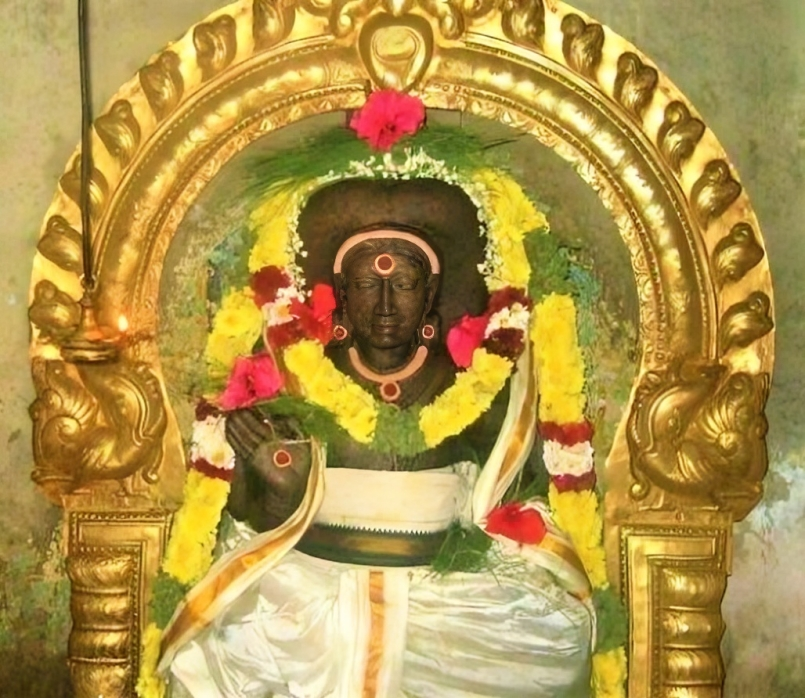
Interestingly, there is at least one manifestation of Ganesh without the elephant head! In Tamil Nadu’s Thilatharpanapuri, close to Koothanoor, we have one Adhi Vinayagar (meaning ancient Vinayak) temple. Here, the deity is with a human head, said to be the early form of Vinayak, exactly as Parvati had made him!
Ancient texts list 24 types of Ganesh idols. These are: Vinayak, Ganadheesh, Vighnesh, Pramatha-dhip, Ganesh, Beej-Ganpati, Hér, Vakratunda, Bal-Ganpati/Tarun-Ganpati, Bhakta-Vignesh, Veer-Vignesh, Shakti-Ganesh, Dhwaja-Ganadhip, Pingal-Ganpati, Uchchistha-Ganpati, Viraj-Ganpati, Lakshmi-Ganesh, Maha-Ganesh, Bhuvanesh-Ganpati, Nritya-Ganpati, Urdha-Ganesh, Prasanna-Ganesh, Unmatta-Vinayak, and Haridra-Ganesh. Unfortunately, idols that match all of these depictions have not been located yet.
Ganesh idols can be segregated into three types – Sthanak (standing), Asan (sitting) and Nritya-rata (dancing).
My personal favorite is the dancing Ganesha of Bengal.
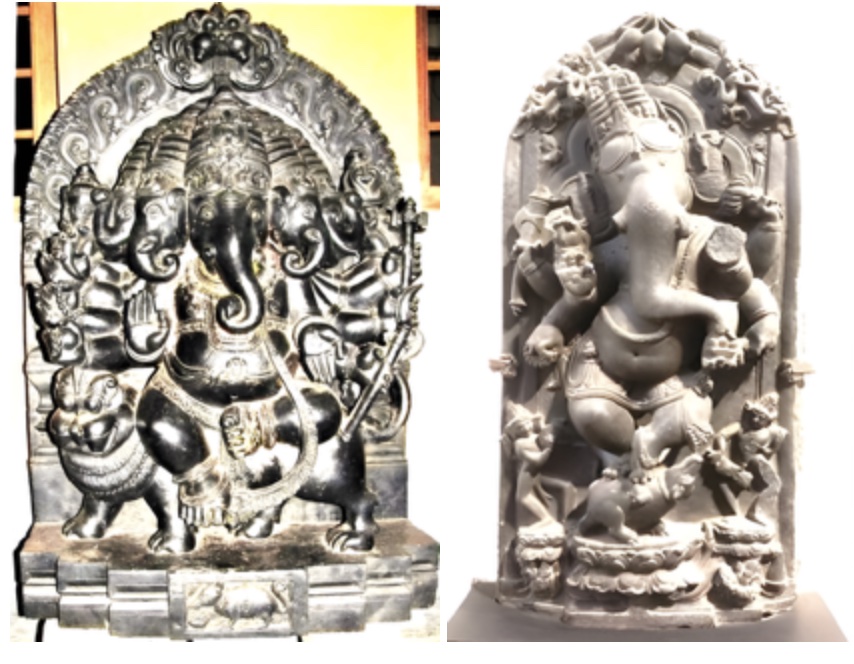
An 8th-century example from North Bengal is in the collection of the Indian Museum, Kolkata.
The eight-handed deity holds clockwise: Prayer beads or rosary, abhaya-mudra (assurance), a battle-axe, his own broken right tusk, a blue lily (Neelotpal), and a pot of sweets (Modaka).
The two musicians, Gaja-karna and Go-karna, dance, playing cymbals and drums, while the spotted mouse, Krauncha, turns his head and watches the dancing Lord in wonder.
Ganesh is usually depicted with his vehicle, the mouse. However, there is an exception in Heramba Ganpati, where he rides a lion. This form of Ganesh, seen in the South, is depicted with five elephant heads – four in each direction and one on top looking at the sky. He rides on a powerfully built lion and has 10 arms. Clearly, our favorite Lord, too, has undergone many transformations over the centuries.
Disclaimer: The opinions and views expressed in this article/column are those of the author(s) and do not necessarily reflect the views or positions of South Asian Herald.
Related posts:
 Gujarat Maharashtra Day Celebrated in New York with Cultural Unity and Diaspora Participation
 Gharat Ganpati Yet Another Proud Moment for Marathi Cinema
 Pravasi Bharatiya Divas 2025: India’s Other Demographic Dividend
 Vedic Mantras and Rituals Invoke Goddess Lakshmi at Flushing Swaminarayan Temple Chopda Pujan

1 comment
Very interesting. So many transformations of our Gods!