Join WhatsApp Channel

The evolution of Bangladesh–United States relations should no longer be viewed through the narrow prism of bilateral diplomacy. It is increasingly becoming part of a broader geopolitical realignment unfolding across the Indo-Pacific, where economic resilience, technological competitiveness, maritime security, and strategic connectivity are redefining international partnerships. In this changing landscape, Bangladesh is steadily emerging as one of South Asia’s most consequential middle powers, while Washington is recalibrating its engagement with countries capable of contributing to a stable and prosperous regional order.
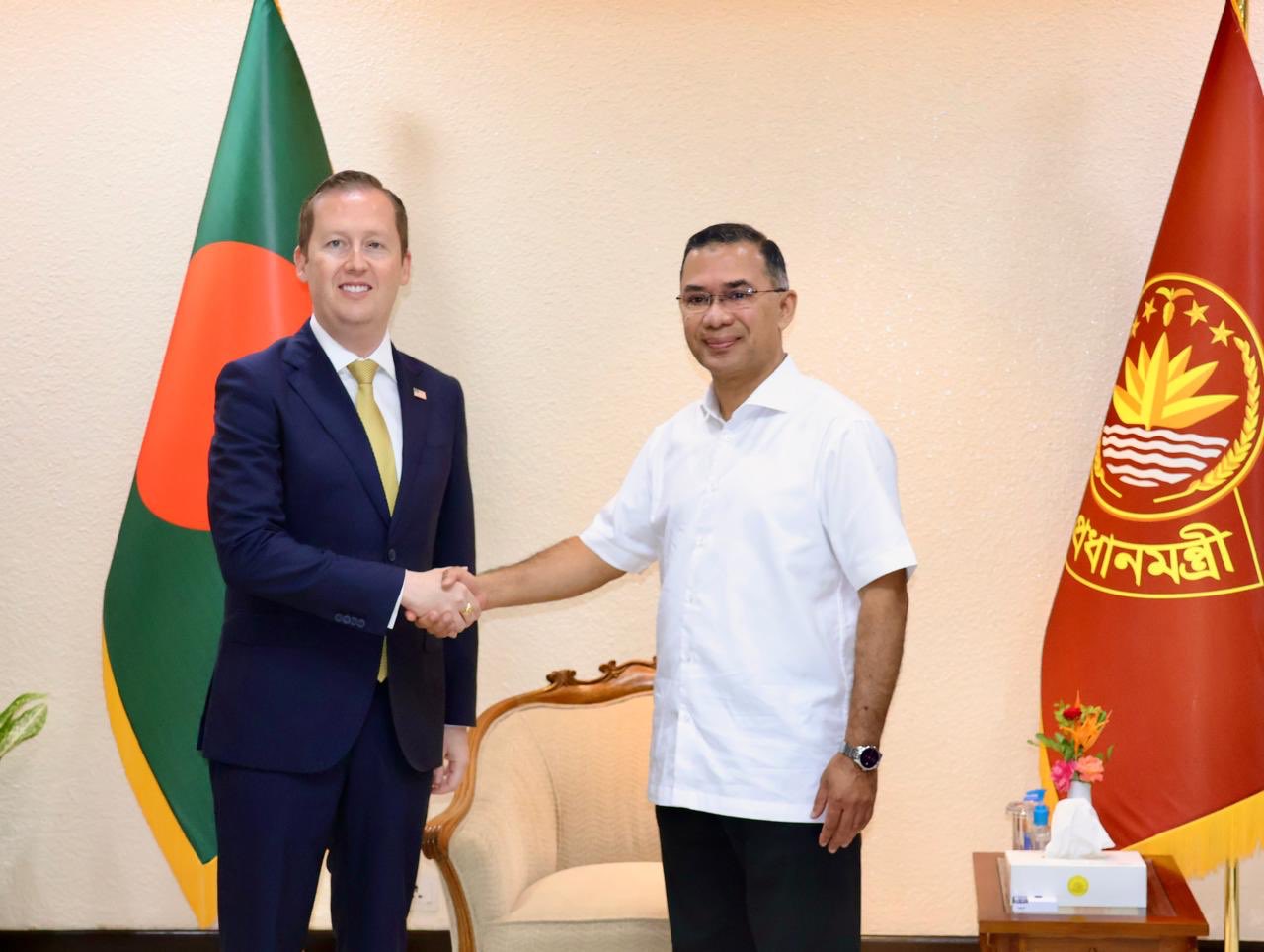
Against this backdrop, the recent visit to Dhaka by Sergio Gor, US President Donald Trump’s Special Envoy for South and Central Asia, deserves attention not simply as another diplomatic exchange but as an indicator of a changing strategic relationship. His meeting with Prime Minister Tarique Rahman, alongside discussions with senior Bangladeshi officials, reflected a relationship that is increasingly focused on long-term economic cooperation, investment, regional stability and institutional engagement.
The official readouts issued by Bangladesh’s Prime Minister’s Office and the Ministry of Foreign Affairs, together with Sergio Gor’s public remarks and posts on X, pointed toward a common objective: expanding the economic dimension of bilateral relations while creating greater opportunities for American investment in Bangladesh. If this direction is sustained, it would represent more than incremental diplomatic progress. It would signal the emergence of a more comprehensive strategic partnership rooted in shared economic interests and regional stability.
This shift should be understood within the context of wider transformations taking place in international politics. The post-Cold War assumption of an uncontested global order has given way to an increasingly competitive international system. Strategic rivalry among major powers now intersects with supply-chain security, critical technologies, energy transition, climate resilience and maritime governance. As governments and multinational corporations diversify economic partnerships, countries with political stability, competitive manufacturing, favourable demographics and strategic geography have acquired renewed importance.
Bangladesh fits that profile with increasing confidence.
Over the past decade, Bangladesh has demonstrated sustained economic resilience while investing heavily in transport infrastructure, digital connectivity and industrial expansion. It has become one of the world’s leading manufacturing economies in ready-made garments and is steadily seeking to diversify into pharmaceuticals, information technology, electronics, shipbuilding and advanced manufacturing. Its graduation from the Least Developed Country category represents not an endpoint but the beginning of a more competitive phase of economic development.
For Washington, Bangladesh’s significance extends well beyond bilateral trade. Located on the Bay of Bengal at the intersection of South and Southeast Asia, Bangladesh occupies a strategic position within the wider Indo-Pacific architecture. Maritime security, resilient supply chains, digital infrastructure, disaster preparedness and regional connectivity increasingly converge in this geography.
Equally important is Bangladesh’s diplomatic approach. Rather than embracing exclusive geopolitical alignments, Dhaka has consistently pursued a multidimensional foreign policy that seeks constructive engagement with all major partners. The United States, China, India, Japan, the European Union, ASEAN members and Gulf countries all remain important pillars of Bangladesh’s external relations. Such strategic balancing reflects both pragmatism and confidence in an increasingly multipolar international order.
This balanced diplomacy also serves the broader interests of South Asia.
Despite accounting for nearly one-quarter of the world’s population, South Asia remains among the least economically integrated regions globally. Political differences, inadequate infrastructure and limited regional connectivity continue to constrain growth. A stronger Bangladesh, supported by diversified international partnerships, has the potential to become a regional connector linking South Asia with Southeast Asia through transport corridors, ports, digital infrastructure and energy networks.
The Bay of Bengal is rapidly emerging as one of the most strategically important maritime spaces in Asia. Investments in Chattogram Port, Matarbari Deep Sea Port, logistics corridors and cross-border infrastructure could transform Bangladesh into a critical gateway for regional commerce. Such developments would benefit not only Bangladesh but also India, Nepal, Bhutan, Sri Lanka and wider Indo-Pacific trade networks.
Economic diplomacy therefore occupies a central place in Bangladesh’s strategic calculations.
As Bangladesh prepares for the post-LDC era, the priorities are becoming increasingly clear: attracting higher-quality foreign direct investment, moving up global value chains, expanding technology-intensive industries and strengthening institutional competitiveness. Greater engagement with the United States has the potential to contribute significantly to these objectives through investment, innovation partnerships, educational collaboration, research cooperation and private-sector integration.
Technology is likely to become an increasingly important pillar of future relations. Artificial intelligence, semiconductors, cybersecurity, biotechnology, fintech and digital infrastructure are reshaping the global economy. Bangladesh’s demographic dividend offers considerable potential, provided investment in education, skills development and innovation keeps pace with global technological transformation.
Climate cooperation represents another area where bilateral and multilateral interests converge. Bangladesh remains among the countries most exposed to climate risks despite contributing minimally to global emissions. Enhanced cooperation with advanced economies on renewable energy, climate finance, resilience infrastructure and green technology would strengthen both sustainable development and regional security.
Security cooperation is also evolving beyond traditional defense considerations. Maritime domain awareness, cyber resilience, humanitarian assistance, disaster response, counterterrorism and peacekeeping have become essential components of modern strategic partnerships. Cooperation in these areas contributes to regional stability without requiring exclusive military alignments.
At the multilateral level, Bangladesh continues to expand its diplomatic profile through active participation in the United Nations and other international institutions. Its growing voice on climate justice, sustainable development, migration, peacekeeping and Global South priorities increasingly complements its expanding bilateral relationships. This combination of bilateral engagement and multilateral activism enhances Bangladesh’s international relevance.
Nevertheless, diplomacy today operates in an environment where information moves faster than policy. Political narratives, speculation and social media often dominate public discourse surrounding high-level diplomatic engagements. While such debates are inevitable, they should not obscure the broader strategic trajectory.
Diplomatic success is ultimately measured by institutional continuity, expanding investment, deeper economic integration, technological cooperation and sustained political trust. Those indicators provide a far more reliable assessment than short-term political commentary.
If the momentum generated by recent Dhaka-Washington engagement translates into increased American investment, expanded commercial partnerships and regular high-level strategic dialogue, it may well represent the beginning of a new chapter in Bangladesh-United States relations.
The implications would extend well beyond bilateral diplomacy.
A stronger Dhaka-Washington partnership could contribute to more resilient regional supply chains, enhanced maritime cooperation, greater economic connectivity and improved investor confidence across South Asia. At a time when the global economy is fragmenting into competing strategic networks, partnerships built on mutual economic benefit, institutional trust and strategic pragmatism are likely to prove both durable and influential.
For Bangladesh, the challenge will be maintaining its carefully calibrated foreign policy deepening engagement with Washington while preserving productive relations with Beijing, New Delhi, Tokyo, Brussels and other key partners. Strategic autonomy, rather than strategic alignment, has become Bangladesh’s principal diplomatic advantage.
The recent visit by Sergio Gor should therefore be viewed not as an isolated diplomatic event but as one indicator of a broader geopolitical transition. Bangladesh is increasingly being recognized not only as one of Asia’s fastest-growing economies but also as a responsible regional stakeholder capable of contributing to stability, connectivity and sustainable development across the Indo-Pacific.
For South Asia, that evolution carries significance far beyond Bangladesh’s borders. It reflects the emergence of a more interconnected regional order in which economic diplomacy, strategic flexibility and pragmatic partnerships—not geopolitical binaries will increasingly define the future.
Disclaimer: The opinions and views expressed in this article/column are those of the author(s) and do not necessarily reflect the views or positions of South Asian Herald.
Related posts:
 Why Bangladesh’s Pivot Toward Türkiye Could Redefine South Asia’s Geopolitical Landscape
 Beyond a Courtesy Call: Paul Kapur’s Dhaka Visit and Bangladesh’s Rising Strategic Weight in South Asia
 Between Opportunity and Entrapment: Bangladesh Must Tread Carefully on the EU Partnership Deal
 India’s Expanding Defense Ties with Europe and Bangladesh’s Strategic Balancing in South Asia