Join WhatsApp Channel

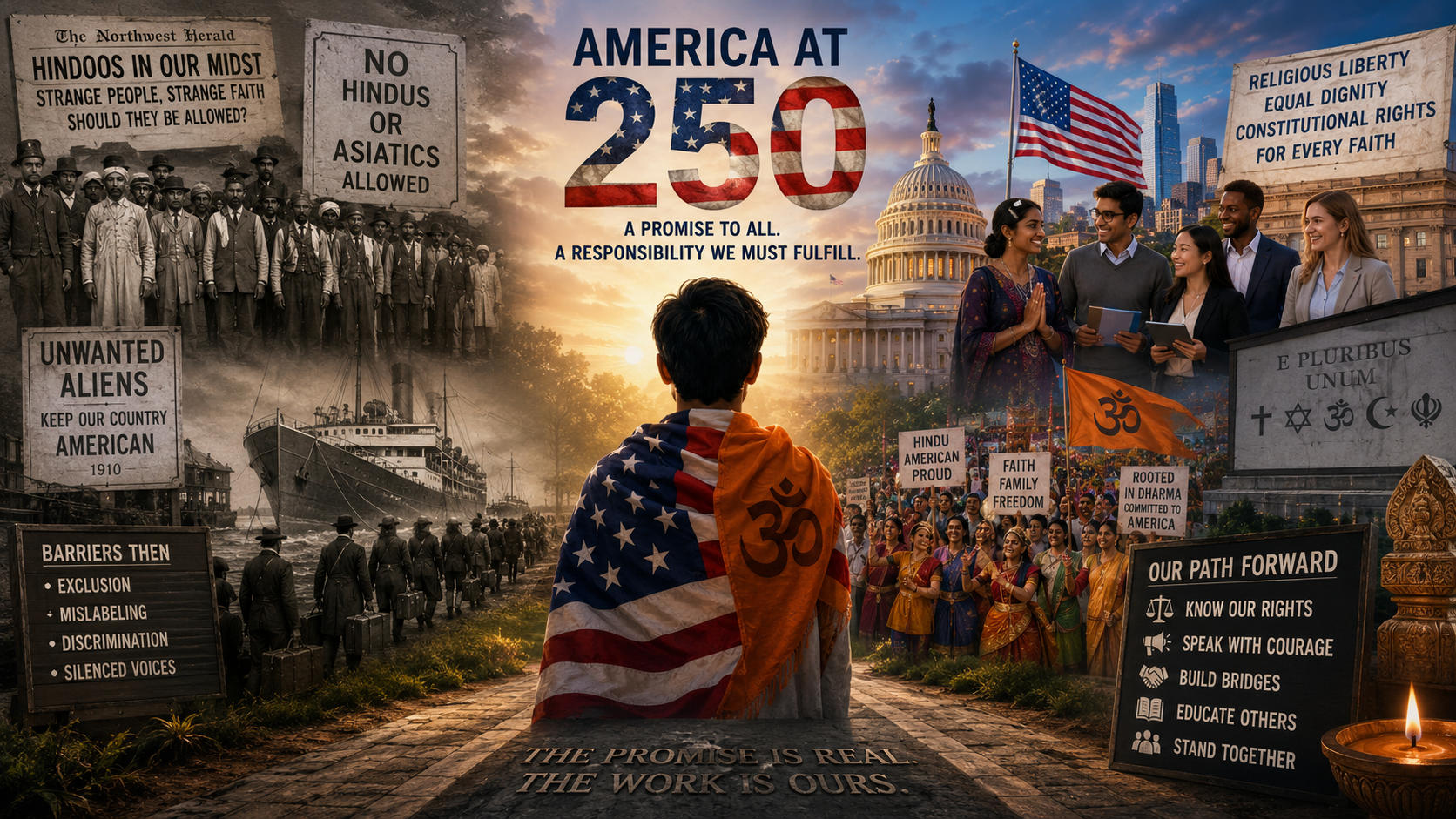
As the United States celebrates its 250th anniversary of independence, the nation must reflect on its founding promise of religious liberty. For over two centuries, this pluralistic democracy has evolved, testing its constitutional protections against successive waves of immigration.
Yet, as Americans mark this historic 250th anniversary, a glaring disparity persists in how different religious traditions are treated in public, academic, and media discourse. Among these, Hinduism, adhered to by over one billion people globally and a highly successful diaspora domestically, occupies a unique and troubling blind spot.
In an open society, no religion is immune from criticism; academic freedom and free expression are essential pillars of democracy. Equally foundational, however, is the right to observe one’s faith with dignity and free from targeted hostility. While many religious minorities in the U.S. actively leverage these constitutional protections, a significant portion of the Hindu diaspora remains unaware of their legal rights or chooses to remain “silent.”
This silence has come at a steep historical and contemporary cost. It must change going forward.
The Deep Roots of the “Hindu Blind Spot”
American exposure to Hinduism was intellectual and spiritual, marked by the visit of Swami Vivekananda to the 1893 World’s Parliament of Religion. While his message of universal acceptance resonated with many, Hindu teachings were frequently misunderstood or subjected to bias in the popular press for decades, and remain less well understood and appreciated.
The challenges Hindu Americans face today are not new; they are tied to a historical trajectory that predates the modern diaspora. When the first major wave of South Asian laborers arrived in the Pacific Northwest in the early 1900s, the American public broadly and incorrectly labeled them all as “Hindus,” regardless of their actual faith (the majority were actually Sikh). Deemed an unassimilable threat by groups like the Asiatic Exclusion League, they were met with immediate, systemic hostility. This culminated in the racist Bellingham, Washington, riots of 1907, where white mobs violently expelled these workers from local mills.
For the first half of the 20th century, early Hindus were stripped of citizenship rights, barred from owning land, and ultimately excluded entirely by the Immigration Act of 1917. When immigration finally reopened via the landmark Immigration and Nationality Act of 1965, the incoming Hindu diaspora adapted a survival strategy centered on professional excellence and political quietism. They focused on building temples, preserving cultural traditions, and achieving professional success while remaining largely outside public advocacy and under the radar.
Double Standard in Western Institutions
A century after the Bellingham riots, the nature of anti-Hindu bias has shifted from physical violence to institutional ridicule, yet the systemic failure to protect Hindu rights remains. A recurring pattern in Western media and academia raises uncomfortable questions: Why does the ridicule of Hinduism pass quietly, while criticism of other major faiths provokes immediate institutional scrutiny?
These questions resurfaced recently following a controversy surrounding the distortion of Hindu deities within academic spaces associated with Harvard University. For many Hindus, the imagery was deeply offensive. Yet, the episode generated minimal institutional introspection and virtually no commentary in mainstream Western media.
To understand the disparity, one only has to look at how similar controversies unfold for other communities. When the French satirical magazine Charlie Hebdo published cartoons depicting the Prophet Muhammad, it triggered a global, high-stakes debate on the boundaries of free speech and religious offense. Similarly, incidents involving antisemitism on American elite campuses routinely spark congressional scrutiny, corporate pullouts, and rigorous institutional accountability.
The Jewish community has successfully established that bigotry against them will not be tolerated. Hindus have historically failed to establish that same boundary. Consequently, Western institutions often interpret Hindu restraint not as civility, but as indifference.
The Internal Dilemma: Why Hindus Remain Asleep
It is tempting to blame this double standard entirely on external bias, but that tells only part of the story. The uncomfortable truth is that the problem is largely internal to the Hindu community itself.
For decades, the diaspora has treated Dharma as a private, domestic affair, confined to rituals, festivals, and family traditions. While these are vital for cultural preservation, they represent only one dimension of Dharma. Protecting the dignity of a tradition in a democracy requires active civic participation, advocacy, and institutional engagement.
Instead, the Hindu community remains fragmented by regional, linguistic, and ideological divisions. Hindus are divided into being Hindus and worshipping in the Mandirs, not only based on the region and what deities are worshipped, their size and leadership, and worst yet, the “politics” and lack of transparency.
Let me take an example from the Twin Cities, home to dozens of Hindu places of worship, religious schools, and community organizations. Historically, they provided cultural identity to Hindu migrants, but with the increasing Hindu population, our second and third generations are not as engaged. Demographic shifts and regionalism have further divided rather than unified Hindus. There is a race to get bigger, not necessarily better. There is little or no concerted effort for collaboration to bridge the intergenerational gap and bring the diaspora together for festivals like Diwali, Holi, Ram Nawani, etc. While there is nothing wrong with having more than one celebration of any Hindu festival to accommodate the increasing number of Hindus, the spirit of collaboration and unity seems to have taken a back seat.
Worse still, the vacuum left by mainstream Hindu silence has been filled by what many in the community call “HINOs”—Hindus in Name Only. These are individuals or highly funded fringe networks who leverage their Hindu heritage or names as an authenticity shield. They speak loudly in academic and media circles, not to explain the essence of Sanatana Dharma, but to actively dismantle diaspora advocacy by labeling legitimate complaints of Hinduphobia as ‘majoritarianism’ or extremism. They have no shame standing next to an individual or collaborating with institutions that are passionately and openly speaking and writing against Hindus, Hinduism, and Hindutva. Minnesota has plenty of them, too.
Because mainstream Western institutions cannot differentiate between authentic practitioners and political activists using a religious label, they treat these loudest dissenting voices as the true representatives of the community. The greater damage to the Hindu community is thus self-inflicted; by remaining quiet, politicizing the Hindu institutions, and Hindus allowing a vocal minority to weaponize their identity against them.
This fragmentation extends into elite academic spaces. Young Hindu professionals and students frequently recount feeling deeply isolated when their traditions are mocked or dismissively deconstructed in classrooms. Many choose not to speak up, fearing they will be labeled “overly sensitive” or politically controversial. They lack the vocabulary and the communal backing to articulate their identity in the public sphere.
Furthermore, popular culture has filled this void. For decades, the global entertainment industry, including Bollywood, has frequently caricatured or minimized traditional Hindu practices, inadvertently teaching both the diaspora and the broader public that Hindu symbols are fair game for cheap distortion. Even the sacred Swastika, a millennia-old symbol of peace and well-being, was conflated with Hitler’s Hakenkreuz (hooked cross) for generations, requiring decades of exhausting work by organizations like the Coalition of Hindus of North America (CoHNA) to finally educate the public on the distinction.
The Awakening of Sanatana Dharma
As America hits its 250-year milestone, a quiet but necessary awakening is finally taking place. Organizations like CoHNA and the Hindu American Foundation (HAF) are actively engaging with policymakers, rectifying textbook biases, and building vital alliances with other minority groups, including Jewish organizations. A younger generation of Hindu Americans is beginning to realize that Dharma does not command passivity; rather, it demands the courage to protect truth (Satya) and uphold righteousness (Righteousness/Justice).
This advocacy must carefully avoid the trap of grievance politics. The goal is not to demand immunity from satire or to stifle academic debate. Open societies require room for critique. Rather, the goal is consistency. If Western institutions respond vigorously to defend the dignity of some communities, they must extend that same seriousness to Hindus.
At 250, America is still learning how to fulfill its promise of equal respect for all faiths. But respect in a democracy is rarely granted automatically; it is built through representation, unity, and the willingness to speak when it matters. For the Hindu diaspora, the era of silent observation must end. The moment of awakening, and collective voice of unity has arrived.
America’s promise of religious liberty is not self-executing. Every generation must renew it. For Hindu Americans, that renewal begins not with anger or grievance, but with confidence, civic engagement, and the willingness to speak with clarity about their own tradition.
Disclaimer: The opinions and views expressed in this article/column are those of the author(s) and do not necessarily reflect the views or positions of South Asian Herald.
Related posts:
 Soul Talk: Rediscovering the Meaning of Dharma
 South Asian Hindu Americans Protest Near the White House Demanding Justice for Hindus in Bangladesh
 CoHNA Hosts 4th Annual Hindu Day of Advocacy at U.S. Capitol, Highlights Rising Hindu American Voice
 CoHNA Capitol Hill Advocacy Draws Bipartisan Support