Join WhatsApp Channel

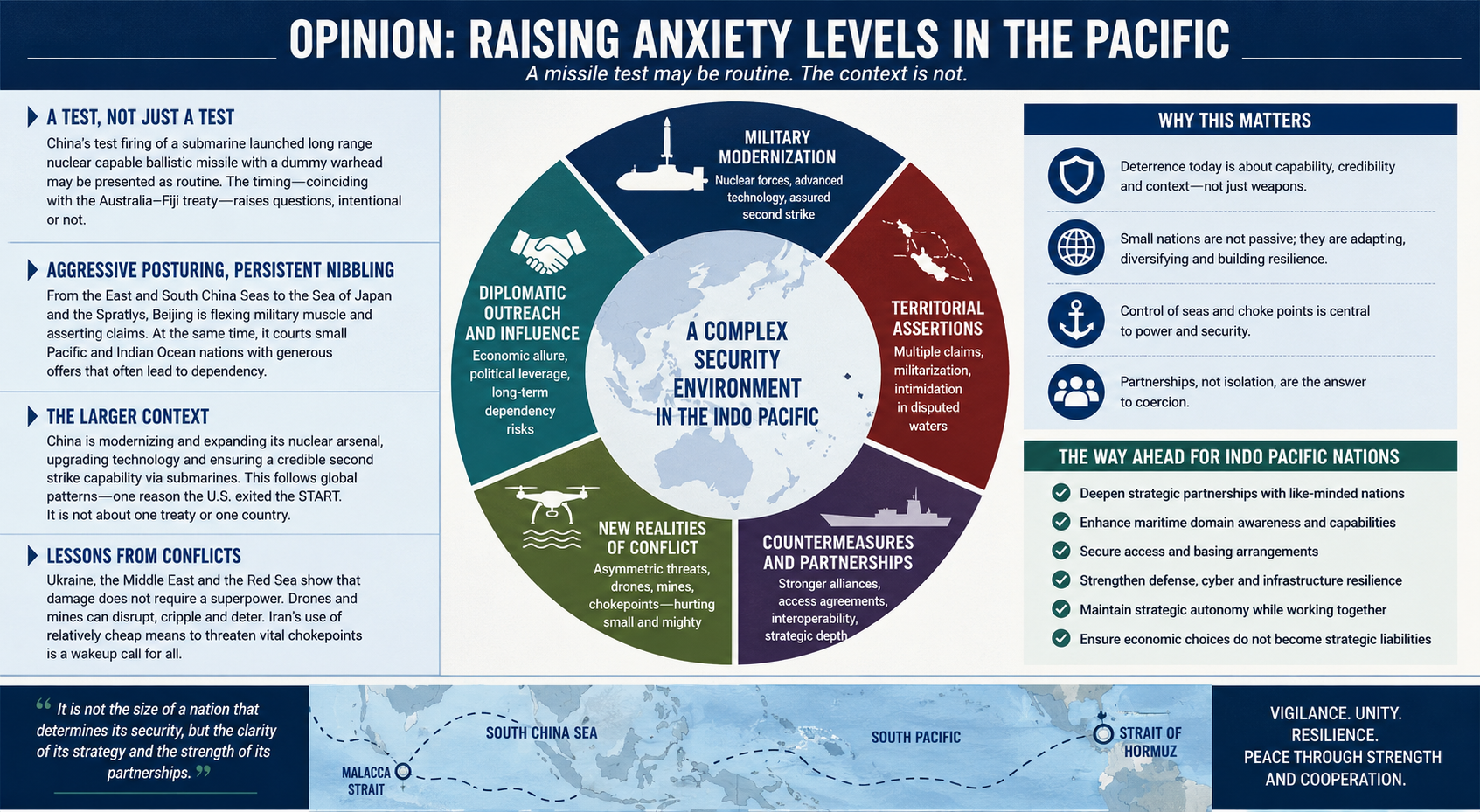
China would like nations in the Pacific to believe that there is nothing out of the ordinary in its test firing of a submarine launched long range nuclear capable ballistic missile but with a dummy warhead. And Beijing is perhaps even amused that countries have reacted even if they may have been given advance notice of an impending test. In the world of diplomacy this can be considered routine, the only surprise being the timing. There is speculation that Beijing timed the test to coincide with the treaty between Australia and Fiji.
For quite some time now nations in the South and Indo Pacific have been seeing the aggressive posturing of China in the East and South China Seas, trying to flex its military muscles in the Sea of Japan as also around the Spratlys where some six nations lay claim to a set of islands, islets and coral reefs, much of land best defined by high and low tides. At the same time nations in the area have seen Beijing trying desperately to nibble away at tiny speck of nations in the South Pacific and Indian Oceans with offers of policing coming with outward generous economic packages that later turn out the typical dependency syndromes. Some wake up early enough to smell the coffee.
Getting worked up on a missile test is to miss the larger context which is one of China only following what others have done as well. It is a well-known fact that Beijing has been working on its nuclear arsenals including weapons and upgrading technology which was one of the reasons the Trump administration walked out of the START. As a nuclear power, China would have to make sure that its second line, the sea via submarines, is in fine form. To see in all this a message to Australia for its Fiji Treaty or in any warning to Japan against building military friendships with India or others could be simplistic. Both Australia and Japan, for instance, know that Beijing does not need any pretext to go about its planned moves.
For a country that pays careful attention to ongoing conflicts to come away with pertinent lessons, Beijing is all too aware of the fact that it does not take a major or a nuclear power to inflict damage on a smaller nation. If Russia is learning it the hard way after four years of its “Special Military Operation” in the Ukraine, the United States and Israel found out in a span of less than four months the extent of destruction Iran can bring about in the neighborhood and beyond, not through expensive bombers and missiles but relatively cheaper drones and mining the critical waterways of the Hormuz. In fact, Iran has given a wakeup call beyond the Middle East by highlighting the crucial chokeholds in navigation that can hurt and bleed the small and the mighty.
Smaller nations in the Indo Pacific like Vietnam and the Philippines have long been taking steps to meet the challenge from China, not merely by taking out any American insurance but also looking for ways to widen their diplomatic and strategic connections. There is talk of both Hanoi and Manila opening out in a major way to the United States through offer of bases whose utility will be much more than that of the earlier Clark Air Base and Subic Bay Naval during the heydays of the Cold War and the Vietnamese conflict. And Vietnam’s Soviet era Cam Ranh Bay and Da Nang bases could be a sure buffer to anything China might want in Cambodia by way of a facility in Siem Reap.
And every now and then there is talk of the Philippines becoming a member of the now four nation QUAD of the United States, Japan, India and Australia. If not a formal addition, why not a QUAD Plus? And in the realm of speculative talk of adding members, why not South Korea and New Zealand or even Indonesia? All of this would undoubtedly whip up the hysteria in China of an Asian NATO with the principal aim of encircling the communist giant. But this eventuality has the potential of turning into a reality as long as China keeps its aggressive intentions that is perceived to be threatening navigation and impeding the concept of a free and open Indo Pacific. Nothing riles nations in the area more than hearing of a 1000-mile territorial limit or sole ownership of the entire Spratlys chain.
In all noise over a submarine launched missile test, China has given Japan one more opportunity to justify its upscaling of defense and strategic planning and edging it closer to jettisoning its Peace Constitution that was carefully drafted at the end of the Second World War. As it is many elements pertaining to military spending and posturing of the Self Defense Force have been chipped away in the recent past; and the conservative government of Sanae Takaichi does not seem to be averse in having a debate on a topic long seen as taboo: the issue of nuclear weapons. There are hardline elements within the Liberal Democratic Party who would not lose sleep if Japan went nuclear. As it is there are those who already believe that Tokyo is just a “screwdriver away” from that status.
Japan has come a long way in the post war international system for it to be taunted with stories of Imperial Japan. In looking for its rightful place in the comity of nations, Japan has long moved away from a mechanical “Cheque book Diplomacy” with its present generation of leaders and youth in being respectful of opinions are unwilling to be perpetually tied to the ghosts of the past. And any amount of guilt trips through what the Imperial Army had done in East and South-East Asia during World War Two or Japanese leaders making annual pilgrimages to the Yasukini Shrine which is passed off as eulogizing war criminals in some quarters will cut much ice hereafter.
Disclaimer: The opinions and views expressed in this article/column are those of the author(s) and do not necessarily reflect the views or positions of South Asian Herald.