Join WhatsApp Channel

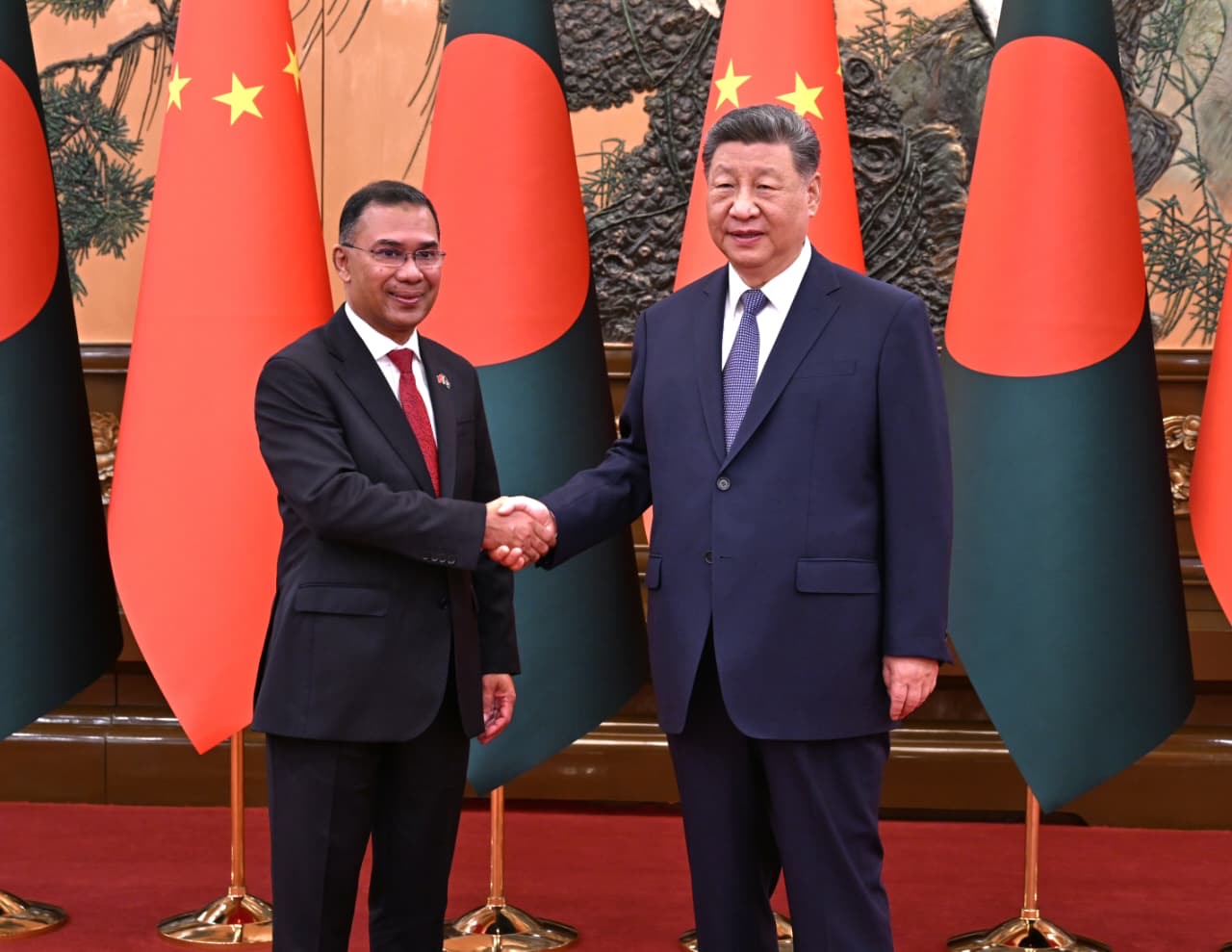
There is a particular kind of power that does not announce itself with fanfare. It arrives quietly through loan agreements, construction contracts, and factory floors and by the time the host nation notices how deep the roots have grown, extraction is no longer a simple matter. This is not a conspiracy theory. It is the unvarnished story of how China, in the span of barely a decade, transformed itself from a peripheral footnote in Bangladesh’s economic ledger into the country’s single most consequential foreign economic partner.
The numbers alone are staggering enough to demand serious reflection. In 2016, China ranked a forgettable 16th among Bangladesh’s foreign direct investors, commanding a mere 1.6 percent of the country’s total FDI stock a figure so modest it barely registered on the radar of policymakers in Dhaka. By 2025, that share had ballooned to nearly 10 percent, and China had vaulted to third place among all FDI sources. In raw dollar terms, Chinese FDI stock surged from $241 million to approximately $2 billion a growth of over 700 percent in less than a decade. Meanwhile, the United States, once the undisputed king of Bangladesh’s investment landscape with a 22 percent share, has watched its position shrink to a distant seventh, its FDI stock contracting from $3.3 billion to just $1 billion. The geopolitical subtext writes itself.
What triggered this seismic shift? The inflection point was October 2016, when Chinese President Xi Jinping landed in Dhaka bearing gifts of extraordinary scale: pledges of $40 billion in investment and financing, split between Belt and Road Initiative projects and joint ventures. The sheer audacity of that figure larger than Bangladesh’s entire national budget at the time was enough to reshape the country’s developmental imagination. Dhaka signed on to the BRI, and the relationship was never the same again.
To Beijing’s credit, the projects that followed were not phantom commitments. The Padma Bridge Rail Link now carries passengers across the country’s most formidable waterway. The Karnaphuli Tunnel has opened a new artery beneath Chittagong’s busiest river. The Chattogram-Cox’s Bazar Railway has connected a tourist and strategic corridor that languished for generations. The Payra Thermal Power Plant feeds electricity to a grid that once bled the economy dry through chronic shortages. These are tangible, visible achievements. Bangladeshi citizens cross these bridges, drive through these tunnels, and ride these trains. The concrete case for Chinese infrastructure financing is built, quite literally, into the landscape.
Yet the story does not end at the ribbon-cutting ceremony. The more consequential and less scrutinized dimension of China’s economic penetration lies not in FDI but in private sector lending. Here, the transformation has been even more dramatic. In 2020, Chinese entities held just 7.5 percent of Bangladesh’s long-term private sector external debt, ranking fifth among creditors. By 2025, that figure had rocketed to 34.2 percent, and China had become the single largest foreign creditor to Bangladesh’s private sector with outstanding loans of $3.37 billion, up from a modest $422 million five years prior. The United States, once second in this category, has fallen to fourth. India does not even make the top ten.
This is where the analysis must resist the seduction of triumphalist narratives whether the Chinese narrative of “win-win cooperation” or the Western narrative of a sinister “debt trap.” The reality, as always, is more nuanced and more demanding of intellectual honesty.
The competitive appeal of Chinese financing is real and rational. As Syed Mahbubur Rahman of Mutual Trust Bank has observed, Chinese capital comes without the ideological baggage that accompanies IMF conditionality or World Bank structural reform requirements. For a government seeking to build a power plant or a railway without submitting to lectures about governance benchmarks, Chinese financing is genuinely attractive. Add to this the competitiveness of Chinese machinery prices which have lured even traditionally Europe-oriented Bangladeshi manufacturers and the economic logic becomes difficult to argue against on purely transactional grounds.
But transactional logic is precisely the problem. The history of BRI engagement across the developing world counsels against treating each project as an isolated commercial decision. Sri Lanka’s Hambantota Port is not merely a cautionary tale about a single bad investment it is a parable about what happens when a country accumulates infrastructure debt that generates insufficient revenue to service itself, and then discovers that the creditor has leverage it is not reluctant to exercise. Pakistan’s experience under the China-Pakistan Economic Corridor tells a similar story: transformative investment, yes, but also circular debt, energy sector distortions, and a structural dependency that has constrained Islamabad’s policy autonomy in ways its leaders did not fully anticipate when signing the original agreements.
Bangladesh is not Sri Lanka or Pakistan. Its macroeconomic fundamentals are stronger, its garment export engine more resilient, and its debt-to-GDP ratio while rising — has not yet reached crisis territory. China’s share of Bangladesh’s total external debt, at roughly 7 percent as of early 2026, remains well below the exposure levels that triggered distress elsewhere. These are important distinctions that deserve acknowledgment. The debt trap hypothesis, applied mechanically and without context, does Bangladesh a disservice.
What deserves more serious attention is the structural composition of the dependency being built. China is simultaneously Bangladesh’s largest trading partner, its third-largest FDI source, its largest private sector creditor, and the primary supplier of the machinery and intermediate inputs that power its most important export industries. When a single country occupies this many nodes in an economy’s supply chain simultaneously, the concept of “diversification” however earnestly invoked by policymakers becomes increasingly theoretical. Diversification requires alternatives, and alternatives require investment in relationships that have not yet been cultivated with the same intensity as the Chinese relationship.
The BNP government under Prime Minister Tarique Rahman appears to understand the opportunity in this relationship, even as questions about the risks remain underexplored in public discourse. The June 2026 state visit to Beijing resulting in 13 signed MoUs spanning trade, infrastructure, green energy, media, and the Teesta River feasibility study signals a deliberate deepening of economic integration. The proposed China-Bangladesh Mongla Port Economic Zone, on land previously earmarked for an Indian economic zone that never materialized, is a particularly vivid illustration of how geopolitical vacuums are filled. Nature, and Chinese capital, abhor a vacuum.
The Teesta project deserves special attention. For years, this river management initiative was entangled in the web of India-Bangladesh relations, blocked by New Delhi’s domestic political constraints. Beijing has now stepped into that space with a feasibility study agreement a move that is as much geopolitical as it is hydrological. Dhaka’s willingness to proceed signals that the post-2024 political transition has fundamentally altered the triangular calculus between Bangladesh, India, and China.
What, then, is the responsible path forward? Bangladesh’s long-term developmental interests are best served neither by uncritical embrace nor reflexive suspicion of Chinese capital. They are served by institutional rigor: transparent procurement processes that prevent cost inflation and kickbacks, robust feasibility analyses that test whether projects generate sufficient economic returns to justify their debt burden, genuine technology transfer clauses that build local capacity rather than simply importing Chinese labor and expertise, and diversification of financing sources that prevents any single creditor from acquiring systemic leverage.
Policy Exchange Bangladesh is right to invoke the principle of debt sustainability as a non-negotiable filter for every new commitment. The question Bangladesh must ask of every proposed Chinese project is not merely “Can we build it?” but “Can we afford to have built it in twenty years?” These are different questions and conflating them has proven catastrophic for countries that confused infrastructure with development.
The quiet conquest is real, and in a cold world of conditional Western financing and retreating American engagement, Beijing’s patient capital has its own undeniable appeal. But Bangladesh’s policymakers must ensure that this conquest remains one of partnership, not subordination that the country retains the strategic autonomy to say no when the terms are unfavorable, to renegotiate when circumstances change, and to walk away when sovereignty demands it.
A decade ago, China was barely visible on Bangladesh’s investment map. Today, it is the map. That is either the story of a remarkable development partnership, or the opening chapter of a more complicated tale. Which story it becomes depends entirely on the quality of governance and strategic foresight that Bangladesh brings to the relationship from this point forward.
The infrastructure is built. The question now is who, ultimately, it serves.
Disclaimer: The opinions and views expressed in this article/column are those of the author(s) and do not necessarily reflect the views or positions of South Asian Herald.
Related posts:
 FDI Inflows to Developing Economies Hit $435 Billion in 2023, Lowest Since 2005
 South Asia’s Debt Crunch Deepens as New World Bank Data Exposes Rising Servicing Burdens, Shrinking Inflows, and Mounting Solvency Risks
 Why Bangladesh’s Pivot Toward Türkiye Could Redefine South Asia’s Geopolitical Landscape
 India Anchors South Asia’s FDI Stability Amid Global Investment Headwinds