Join WhatsApp Channel

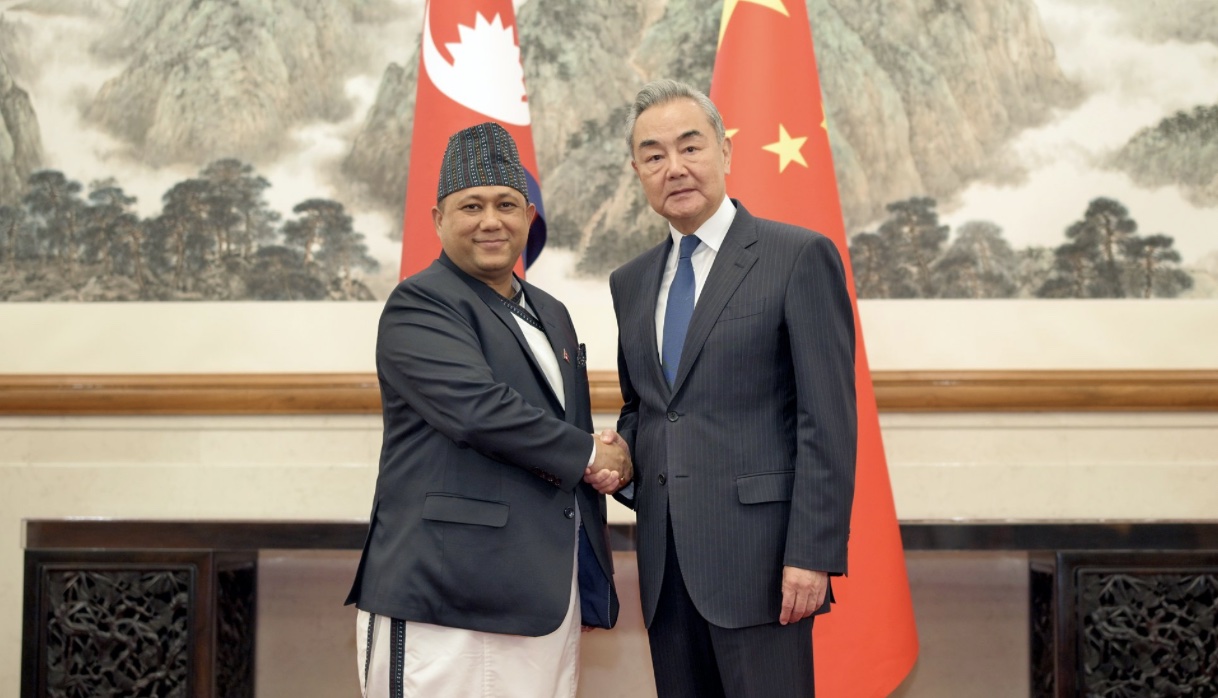
Nepal’s Foreign Minister Shisir Khanal’s visit to China was a carefully coordinated move aimed at Beijing, New Delhi, and Washington and, just as importantly, at the domestic audience.
Khanal’s message to Beijing was clear following his visit to New Delhi. Nepal’s new government is not shifting its stance. Instead, it is navigating the well-known yet increasingly delicate balance between its two influential neighbors.
This was more than a routine diplomatic courtesy call. It marked the Balen Shah government’s first major effort to establish its China policy following the political upheavals of 2025 and the 2026 elections. In that sense, it was successful. Beijing received the message it sought – continuity, stability and a lack of unexpected changes.
Lofty Rhetoric
Behind the comforting words, the visit revealed a less flattering truth. Nepal’s foreign policy is often marked by lofty rhetoric and limited economic achievements.
Khanal’s discussions with Chinese officials, including Foreign Minister Wang Yi, focused on anticipated topics such as investment, connectivity, technology, and tourism. Khanal highlighted Nepal’s aim to cooperate without becoming entangled in great-power rivalry. For its part, Beijing reaffirmed support and expressed continued interest in infrastructure development and regional connectivity.
No major deals were signed during the visit, perhaps intentionally. The trip’s purpose was to reset the tone of the relationship. Both sides were gauging each other’s positions. The ultimate concern is not what was discussed in Beijing but what tangible changes occur on the ground.
Although Nepal’s political leaders frequently mention ‘economic diplomacy’, their success so far has been limited. China is now Nepal’s second-largest trading partner, yet the relationship remains unbalanced. Nepal imports significantly more from China than it exports, and this gap is widening. Even with preferential market access from China, the benefit is minimal if Nepal struggles to produce competitively or to transport goods smoothly across the border.
The story of infrastructure development unfolds similarly, with grand promises but sluggish progress. Projects are delayed by financing disagreements, bureaucratic hurdles, and ongoing uncertainty over whether Nepal prefers loans, grants, or a combination of both. China’s signature Belt and Road Initiative, once promoted as a game-changer, now exemplifies this indecision. Essentially, the issue has shifted from a scarcity of opportunities to a failure to execute.
The Shah government deserves recognition for attempting to redirect attention. Its focus on technology, digital infrastructure and modernization marks a departure from the previous narrow focus on roads and hydropower. This shift is long overdue. For Nepal to genuinely advance, it must move beyond relying solely on slow, large-scale projects.
Tourism and hydropower remain key areas of Nepal’s collaboration with China. However, progress largely depends on Kathmandu’s ability to implement projects, not just Beijing’s willingness. Nepal has repeatedly expressed its intention to become an energy exporter. Yet it remains a nation of potential, lacking execution.
The political dimension is also significant. Beijing’s concern is clear. China favors predictability on a crucial Himalayan frontier. However, Nepal has been unpredictable lately. The country’s new leaders, shifting alliances, and evolving priorities are disrupting Nepal’s core value of stability. Khanal’s visit was partly intended to reassure China that its core foreign policy principles remain unchanged. Whether Beijing truly trusts this remains uncertain.
India inevitably remains a significant third party in the background. Nepal’s geography means that any move toward China is closely scrutinized in New Delhi. Similarly, gestures toward India are monitored in Beijing. This longstanding situation is becoming increasingly difficult to manage as regional rivalry intensifies.
The United States’ growing engagement with Nepal in recent years has unsettled China, especially as the 14th Dalai Lama ages and questions of succession grow more pressing. Beijing is particularly sensitive to the presence of up to 20,000 Tibetan refugees in Nepal. To underscore these concerns, Wang reminded Khanal of the saying, “a good neighbor is better than a distant relative”.
Real Challenge
Although less outspoken about its concerns, India also views increased U.S. involvement in Nepal as a challenge to its traditional influence. In this context, Khanal’s visit was significant. The order of visits – India first, China second – was deliberate. This sequence served as a subtle message that Nepal aims to maintain a neutral diplomatic stance and avoid being seen as siding with any major power.
But symbolism has its limits. The true measure of Nepal’s ‘balanced’ foreign policy is not the sequence of visits but whether the country can secure substantial economic benefits from both relationships without becoming entangled in conflicts. That remains the real challenge.
Khanal’s trip managed to reopen dialogue and restore some trust. But confidence alone does not lead to job creation, reduce trade deficits or complete infrastructure projects. Nepal requires consistent policies, strong institutions, and the political will to implement plans. Until these are in place, high-level visits will continue to grab headlines but will not necessarily garner results.
Disclaimer: The opinions and views expressed in this article/column are those of the author(s) and do not necessarily reflect the views or positions of South Asian Herald.