Join WhatsApp Channel

In an era when most power plants are retired after a few decades of operation, two nuclear reactors commissioned when man had just landed on the moon are preparing to enter yet another decade of service.
The twin reactors of the Tarapur Atomic Power Station (TAPS) in Maharashtra, commissioned in 1969, have received regulatory approval to continue operating for another 10 years, cementing their status as the world’s oldest functioning commercial nuclear power reactors and highlighting India’s growing expertise in extending the life of strategic energy assets.
The approval is more than a technical milestone. It represents a symbolic moment in India’s nuclear journey—from a nation that imported nuclear technology in the 1960s to one that now relies on indigenous engineering capabilities to modernize and sustain complex nuclear infrastructure.
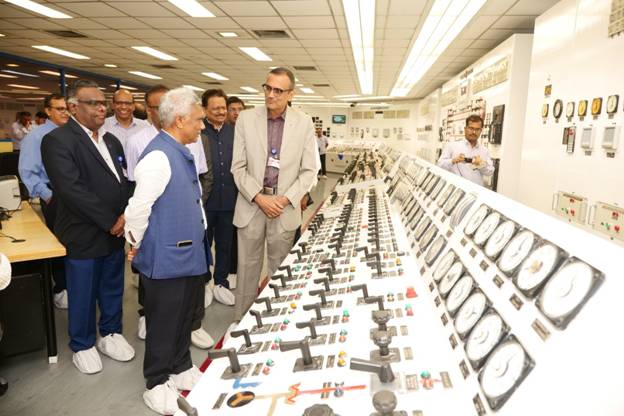
During a visit to Tarapur, Department of Atomic Energy Secretary and Atomic Energy Commission Chairman Dr. Ajit Kumar Mohanty reviewed the life-extension program and praised generations of scientists, engineers and operators who have kept the reactors running safely for more than five decades.
“The continued operation of the world’s oldest running nuclear reactors is a testimony to India’s technological and regulatory maturity,” Mohanty said, describing the extension as a reflection of the country’s march toward technological self-reliance.
The story of Tarapur mirrors the evolution of India’s nuclear sector itself. When the station was commissioned in 1969, it marked the beginning of commercial nuclear power generation in India and became the first nuclear power station in Asia outside the Soviet bloc. At the time, the country depended heavily on foreign technology and expertise. Today, the reactors are being sustained through indigenous inspection systems, advanced engineering solutions and home-grown modernization programs.
The latest life-extension effort involved extensive inspection and refurbishment of critical equipment, replacement of ageing components, modernization of electrical systems and deployment of advanced indigenous technologies to assess reactor integrity. Officials say the project was executed under strict regulatory oversight and a “zero harm” philosophy.
For India’s energy planners, the significance extends beyond preserving a historic facility. Nuclear energy is expected to play an increasingly important role in meeting the country’s rapidly rising electricity demand while supporting its climate commitments. Unlike solar and wind power, nuclear plants provide round-the-clock baseload electricity without direct carbon emissions.
According to the Nuclear Power Corporation of India Ltd. (NPCIL), TAPS Units 1 and 2 have generated more than 100 billion units of electricity since their commissioning. The utility estimates that this output has helped avoid more than 86 million tons of carbon dioxide-equivalent emissions while strengthening national energy security.
The decision to extend the reactors’ operating life also comes at a time when India is pursuing ambitious plans to expand its nuclear generation capacity. Policymakers increasingly view nuclear power as an essential pillar of a diversified clean-energy mix, particularly as the country seeks to balance economic growth with decarbonization goals.
Industry experts note that extending the life of existing reactors is often significantly cheaper and faster than building entirely new facilities. Around the world, several countries have opted to extend the operating lives of ageing reactors to preserve low-carbon generation capacity and reduce dependence on fossil fuels.
Tarapur’s experience could therefore provide valuable lessons for the management of India’s future reactor fleet. The station has become a test bed for ageing-management practices, component replacement strategies and safety upgrades that could be replicated elsewhere in the country.
During the visit, Mohanty also inaugurated a Primary Coolant Pump Test Facility, a move that officials said would strengthen maintenance and testing capabilities at the site.
For many in India’s nuclear establishment, however, Tarapur represents something larger than an engineering achievement. It is a living reminder of a scientific vision that began more than half a century ago and continues to evolve.
As India advances toward its long-term goal of becoming a developed economy, the continued operation of Tarapur’s pioneering reactors underscores a broader message: that old infrastructure, when supported by modern technology, rigorous safety standards and continuous innovation, can remain relevant in a rapidly changing energy landscape.
The next decade of operation for TAPS 1 and 2 will not merely extend the life of two reactors. It will extend the legacy of India’s first nuclear power station while helping power the country’s transition toward a cleaner and more energy-secure future.