Join WhatsApp Channel

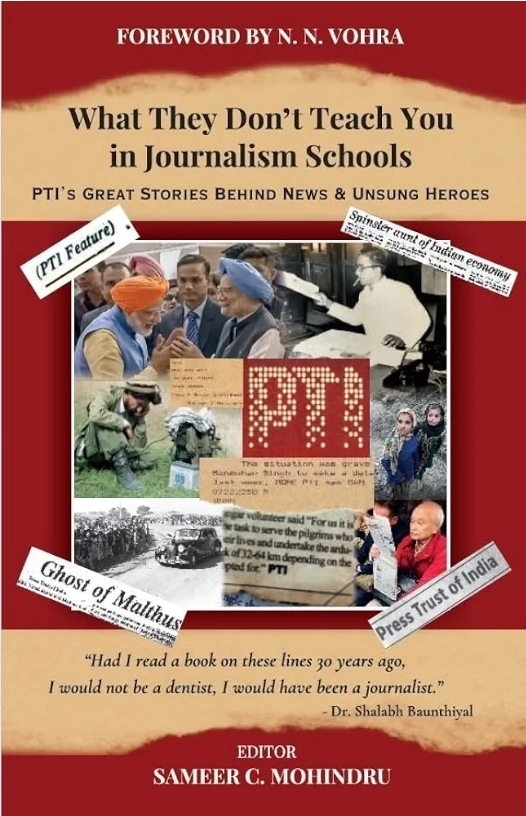
For readers who encountered PTI copy in “India Abroad” or “India West” during the 1990s, Sameer Mohindru’s “What They Don’t Teach You In Journalism Schools” offers a rare glimpse behind the bylines. The book is not a manual for journalism students. It is an insider’s account of India’s oldest news agency, told through anecdotes, operational challenges, and the disciplined craft that rarely features in academic curricula.
To much of the Indian diaspora, “PTI” is a line of attribution preceding a news item. Mohindru explains the mechanism behind it: how a report from Srinagar reaches a community publication in Edison, New Jersey, within minutes; why features on unsung individuals are filed in the early hours; and how reporters reconcile speed with accuracy when serving one of the world’s largest diaspora audiences. The book underscores that wire copy remains the primary source for much of the homeland news consumed abroad.
While journalism schools focus on the inverted pyramid and codes of ethics, Mohindru documents the realities of deadline pressure, unresponsive sources, and reporting from volatile situations with minimal resources. The narrative reinforces a view held by many veteran journalists: that sustained newsroom experience is an indispensable complement to formal training. For diaspora readers unlikely to work in a Delhi newsroom, the book provides an accessible substitute.
The subtitle -Unsung Heroes- is apt. Mohindru profiles desk editors, translators, and stringers from smaller towns whose reporting shapes international perceptions of India. For readers frustrated by external coverage of the subcontinent, the book clarifies why PTI’s output often differs: it is produced by journalists embedded in the context, rather than by correspondents filing on assignment.
News alerts on community radio, social media forwards on ISRO missions, and syndicated reports in Indian diaspora outlets often originate as PTI copy. Understanding this workflow equips readers to assess the provenance of information and to distinguish credible reporting from misinformation circulating overseas.
The book occupies a middle ground between those who advocate for learning exclusively in newsrooms and those who emphasize formal instruction. Mohindru demonstrates that professional instinct and mentorship are complementary. For diaspora families evaluating journalism programs, the text illustrates what structured courses cannot replicate: reporting under pressure during a crisis or covering an unscheduled press conference.
Recurring themes include patience, discipline, and adherence to constitutional norms—attributes less frequently addressed in classrooms. For diaspora communities navigating questions of identity, the book presents a model of professional conduct: verify facts, protect sources, and meet deadlines.
Beyond its focus on journalists, the book acknowledges the technical and administrative staff who modernized PTI’s operations. Engineers, transmission operators, and support personnel, working under leaders such as Yogendra Upadhye, P. Unnikrishnan, and Gourang Kundapur, contributed to the agency’s transition to digital workflows. Several later moved into editorial roles. Their inclusion broadens the scope of the narrative and honors those who sustained the agency’s mandate to “bring the world to you.”
The book’s PTI-centric focus means it does not address digital-native workflows such as short-form video or platform-specific distribution. Readers seeking guidance on building independent digital news operations will need supplementary resources. Additionally, the text assumes familiarity with Indian politics and institutions, which may limit accessibility for first-generation readers unfamiliar with the context. A glossary would have improved its utility for audiences in the U.S. and the U.K.
Read this if you wish to understand the origins and standards of the India news you consume abroad. The book is a suitable gift for diaspora students considering journalism, particularly those whose conception of the field is shaped by social media.
Available through online retailers, it represents a modest investment. Its larger value lies in an implicit argument: wire service journalism remains a component of India’s soft power. For the diaspora, understanding how that system functions is essential to interpreting the news it produces.