Join WhatsApp Channel

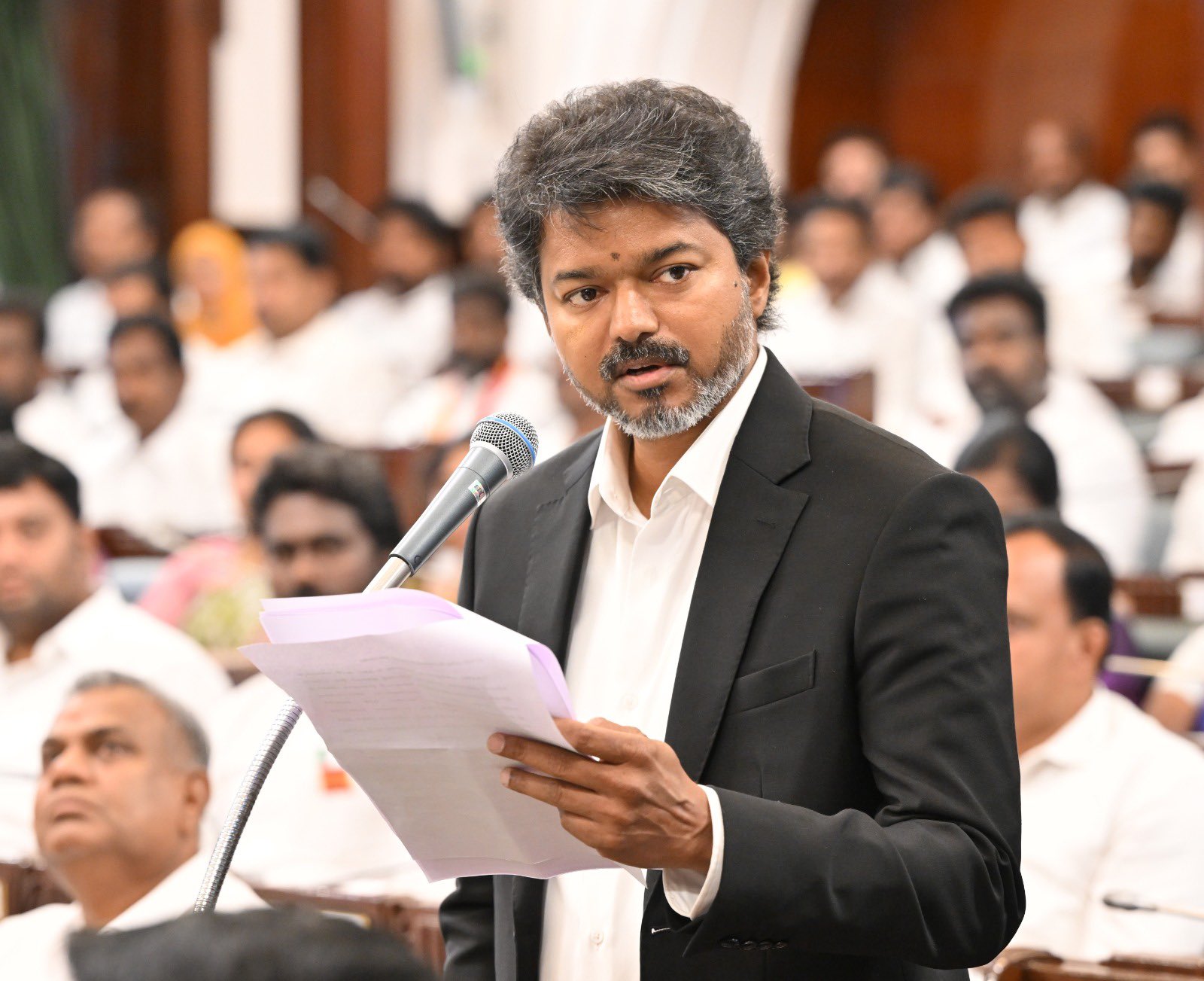
When C. Joseph Vijay told the Assembly “This is not a minority government — it is a government for the minorities,” he was doing something Tamil Nadu had not seen in half a century: a complete outsider reshaping the grammar of power from within it.
By the time Speaker J.C.D. Prabhakar called the division on the trust vote in the Tamil Nadu Legislative Assembly on Wednesday — 144 ayes, 22 noes, 61 walkouts led by Udhayanidhi Stalin — the numbers had already told their story before the ink dried on any tally sheet. Vijay’s Tamilaga Vettri Kazhagam (TVK), which did not exist two years ago, had survived its first great constitutional test with a margin that left the room stunned. But the more important story was not in the arithmetic. It was in the language.
“This government will function with the speed of a horse and will not indulge in horse-trading,” Vijay told the Assembly, deploying one of the better puns heard in that chamber in years — a pointed needle aimed at the rebel AIADMK bloc that had just defied their party whip to keep him in office. He had earlier, in his swearing-in address, stripped back every layer of cinematic grandeur: “I do not hail from any royal lineage. I am like you — one among your family, one of your sons.” He had promised, bluntly and unusually for a politician, to “only promise what is possible.” He had accused the outgoing DMK government of leaving behind a depleted treasury, and announced a white paper on state finances.
The pitch was deliberate. Vijay had spent eighteen months as TVK president doing something no Tamil Nadu political leader had tried in this particular way: running not against the political class, but against the very idea of the political class. “No one can halt the rise of my people,” he had told thousands at TVK’s first general body meeting in March 2025. “When the right time and place align, even the impossible becomes possible.” The rhetoric was Periyarite in its egalitarianism, evangelical in its certainty, and entirely cinematic in its cadence.
Tamil Nadu has seen this grammar before. But never quite in this combination. And never from someone who had just won an election for the first time.
The Sentences That Changed Everything
To understand how radical Vijay’s ascent is, you need to read it against the inaugural moments of those who came before him — the speeches that announced not just new governments, but new Tamil Nadus.
When C.N. Annadurai swept to power in 1967, ending Congress dominance in one of the most consequential regional elections in Indian history, he articulated a founding principle that would define Dravidian politics for six decades: “A leader should be a servant to the people, not their master.” It was Annadurai who renamed Madras State to Tamil Nadu, who gave Self-Respect marriages legal standing, who turned Tamil identity into a governing ideology rather than a cultural sentiment. His government was the first non-Congress majority in any major Indian state. He died of cancer just two years into office, but the structure he built — language, land, social justice, anti-Brahmin egalitarianism as the moral scaffolding of governance — outlasted him by fifty years.
Karunanidhi, who succeeded him in 1969, was no less acutely aware of what the moment demanded. Famously, he took office describing the Chief Ministership as a “Crown of Thorns” — acknowledging, at the very moment of triumph, the weight of the job rather than its glory. He later crafted a political slogan that revealed his diplomatic instincts for managing New Delhi: “Uravukku Kai Koduppom, Urimaikku Kural Koduppom” — “Let us give our hands to relationship and raise our voice for our rights.” It was the grammar of a Tamil leader who understood that confronting the Centre required first disarming it. Five terms, five decades, and a library of screenplays later, Kalaignar remained perhaps the most intellectually formidable Chief Minister Tamil Nadu has had — a man who used literature, film and rhetoric in one integrated political project.
MGR broke from Karunanidhi’s DMK in 1972, founded the AIADMK, and arrived at the Chief Minister’s chair in 1977 on a wave of fandom so intense it has never been replicated in Indian political history — until, arguably, now. His early speeches as Chief Minister did not dwell on ideology or administrative architecture. They were built around something more primal: the poor were his people, and the government existed to visibly protect them. The noon meal scheme he expanded became the most enduring welfare programme in Tamil Nadu’s history, not because it was the most expensive, but because it was the most felt. MGR understood that political loyalty at the bottom of the pyramid is built not through argument but through the body — through being fed, housed, seen.
Jayalalithaa entered power in 1991 carrying the mantle of MGR’s legacy and the fury of someone who had been publicly humiliated in the Assembly chamber a year before. Her inaugural message was forged from a different metal: “I will always be there with you, working for your welfare. Your welfare is my only aim.” But alongside that warmth was something colder and more commanding: “I don’t want to be the Chief Minister of Tamil Nadu. I am the Chief Minister of Tamil Nadu.” — a distinction she meant with total seriousness. Where Annadurai had been literary, Karunanidhi intellectual, and MGR emotional, Jayalalithaa was imperial. The “Amma” ecosystem she built — Amma canteens, Amma water, Amma pharmacies — fused welfare with political branding in a way that had never been done so systematically. Her motto, as her AIADMK colleagues recalled after her death, was “Makkalaal Naan, Makkalukkaaga Naan” — “I am by the people and for the people.” She wore it as both a shield and a sovereign seal.
MK Stalin came to power in May 2021 in the shadow of COVID and the long aftermath of Jayalalithaa’s death, which had left Tamil Nadu politically adrift for five years. He did something deliberate and slightly counter-intuitive for the son of Karunanidhi: he described himself not as a Chief Minister but as a “frontline worker.” He wanted to signal modesty, bureaucratic seriousness, a rejection of personality cult. His swearing-in — where he introduced himself as “Muthuvel Karunanidhi Stalin,” reclaiming his father’s name from years of opposition mockery — was freighted with filial emotion. But his governance vocabulary was technocratic: economic advisory councils with Raghuram Rajan and Esther Duflo; real-time governance dashboards; investment summits; a relentless push on cooperative federalism. He ran Tamil Nadu less like a Dravidian patriarch and more like a focused CEO who happened to believe in social justice.
The New Register
Vijay’s voice in the Assembly on Wednesday was calibrated to carry all of these echoes without being trapped by any of them.
Like Annadurai, he positioned himself as a servant, not a ruler — the son of an ordinary assistant film director, he was at pains to say, who “knows what poverty and hunger feel like.” Like MGR, he reached for the emotional register of ordinary people before the administrative one. Like Jayalalithaa — and this is the comparison his detractors will most resist — he is building a near-cult personal following in which the leader and the movement are essentially the same entity. “There is only one center here, the center under my leadership,” he declared at his swearing-in, in language that would not have sounded out of place from Amma herself. Like Stalin, he faces a state deeply embedded in global manufacturing chains, sensitive investment flows, and a fiscal reality that cannot be wished away with populist rhetoric.
What he said about the DMK’s financial legacy — that they had “emptied the treasury” and left behind a debt of Rs 10 lakh crore — provoked an immediate counter-attack from Stalin on X. “Don’t start saying right away that the government has no money,” Stalin shot back. “What’s needed is the will to give it to the people, and the ability to govern.” The exchange was revealing: Vijay blaming the predecessor to manage public expectations, and Stalin — now in opposition for the first time since 2021 — refusing to let him own the narrative unchallenged.
The drama of the trust vote itself had a cinematic texture that even screenwriters might have hesitated to draft. Udhayanidhi Stalin, leading the DMK walkout, told the House that the AIADMK split revealed the moral cost of Vijay’s arithmetic: “The Chief Minister rushed to meet the rebel MLAs even before they had officially quit the party. This is not a change; it is an exchange.” It was the sharpest line of the session — and the DMK’s strategic gift to itself. By walking out rather than voting against, the party preserved its dignity, avoided humiliating defeat on the floor, and positioned itself as a responsible opposition that would “not create hurdles” while waiting for Vijay to stumble under the weight of his own promises.
The Geometry of Survival
The numbers that delivered Vijay his victory contain within them the seeds of his future vulnerability. The rebel AIADMK bloc — around 25 to 30 legislators aligned with SP Velumani and C Ve Shanmugam, who defied party chief Edappadi K. Palaniswami’s orders — are now Vijay’s most powerful and most dangerous friends. One AIADMK rebel declared from the floor: “I supported this government yesterday, I support it today, and I will continue to for five years.” But rebel legislators across Tamil Nadu’s history have never been unconditional loyalists. They expect accommodation: cabinet positions, district influence, personal patronage. Managing them without alienating his Congress, CPI(M) and VCK allies — who come with their own ideological expectations — will require a political dexterity that cinema has not necessarily trained him for.
Then there is the fiscal mathematics that no amount of emotional capital can defer indefinitely. Tamil Nadu carries one of the heaviest debt burdens among Indian states. Vijay’s TVK went into the election with an expansive welfare manifesto: enhanced financial assistance for women, subsidized LPG cylinders, education loans up to Rs 25 lakh, MSP-like protections for fish varieties, relief during fishing ban periods, expanded housing support. Every major Tamil Nadu Chief Minister since MGR has discovered the same iron law: populism wins elections; budgets end careers. Jayalalithaa managed it through sheer force of authority. Stalin managed it through institutional discipline and creative fiscal negotiation with the Centre.
Vijay’s relationship with New Delhi will be the defining external tension of his term. He campaigned against the BJP as an ideological adversary, describing it as a party that “cannot win in this state with any alliance” and warning Modi to “handle Tamil Nadu with care.” But Tamil Nadu’s infrastructure ambitions — multiple phases of Chennai Metro, semiconductor-linked industrial investments, logistics corridors, port modernization along the southern coast — run directly through central government clearances and funding partnerships. Stalin, for all his sharp federalist rhetoric, managed to simultaneously oppose Modi politically while cooperating pragmatically on investment summits and industrial corridor negotiations. Vijay’s post-victory messaging — focused on state rights and welfare rather than aggressive federal conflict — suggests he may have already absorbed this lesson.
The Open Scene
Tamil Nadu has a tradition of political personalities who were larger than their parties. Annadurai was this. MGR became this. Jayalalithaa refined it into an art form. Vijay is the most extreme version of it yet — a man whose “party” is, in many ways, a fandom infrastructure that converted itself into a political organization in under two years. His first election produced 108 seats. His first trust vote produced 144. His first speech as Chief Minister produced a sentence that every political journalist in the state will be parsing for months: “This is not a minority government — it is a government for the minorities.”
The DMK walked out. The AIADMK split. The Congress became a kingmaker again after decades in the wilderness. And in the Assembly chamber, a man who spent thirty years playing heroes on screen sat down as Chief Minister of the sixth-largest state economy in India.
For Annadurai, the transforming sentence was about Tamil identity. For MGR, it was about feeding the hungry child. For Jayalalithaa, it was about sovereign authority. For Stalin, it was about the frontline worker. Vijay’s sentence, on Wednesday, was about belonging: “I am like you. I am one among your family.”
Whether that is enough — whether belonging can be translated into governance, whether fandom can be administered, whether cinema can survive contact with the budget — is the question that the next five years will answer, one Cabinet meeting, one welfare transfer, and one Assembly session at a time.
The opening scene has been shot. The film is only beginning.
The trust vote tally — 144 in favor, 22 against — is the same number of seats MGR won when he first swept to power in 1977. Whether that symmetry is coincidence or portent, Tamil Nadu’s new Chief Minister would be wise not to read too much into it. MGR spent a decade building his majority. Vijay has just secured his first week.
Disclaimer: The opinions and views expressed in this article/column are those of the author(s) and do not necessarily reflect the views or positions of South Asian Herald.