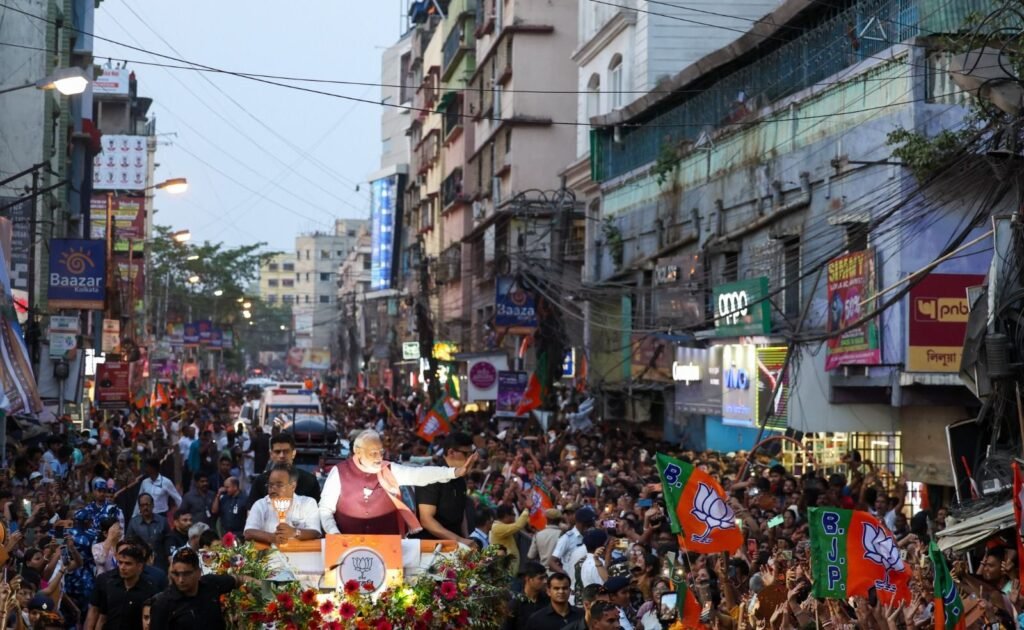
This is not just an electoral victory. In this defining moment, it is a civilizational shift, a turning of the tide, a reclamation long awaited.
West Bengal shall now rise once again and reclaim the glory it was denied for decades by cynical, power-hungry politics. What unfolds from this moment is not merely a change in government, but the dawn of a New Bengal, one that firmly rejects crime, corruption, and communalism, and steps confidently into India’s larger march toward development and growth. From infrastructure to industry, from health to education, from farms to factories and above all, in ensuring safety, security, and dignity for women, Bengal is poised for rapid, tangible transformation.
But beyond policy and progress, this victory marks something deeper, the beginning of healing. The soul of Bengal, bruised and diminished by years of corrosive politics, begins its restoration. This is a land that once nurtured the very idea of Indian nationalism. It was in Bengal’s fertile soil and flowing rivers that Bankim Chandra Chattopadhyay found his inspiration and gave us Vande Matara, the immortal ode to Bharat Mata. It was Bengal’s splendor that moved Rabindranath Tagore to compose Jana Gana Mana, the Morning Song of India.
It is here that the idea of Bharat Mata first took shape, first in the 1873 play Bharat Mata by Kiran Chandra Banerjee, and later immortalized in the evocative painting by Abanindranath Tagore in the early 20th century.
Advertisement
And then came the profound articulation of nationalism by Sri Aurobindo in his historic Uttarpara Speech, a moment that transformed political thought into spiritual conviction. His words continue to echo across time:
“Nationalism is not politics but a religion, a creed, a faith… it is the Sanatan Dharma which for us is nationalism…”
This philosophical foundation is not abstract; it is deeply rooted in Bengal’s lived history. This is the land of reformers and revolutionaries, saints and scientists. Ishwar Chandra Vidyasagar once led pioneering legislative efforts to protect women, a legacy that must now be reclaimed as Bengal confronts the erosion of women’s dignity in recent times.
This is the land of spiritual giants like Ramakrishna Paramahansa and Swami Vivekananda, whose vision transcended boundaries. It is the land that gave us scientific minds such as Jagadish Chandra Bose, Prafulla Chandra Ray, Satyendra Nath Bose of Bose–Einstein fame, Meghnad Saha, and Upendranath Brahmachari, who discovered the cure for Kala-azar.
And it is the land of sacrifice, of revolutionaries who laid down their lives for India’s freedom: Khudiram Bose, Surya Sen (Master Da), Pritilata Waddedar, Binoy Basu, Badal Gupta, Dinesh Gupta, Bagha Jatin, a lineage of courage that is endless and unmatched.
With the BJP’s victory, West Bengal witnesses a profound homecoming. Because this is also the land of Syama Prasad Mookerjee, one of India’s tallest nationalist leaders. He ensured that Bengali Hindus retained their rightful place during Partition and stood firm during the horrors unleashed since Direct Action Day. As the founder of the Bharatiya Jana Sangh, the ideological forerunner of the BJP, he gave the nation a rallying call that still resonates: One Nation, One Flag, One Prime Minister.
This victory is also the revival of Bengal’s deep-rooted civilizational and spiritual traditions. Bengal has time and again led revivalist movements within Hinduism. Even reformist currents that emerged here drew deeply from the Vedic and Upanishadic foundations of Sanatana Dharma. Bankim’s Anandamath must be understood in the context of the Sanyasi Rebellion, a movement that stirred Hindu consciousness. Vande Mataram, born from that work, became the very mantra of Indian nationalism.
In 1892, Chandranath Basu authored Hindutva, the first formal articulation of the idea of Hindutva. In 1905, Abanindranath Tagore’s Bharat Mata gave a visual soul to the nation.
Bengal also gave rise to cultural and spiritual movements that strengthened Hindu identity, the Hindu Mela, akin in spirit to Ganesh Chaturthi celebrations elsewhere; the Bhakti movement as carried forward by Chaitanya Mahaprabhu; and the spiritual renaissance ushered in by Rani Rashmoni through the Dakshineswar temple, where Ramakrishna Paramahansa served.
From there emerged Swami Vivekananda’s global vision, institutionalized through the Ramakrishna Mission and its headquarters at Belur Math.
That continuum extended into the modern era when A. C. Bhaktivedanta Swami Prabhupada established the International Society for Krishna Consciousness in 1965, rooted in Mayapur, taking Bengal’s spiritual legacy to the world.
That tradition lives on and today, it finds renewed political expression.
This moment marks the return of hope. It liberates Bengal and its people from the grip of fear, lawlessness, and decay. It promises transparent and responsible leadership, encourages people’s participation, and seeks to unleash the aspirations of millions.
Together, West Bengal will rise again, not just as a state, but as an idea. A beacon. A force.
This is not the end of a journey, it is the beginning of Bengal’s renaissance. And this time, its rise will be enduring.
Disclaimer: The opinions and views expressed in this article/column are those of the author(s) and do not necessarily reflect the views or positions of South Asian Herald.