 Join WhatsApp Channel

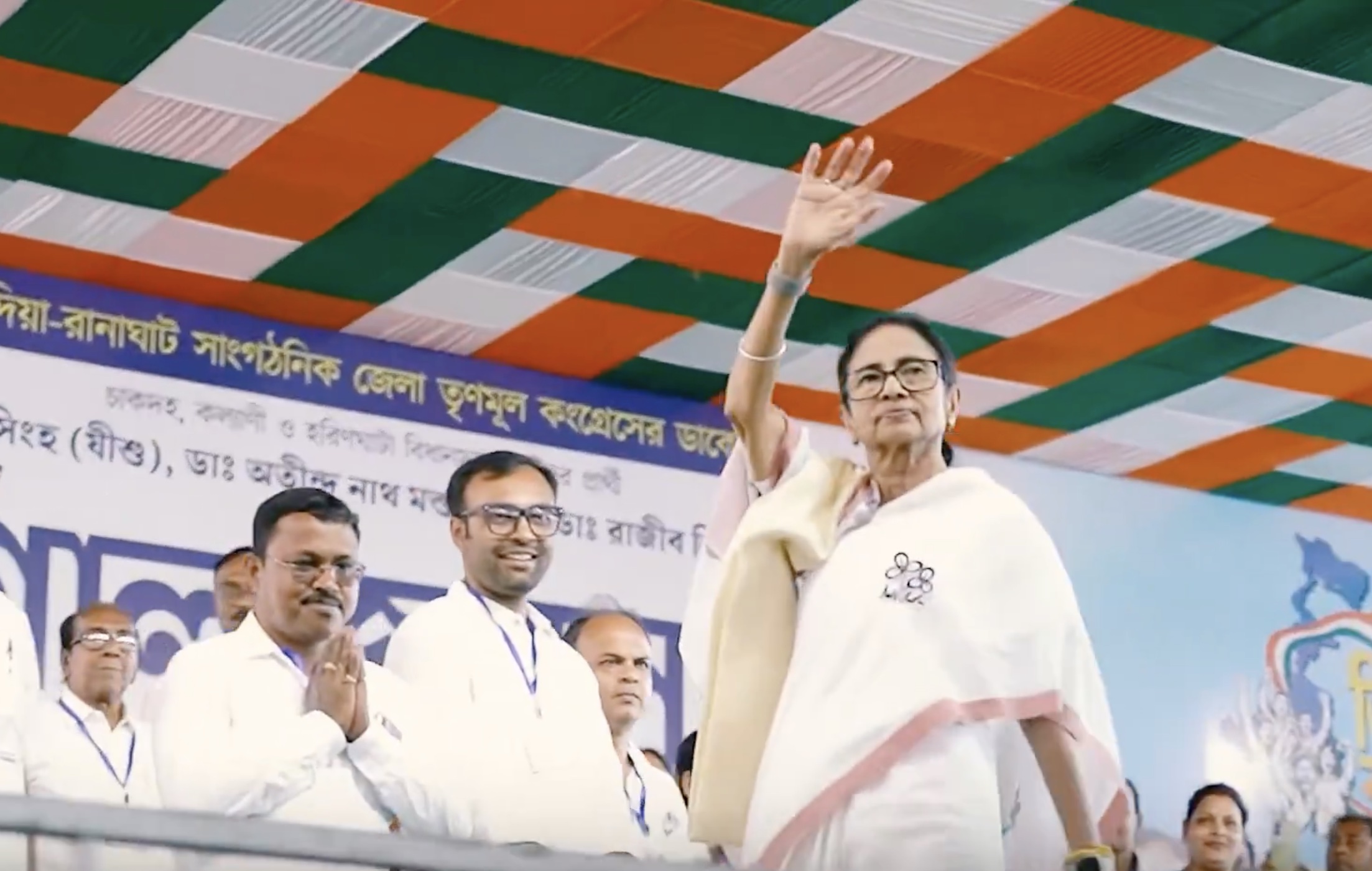
As Bengal celebrates ‘Poila Baisakh,’ the first day of the Bengali calendar, a vibrant expression of the culture of this riverine land, electoral battle lines are hardening over that very sense of ‘Bangaliana’ (Bengali-ness) that its people, regardless of their mother tongue, hold dear.
Huge hoardings with Trinamool party leader and state Chief Minister Mamata Banerjee smiling with folded hands with the tagline ‘Bangla nijer meyekei chay’ (Bengal wants its own daughter) stare down at travelers driving through state highways which criss-cross the ever-green rural landscape leading to Kolkata, while TMC’s pop up ads on social media speak of “Abar jitbe Bangla” (Bengal will win once again).
Crowds roar ‘Joi Bangla’ at rallies being held by Chief Minister Banerjee in Medinipur district, 125 kms to the southwest of Kolkata, while Banerjee speaks of “Bangali Asmita” and talks of “ora” (those others or outsiders) attacking Bengal’s culture.
This is part of the ruling TMC’s answer to BJP’s campaign stressing that a double engine government will bring change and development to a state which once boasted of being the richest in India or focussing on Enforcement Directorate raids on TMC leaders.
While some dismiss the Trinamool theme as “gimmickry,” it strikes a chord with many others who feel it articulates the fears of middle-class Bengalis that their numbers, language and culture may be under threat from a fresh influx of migrants or by “outsiders” who seek to control the state.
“There is a feeling that Bengal is being treated as a subaltern state in a colonial sense,” Jawhar Sircar, former Culture Secretary and Rajya Sabha MP, told UNI in an interview.
Kolkata has long prided itself on its centuries-old cosmopolitan character, home to vibrant communities speaking Hindi, Marwari, Gujarati, Tamil, Malayalam, Urdu, and even Chinese, as have most of Bengal’s river-port cities, ranging from Berhampore in the north to Chandanagar in the South.
Though an overwhelming 86 per cent of people in West Bengal speak Bengali, most of those who migrated to Bengal in search of jobs or businesses over the centuries have integrated well into Bengal’s society and feel they are part of the ‘Bangaliana’ that Bengalis flaunt on occasions such as ‘Poila Boisakh’ or Durga Puja.
Yet, the subdued language politics that flickered in the 1960s before fading out by the 1980s have resurfaced in recent years, finding new expression through groups such as ‘Bangla Pokkho’ (For Bengal), which have gained visibility on social media demanding that the Bengali language and culture be given pride of place.
“There is a cultural gap in the way BJP has approached Bengal from overlooking the state which gave them 18 Lok Sabha MPs while naming cabinet ministers to mispronouncing names of its cultural icons. And Mamata Banerjee, for all her drawbacks is taking full advantage of that,” said Sirkar, who quit the TMC and politics two years back.
The TMC’s subtle culture-based campaign has struck a chord somewhere. Samarendra Nath Mukherjee, 85, a Kolkata-based retired corporate executive, told UNI “Eta rajnitik lorai noy. Eta Bangalir Asittor Lorai (This is not a political battle, this is a battle for Bengalis existence,” while an appreciative crowd of middle aged and old men and women nodded their head at a tea shop near the Kalighat temple.
Some 108 kms away at Sajnekhali in the Sunderbans, Ashish Haldar, a fish whole-seller echoed a similar unease. “Ora amader upor dokhol nite chai (They (outsiders) want to take control of the state).” Much of Bengal’s trading and financial business has already passed away from the traditional Seth, Basack and Chanda mercantile families to traders from Rajasthan, Gujarat and North India, claimed Haldar.
As a counter BJP is stressing on the corruption cases and scandals which have been dogging the ruling TMC for the last few years. BJP’s candidate from the posh Ballygunge constituency in Kolkata, Dr Shatorupa, who does not use a surname by choice, told UNI, “Mamata Banerjee is clutching at straws to try to save a party which is in trouble because of the long list of corruption charges against it. Their ‘Bangaliana’ is a false narrative designed to divert the common man’s attention.”
Three days ago the Enforcement Directorate raided the home of former Bengal education minister Partha Chatterjee, while on Monday the agency also arrested Vinesh Chandel, founder of I-PAC, which consults TMC on political campaign strategy in connection with suspected money laundering linked to an alleged coal scam.
Shatorupa, a product of the elite Loreto House school, Calcutta University and the BHU, pointed out that Jan Sangh, BJP’s predecessor party was formed by Syama Prasad Mookerjee, “who was steeped in Bengali culture” as are all its candidates from the state. “Outsiders can’t rule the state. If we win, it will be from among us Bengalis who will form the cabinet,” she argued.
However, as the city went about enjoying its Bengali New Year holiday by shopping at New Market and Gariahat shopping arcades and dining out at clubs and restaurants boasting of Bengali dishes from Hilsa in mustard sauce to mutton biryanis, TMC remained hard at work with its ‘Bangaliana’ campaign.
TMC leader Debasish Kumar told UNI, “The fight in this election is no longer being seen as one between the BJP and the Trinamool. It is increasingly being perceived as a battle over control of Bengal by outsiders.” (UNI)
Related posts:
 Indian State Elections: A Republic at the Polls, Two Very Different Battles
 Opinion: Regional Cinema Cannot Thrive Through Coercion and Quotas
 The Gulf in the Ballot Box: How a Distant War Is Reshaping India’s Five-State Election
 Indian PM Modi’s BJP Hopes to Tighten Control of the Upper House of Parliament
