 Join WhatsApp Channel

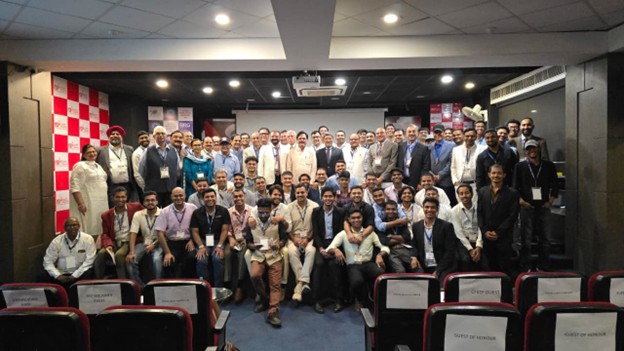
The idea sounded simple enough — get former Sainik School cadets in one room and see what comes of it. What unfolded instead was a gathering that hinted at something more ambitious: a coordinated national alumni network with a role extending well beyond nostalgia.
At the All India Sainik Schools Alumni Meet 2026 held in the capital, over 150 alumni — from decorated military officers to civil servants, entrepreneurs and media professionals — came together to revive an old instinct: collective identity forged in uniform, even if many no longer wear one.
The tone of the meeting was less ceremonial, more purposeful.
“This cannot just be about reunions,” one organizer remarked on the sidelines. “The question is — what can this network actually do?”
That question shaped much of the discussion through the day.
The initiative itself has been quietly in the works for years. It traces back to 2018, when Santosh Kumar, a Merchant Navy officer and alumnus of Sainik School Tilaiya, began informally reaching out to fellow alumni across batches and states. The effort gathered momentum more recently, with entrepreneur Kumar Basant Singh stepping in to formalize the platform and organize the Delhi meet.
The turnout reflected the breadth of the Sainik School ecosystem — one that has steadily fed not just the armed forces but also bureaucracy, policing, corporate leadership and academia.
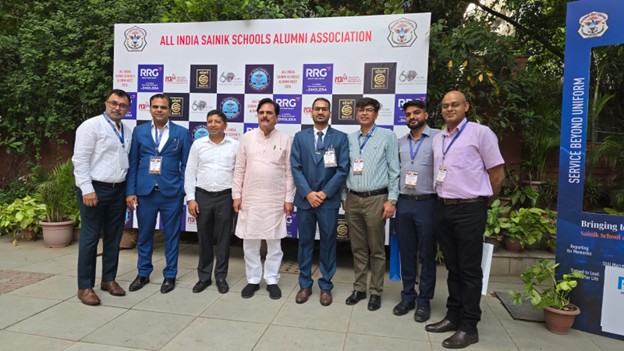
Former Gujarat minister and Sainik School Balachadi alumnus Naresh Gangaram Raval, the chief guest, struck a reflective note, recalling a time when alumni networks functioned on handwritten letters.
“Today you have instant communication. In our time, even sending a postcard required thought — and money,” he said, drawing a contrast that underscored how far the network could now expand.
But Raval’s remarks also carried a subtext — that access to such institutions has long been seen as an advantage. He recounted a conversation from his early political years with Narendra Modi, who had expressed a desire to study at a Sainik School but never had the opportunity.
“It stays with you,” Raval said, suggesting that the schools still carry a certain prestige, and perhaps, exclusivity.
That legacy — of discipline, hierarchy and camaraderie — was repeatedly invoked, but not uncritically. Several speakers argued that the alumni network must evolve beyond its traditional military pipeline.
Dr Ashok Dalwai, former Union Secretary, pushed for structured mentorship, especially for students who do not join the armed forces — an increasingly common trajectory.
“There is a gap after school. Alumni can fill that gap,” he said.
The conversations reflected that shift. Panels moved quickly from reminiscences to practical concerns: career pathways, internships, startup funding, and even political engagement.
Among those present were former Delhi Police Commissioner Neeraj Kumar, Air Marshal Anil Chopra (Retd.), BSF DIG Sanjay Kumar and media executive Ashish Sinha — a cross-section that illustrated how far Sainik School graduates have spread across professions.
Yet, for all the talk of scale, the network remains largely informal.
That may be about to change.
A proposal to establish the All India Sainik Schools Alumni Association (AISSAA) was put forward at the meet, outlining plans for a national directory, mentorship programmes, scholarships and support systems for defense aspirants. There was also talk of leveraging the network for entrepreneurship and policy influence — an idea that drew both interest and caution.
“Structure is good,” said one senior alumnus. “But it must not become another bureaucratic body.”
Messages from senior military leadership — including the Army and Navy chiefs — lent weight to the initiative, though their tone remained broadly encouraging rather than directive.
India today has more than 30 Sainik Schools and an alumni base estimated at over 150,000. For decades, their influence has been visible but scattered. The Delhi meet suggested a shift — toward consolidation.
Whether that translates into a lasting institution remains to be seen.
For now, the mood was one of cautious optimism — and a recognition that identity alone is no longer enough. As one participant put it, “The brotherhood exists. The challenge is to make it relevant.”
Related posts:
 Loyola College’s 100th Anniversary Brings Global Alumni Together in Dallas, Texas
 Loyola USA Alumni Association to Celebrate 100 Years of Loyola College with National Summit in Dallas
 Loyola Alumni Mark Centenary in Dallas with Powerful Calls for Philanthropy, Leadership, and Global Impact
 CUNY Announces 2025 “50 Under 50” Alumni Honorees Celebrating Alumni Shaping New York and Beyond
