Join WhatsApp Channel

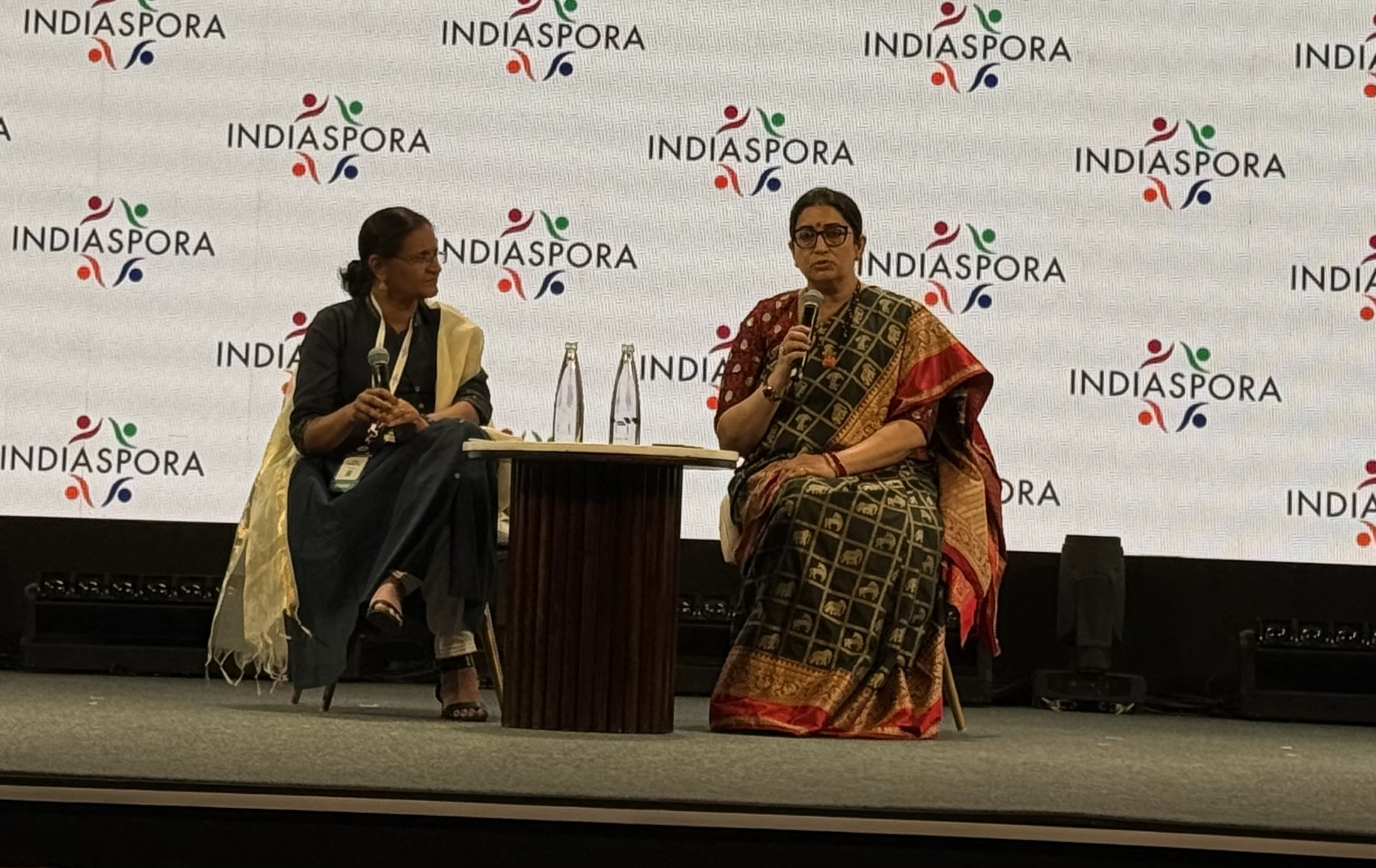
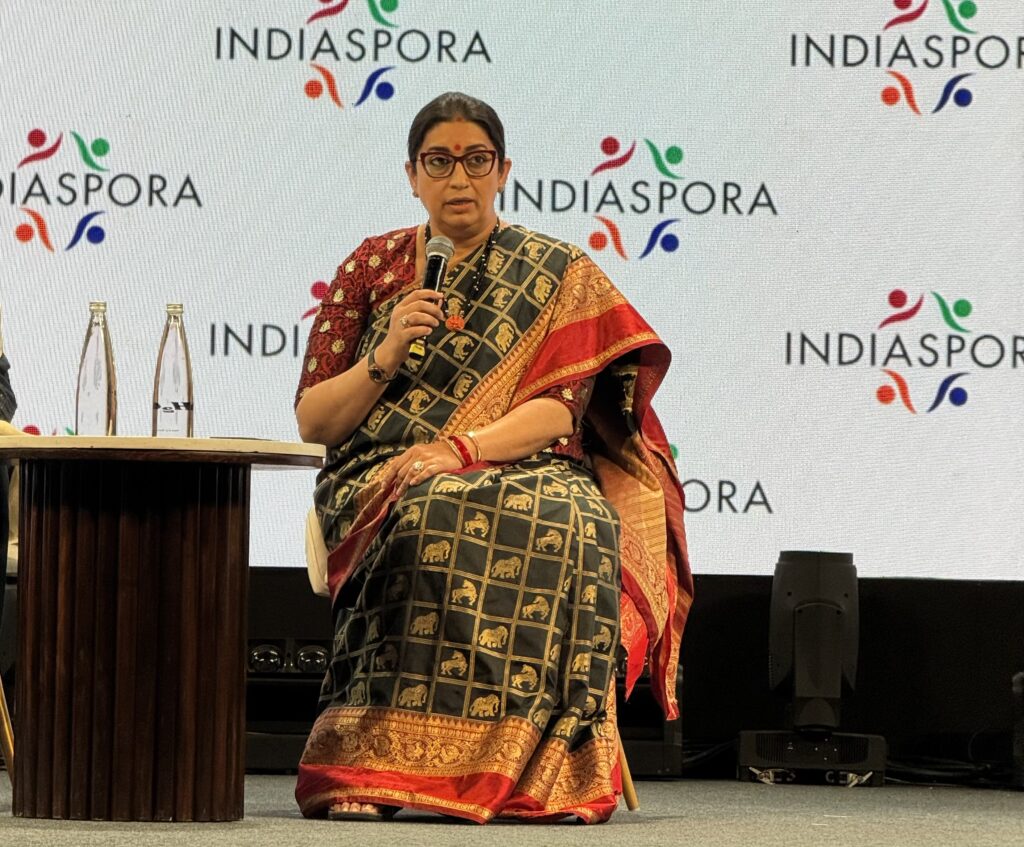
Former Union Minister of India, Smriti Irani, has called on members of the global Indian diaspora to invest in small businesses in India, highlighting their critical role in driving innovation, economic growth, and inclusive development.
Irani made these remarks during an evening plenary conversation with Indiaspora’s Executive Vice President and Chief Community Engagement Officer, Shoba Vishwanathan, on March 24, 2026, at the Indiaspora Forum 2026 held at the JW Marriott Hotel and Convention Centre in Bengaluru.
Addressing the diaspora, Irani said, “I know many of you went for greater prospects overseas. I know geopolitically, things are right now so surcharged that as a politician, I would not like the diaspora be in anybody’s firing line,” adding “So the only thing that I would hope that you can do, is help as many Indians as possible in the area of research, in the area of technology. And if you’re investors, please invest in small businesses.”
Highlighting her role as a strategic advisor to the Confederation of All India Small Traders, Irani noted that the organization represents 40,000 trade associations and 18 million small traders. She underscored the structural challenges faced by small traders and manufacturers, particularly in accessing capital, noting that large investments often circulate within established financial networks.
Encouraging targeted support, she said, “So if you truly want to contribute, find those innovators who don’t know how to commercialize their innovation, especially if they’re women, please help.”
Irani also shared personal reflections on leadership and professional growth, advising, “never aspire to be loved by everybody. If you’re good at your job, you’ll be hated. And the minute somebody dislikes me, I try to look into why they dislike me, and then I eventually find that’s because they can’t compete with me.”
She added that individuals who are genuinely talented tend to respect others with similar abilities, while those who rely on hard work often recognize and value the efforts of others. “So don’t aspire to be loved. Don’t even aspire to be respected,” she said. “If you have capacity, and you can meet that capacity as a professional, as a person, that’s the greatest joy, because you are born alone, you will die alone.”
Irani outlined her efforts to promote women’s entrepreneurship through the SPARK initiative, which aims to support one lakh women-owned businesses across 300 cities in India. As part of this initiative, she noted partnerships with institutions such as the British Council to provide foundational English language skills, enabling women entrepreneurs to engage in global supply chains.
She further highlighted collaborations with professional regulatory bodies, including the Institution of Chartered Accountants and Company Secretaries, to help women formalize their businesses and navigate taxation and compliance frameworks. “We recognize that there is a lot of disciplined frameworks that financial institutions want to possibly reflect upon when they want to invest in a female owned business, and that is why we are getting them institutionally ready,” she said.
Irani also expressed confidence in potential collaboration with the National Stock Exchange to identify and support at least 200 companies in their valuation journey, positioning them for growth within India’s capital markets. “So, it’s funded by professionals like me, and it is to ensure that they are one lakh women in business in 300 cities in India,” she said, emphasizing the initiative’s scale and ambition.
Emphasizing the importance of financial independence, Irani said that women’s empowerment must extend beyond education and skills to include economic strength. “My belief has been that when a female has a very robust financial life, she knows how to afford a good lawyer. She knows how to afford better health care,” she said, adding that her work has focused on strengthening financial outcomes for individuals and institutions.
Reflecting on her early career, Irani recounted her first job at McDonald’s, where she worked long hours for modest pay.
“I was grateful that I had a job on standby, though, the job entailed that I wash utensils. I didn’t even have the job to stand up next to a counter and say, welcome to McDonald’s,” she said. “But when I went to that particular job site, I remember my first conversation with the person who was hiring when they said you can be hired for 1800 bucks a month. It was a 12-hour shift, and the one big take away from it was that you will get a burger to eat during lunch break.”
She added, “My question to that person, which kind of stunned him. This is the entry job. Tell me how I can be manager. And he just looked at me and said are you out of your mind? Can you just start washing utensils.”
Irani said that throughout her career, including her early days in the media industry where she earned a modest salary, she remained focused on upward mobility and financial growth through skill development and professional commitment.
“And I think many women are very oriented from that perspective. They are on the lookout for an economic opportunity because it not only gives them a sense of financial freedom for themselves, but they also know that they have the capacity, then to contribute to a larger ecosystem within their own family subset where issues of education and health are concerned.”
Citing research, she noted that 40 percent of women’s earnings are reinvested in family welfare, particularly in education and healthcare, underscoring the broader societal impact of women’s economic participation.
Related posts:
 Gurudev Sri Sri Ravi Shankar Advocates “Absolute Intelligence” to Address Loneliness and Boost Creativity at Indiaspora Forum 2026
 Invest India Business Forum in Seattle Advances Trade and Technology Links with India
 Women Don’t Lack Ambition, They Lack a Level Playing Field
 At Indiaspora Forum 2026, Prominent Voices Emphasize Collaboration, Innovation, and the Power of Giving