As the U.S. immigration system approaches a new fiscal year on October 1, the September 2026 Visa Bulletin may prove to be less important for where it leaves South Asian green card applicants than for what it signals about the road ahead.
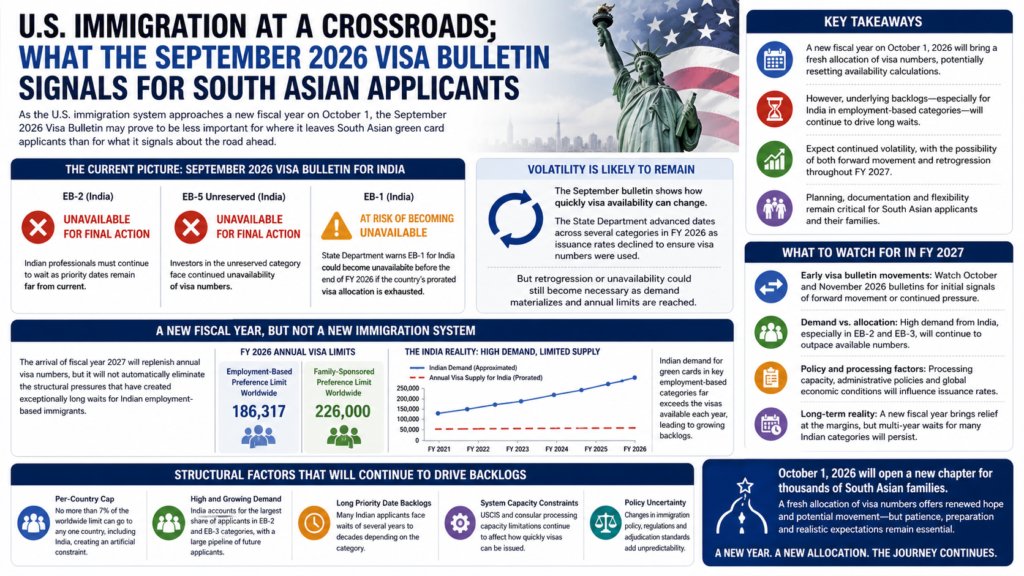
The immediate picture is one of pressure. India’s EB-2 category remains unavailable for final action, EB-5 unreserved visas are also unavailable, and the State Department has warned that even EB-1 for India could become unavailable before the end of fiscal year 2026 if the country’s prorated visa allocation is exhausted.
Yet the beginning of fiscal year 2027 will bring a fresh annual allocation of employment-based and family-sponsored immigrant visa numbers, potentially resetting the calculations that have produced the end-of-year squeeze. For thousands of Indian professionals — and for South Asian families whose lives have been shaped by priority dates, visa extensions and years of uncertainty — October could open a new chapter, even if it is unlikely to resolve the underlying backlog.
The September bulletin itself makes clear how quickly visa availability can change. The State Department said that immigrant visa issuance rates had declined during fiscal year 2026, prompting the department to advance dates across several categories to ensure available visa numbers were used. But it simultaneously warned that retrogression or unavailability could still become necessary as demand materializes and annual limits are reached.
Advertisement
That volatility is likely to remain the defining feature of the months ahead.
A New Fiscal Year, but Not a New Immigration System
The arrival of fiscal year 2027 will replenish annual visa numbers, but it will not automatically eliminate the structural pressures that have created exceptionally long waits for Indian employment-based immigrants.
For fiscal year 2026, the worldwide employment-based preference limit was set at 186,317, while the family-sponsored preference limit stood at 226,000. The per-country limit was based on 7% of the combined annual preference allocation, subject to statutory adjustments and carryover provisions.
The problem for India is that demand from a single country can far exceed the share available under the existing statutory framework.
That means a new fiscal year may provide temporary relief, particularly in categories that became unavailable late in September, but the fundamental imbalance between demand and available numbers will remain.
For Indian professionals, the most closely watched development will be the future of EB-2. The category, used extensively by professionals with advanced degrees or exceptional ability, is unavailable for India under September’s Final Action Dates chart. Its Dates for Filing cut-off, however, remains January 15, 2015, underlining the distinction between being permitted to file an application and actually becoming eligible for a green card number.
The reopening of a new annual pool of visa numbers could eventually restore final action availability. But the pace of any movement will depend on how much demand accumulates and how the State Department manages the allocation during the early months of fiscal year 2027.
For families who have spent years in the queue, therefore, October may represent a reset in numbers, not necessarily a reset in waiting time.
EB-1’s Warning Signal
The pressure building in EB-1 may be equally revealing.
For September, India’s EB-1 Final Action Date stands at October 15, 2022. But the State Department has explicitly warned that heavy demand and visa-number use could make the category unavailable before September 30.
That development carries implications beyond a single category.
Over recent years, EB-1 has become an increasingly attractive alternative for Indian professionals seeking to escape the far longer EB-2 and EB-3 queues. If demand continues to shift toward EB-1, the category itself could increasingly experience the same congestion that applicants were attempting to avoid.
The result could be a broader redistribution of pressure across the employment-based system rather than a genuine reduction in the overall backlog.
For the Indian-American community, that would represent a significant change. The traditional hierarchy — in which EB-1 was viewed as a comparatively faster route and EB-2 and EB-3 as the categories defined by prolonged waiting — may become less clear-cut.
The South Asian Dimension
While India remains the epicenter of the employment-based backlog, the implications extend beyond Indian nationals.
South Asian migration to the United States is increasingly diversified. Students, technology professionals, healthcare workers, researchers, entrepreneurs and family-sponsored immigrants from Bangladesh, Nepal, Pakistan, Sri Lanka and other countries in the region are navigating a U.S. immigration environment that is becoming more restrictive and unpredictable, even where their priority-date backlogs differ from India’s.
For these communities, the next fiscal year will test whether the U.S. immigration system can maintain a balance between two competing realities: the continued demand for global talent and increasingly complicated pathways to permanent residence.
The September bulletin notes that limited or suspended visa operations at some posts, along with immigration policies introduced since January 2025, contributed to lower immigrant visa issuance during fiscal year 2026.
That suggests that future visa movement will not be determined solely by statutory numerical limits. Consular capacity, administrative policy and broader geopolitical developments could also influence how quickly available numbers are actually used.
In other words, the priority-date queue is increasingly being shaped not just by demand, but by the operational ability of the immigration system to process that demand.
Family Backlogs Will Remain a Longer-Term Challenge
The fiscal-year reset may have limited impact on the much deeper problem confronting family-sponsored applicants.
For India, the September Final Action Date for the F4 sibling category is November 1, 2006. F3, covering married sons and daughters of U.S. citizens, stands at October 22, 2014.
These dates demonstrate that, for many South Asian diaspora families, immigration planning has become an intergenerational exercise.
The next Visa Bulletin may move the dates forward, backward or leave them unchanged. But incremental monthly movement does not alter the central reality: family members separated by immigration categories can spend years waiting for the legal opportunity to reunite permanently.
That issue is likely to remain a major concern for diaspora communities irrespective of what happens in October.
What to Watch After October 1
The first few Visa Bulletins of fiscal year 2027 will provide the clearest indication of whether the new annual visa allocation produces meaningful movement.
The key questions will be whether EB-2 for India reopens for final action, how far EB-1 advances after its end-of-year pressure, whether EB-3 can move beyond its January 2014 Final Action Date, and whether EB-5 unreserved availability is restored for Indian investors.
The State Department has already demonstrated in fiscal year 2026 that dates can advance significantly when visa demand or issuance patterns change. But it has also made clear that those advances can be followed by retrogression when demand returns.
For South Asian immigrants, therefore, the most likely future is not one of a straight-line recovery.
Instead, fiscal year 2027 could bring a cycle of early movement, rising demand and renewed pressure on annual limits.
A System at a Crossroads
The larger question extends beyond the monthly arithmetic of the Visa Bulletin.
The United States continues to attract highly educated migrants from South Asia, many of whom first arrive as students or temporary workers and subsequently become integral to industries ranging from technology and medicine to research, higher education and entrepreneurship.
But the longer the gap persists between temporary participation in the U.S. economy and permanent immigration status, the more difficult it becomes to argue that the existing system is aligned with the country’s long-term economic interests.
For Indian applicants, the September 2026 bulletin is therefore both an endpoint and a warning.
It closes a fiscal year in which EB-2 became unavailable, EB-1 came under renewed pressure and the employment-based queue once again demonstrated its vulnerability to sudden changes in demand.
The opening of fiscal year 2027 may bring fresh visa numbers and, with them, fresh optimism. But unless the underlying mismatch between high demand and limited country-specific allocations changes, South Asia’s green card queue is likely to continue moving in a pattern that has become painfully familiar to the diaspora: advance, pause, retreat — and wait again.