
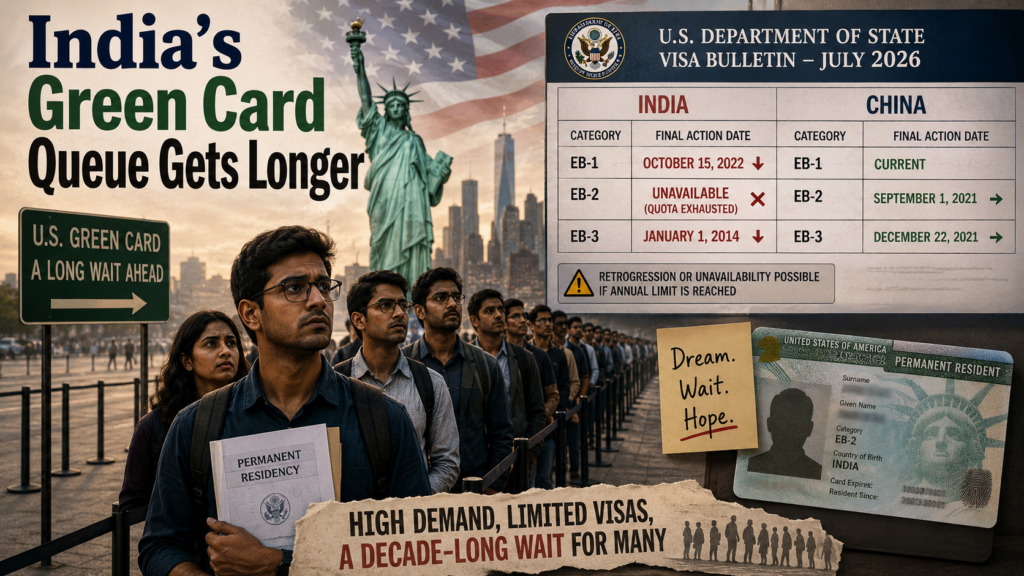
Indian professionals hoping for permanent residency in the United States have suffered another setback after the U.S. State Department’s July 2026 Visa Bulletin declared the Employment-Based Second Preference (EB-2) category unavailable for Indian applicants for the remainder of the fiscal year.
The move reflects the exhaustion of India’s annual EB-2 visa quota amid exceptionally high demand, halting green card approvals for thousands of highly skilled workers, including technology professionals, engineers, doctors and researchers. The category is expected to reopen only in October with the start of the new fiscal year.
The bulletin also brings bad news for applicants under the Employment-Based First Preference (EB-1) category, where the final action date has retrogressed to October 15, 2022. Officials warned that EB-1 could face further retrogression—or even temporary suspension—if India’s annual allocation is exhausted before September.
Meanwhile, India’s Employment-Based Third Preference (EB-3) category remains severely backlogged, with final action dates stuck at January 1, 2014, leaving many applicants facing waits exceeding a decade.
Advertisement
China, while also experiencing delays, remains significantly ahead. Chinese EB-2 applications are being processed with a final action date of September 1, 2021, while EB-3 stands at December 22, 2021—nearly eight years ahead of India’s EB-3 queue. Most other countries continue to enjoy “Current” status for EB-1 and EB-2 visas.
The widening gap stems from the U.S. per-country cap, which limits each nation to roughly seven percent of employment-based immigrant visas regardless of demand. As the largest source of H-1B professionals, India has accumulated decades of pending green card applications.
The July bulletin also declared India’s unreserved EB-5 investor visa category unavailable after its annual quota was exhausted. With demand remaining exceptionally high, the State Department warned that further retrogressions are possible before the fiscal year ends, underscoring that meaningful relief for Indian applicants is unlikely without legislative reform of the per-country quota system.