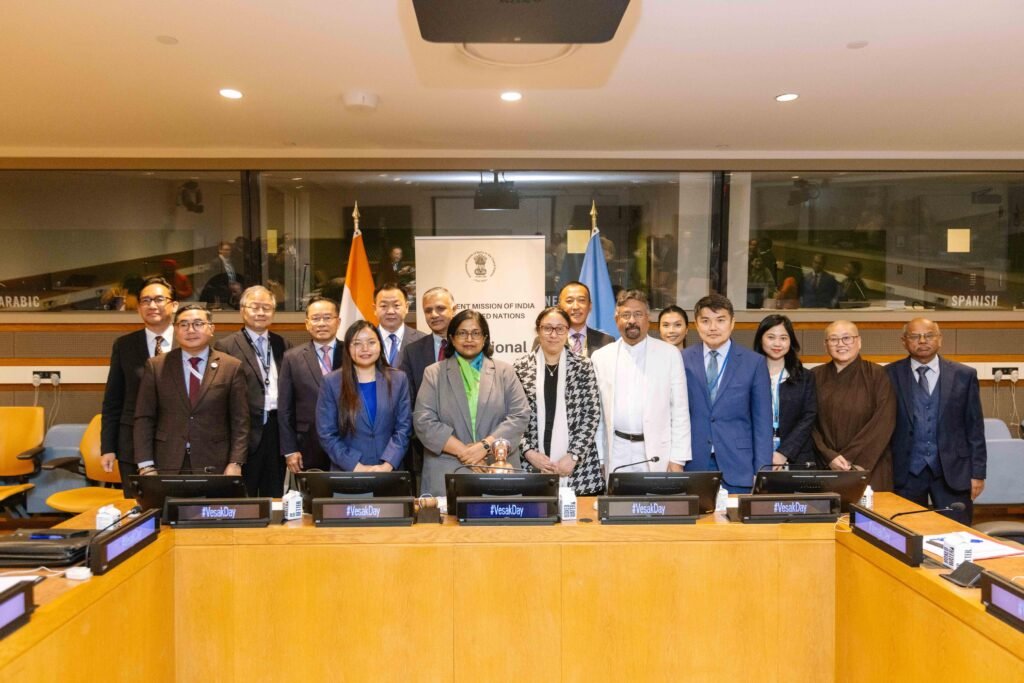
To mark the International Day of Vesak, the Permanent Mission of India to the United Nations, in collaboration with the Permanent Missions of Sri Lanka, Nepal, Bhutan, Cambodia, Japan, Lao PDR, Mongolia, the Republic of Korea, Thailand, and Viet Nam, convened a panel discussion on April 30, 2026, at the United Nations Headquarters in New York.
The discussion centered on the theme “Leveraging Buddhist Heritage for Strengthening Global Peace and Cooperation,” examining how shared Buddhist traditions across the region can contribute to fostering international collaboration amid ongoing global conflicts.
In her welcome remarks, Chargé d’affaires Ambassador Yojna Patel highlighted the “deep civilizational bond” linking communities from the Indian Ocean to the Indo-Pacific through shared traditions of Buddhist “art and culture, architecture, flow of ideas and values.”
She also outlined India’s efforts to “revitalize and strengthen” these ties, including the development of a Buddhist tourism circuit and initiatives to preserve and restore “Buddhist heritage sites, monasteries, conservation of archaeological sites, and pilgrimage infrastructure in neighboring partner countries leading to an organic evolution of a transnational spiritual corridor.”
Advertisement
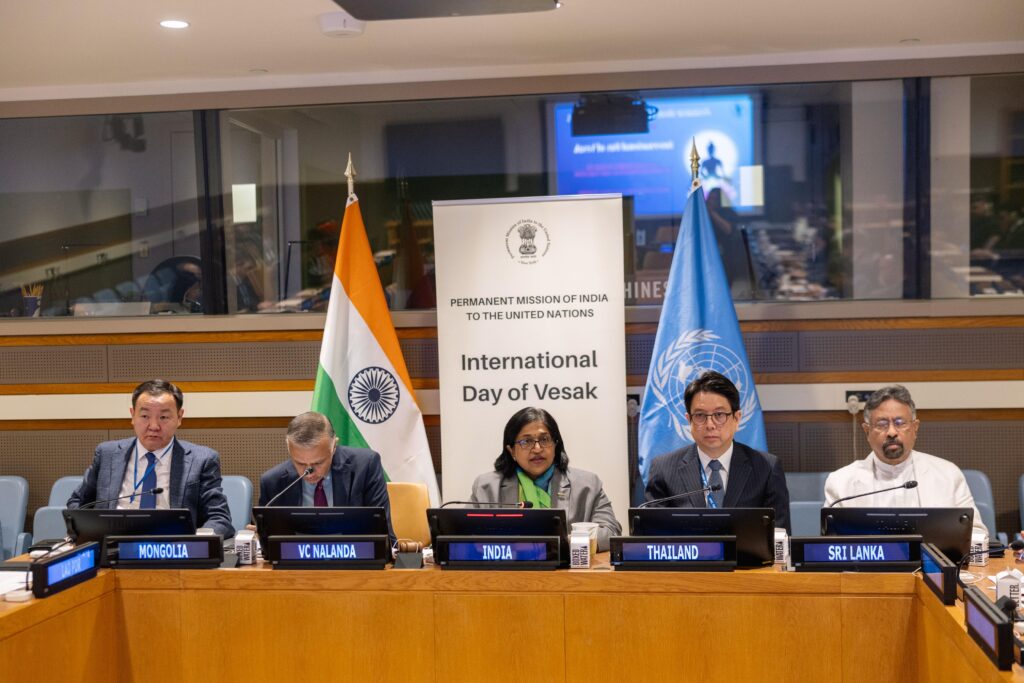
Delivering the keynote address, Nalanda University Vice Chancellor Prof. Sachin Chaturvedi underscored “interdependence and collective welfare” as “central tenets” of Buddhism that remain relevant to contemporary global governance. He called for a shift from sector-specific and quantitative development models toward integrated, human-centric approaches to achieving the Sustainable Development Goals, linking Buddhist philosophy to “ethical development, sustainability, and global systems thinking.”
Speakers from participating countries emphasized the continued relevance of Buddhist values in today’s complex global environment. Member States highlighted principles such as compassion, moderation, and dialogue, drawing from their own traditions. Bhutan referenced its Gross National Happiness framework, Japan, Thailand, and Viet Nam emphasized human dignity, and the Republic of Korea noted Buddhism’s growing resonance among younger generations.
Sri Lanka’s Permanent Representative to the United Nations, Jayantha Jayasuriya, noted that Vesak, the most sacred day for Buddhists, falls on the full moon of May and commemorates the birth, enlightenment, and passing of Lord Buddha. He said the teachings of the Buddha guide humanity toward values such as loving kindness (Metta), sympathetic joy (Muditha), compassion (Karuna), and equanimity (Upekka), which can help address conflict and human suffering.
Jayasuriya also highlighted the historical influence of Emperor Asoka, noting, “He shifted the mode of administration from confrontations and conflicts to active dissemination and spread of righteousness and compassion, even beyond his kingdom.”
He added, “His son, Mahinda, a Buddhist monk with a group of his companions led a mission from India to Sri Lanka during Emperor Asoka’s reign and on his very first visit itself delivered a sermon to the then Ruler of Sri Lanka, King Devanampiyatissa, who thereafter embraced Buddhism and initiated several processes that deeply rooted Buddhism in the hearts of Sri Lankans.”
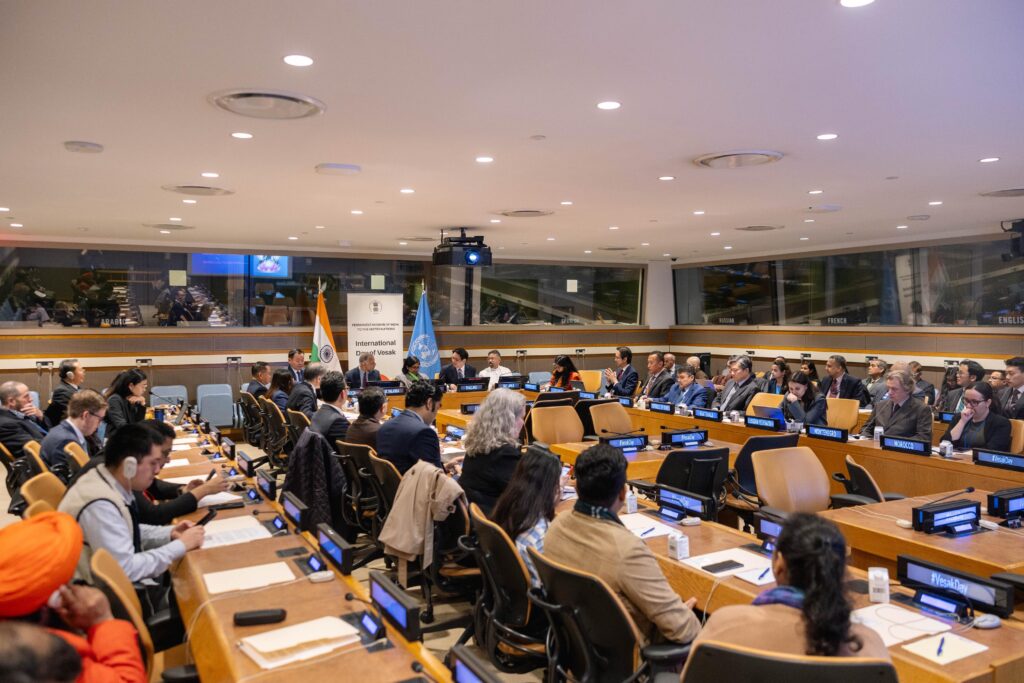
He further noted that protecting and fostering “Budhha sasana” remains a constitutional responsibility of Sri Lanka.
Delegations from Mongolia, Lao PDR, and Cambodia reaffirmed their commitment to the principles of Lord Buddha, while Nepal emphasized the “Middle Path” as a framework for moderation and peaceful coexistence. Collectively, participants underscored that Buddhist heritage can serve as a unifying force to build “trust, people-to-people connections, and cooperative approaches to peace and development.”
The observance aligns with United Nations General Assembly resolution 54/115, adopted in 1999, which formally recognizes the International Day of Vesak. The day, observed annually on the first full moon of May, commemorates the birth, enlightenment, and passing of Lord Buddha and highlights his enduring message of “compassion, peace and goodwill.”
The resolution also acknowledges the historical and spiritual contributions of Buddhism over more than two and a half millennia and calls for appropriate observances at United Nations Headquarters and other UN offices, in consultation with relevant stakeholders.