Join WhatsApp Channel

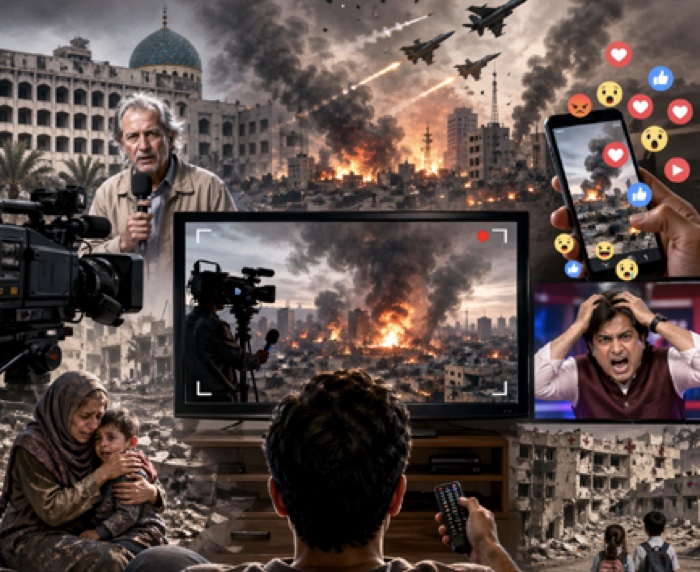
Nothing about the bride or groom matters, goes an Indian saying, if the priest performing the marriage is fed well. War in the drawing room via TV and social media posts has come to be that, no matter how its victims suffer. It is exciting entertainment.
The advent of television was long ago, but watching a conflict on television, in your drawing room or bedroom, began a little over 35 years ago, to be precise, on January 17, 1991. The experience was like watching a movie’s first day, first show, in the years gone by. An entire world awaited reporting by Peter Arnett on CNN from the Al-Rasheed Hotel in Saddam Husain’s Baghdad.
That the much-hated and targeted dictator had ensured Arnett’s presence facilitated unparalleled, albeit heavily censored, reportage didn’t matter to the viewers, not even to those who defeated Iraq, but missed killing Saddam. Arnett won fame and the Pulitzer Prize, but was also criticized over reports on civilian casualties caused by US bombing. It had led to accusations that he was a conduit for Iraqi propaganda. No empathy for the victims beyond a few tears and tch-tch-tch expression of agony. Parallels can be drawn between 1993 in Iraq and 2026 in Iran.
The war has since been part of the global television fare. The footage, supposedly distributed free globally to media outlets, ensures that only that version, by and large, is carried as ‘truth.’ The other side only makes ‘claims.’ Social media and various streams have only added to this imbalance.
A little-known Hindi TV channel recently showed its anchor tearing his hair, actually, before the camera and audiences, yelling why India was ‘ignored’ by all sides, especially the USA, for the role of playing a mediator. His anger betrayed the level to which some of the TV channels have descended to get eyeballs. India has 908 private satellite TV channels, of which approximately 393 deal in news and current affairs channels, catering to diverse audiences in dozens of languages.
Mercifully, as it happens before cricket tournaments, wide-screen ‘smart’ television sets and advanced over-the-top (OTT) services dealing exclusively with the ongoing conflict have yet to be advertised.
During the earlier round of the Gulf conflict, and much less so, in India’s very own four-day “Operation Sindoor” against Pakistan, visuals of the flight of drones and missiles became strong reminders of the mythical. Arrows and maces multiplying on silent chanting by the warriors who fought the battles in Lanka in the Ramayana serials, and at the 18-day Mahabharat fought at Kurukshetra. The parallels from the two epics were there to see, perceive, and enjoy.
However, it would be unfair to single out the Indian TV channels or, for that matter, the parallels between the mythical arrows and the drones and missiles of today. The penchant for watching a war in progress, and the war itself, no matter the loss of innocent lives, hospitals and school children included, and the destruction of ancient cultural heritage, is actually universal.
Disclaimer: The opinions and views expressed in this article/column are those of the author(s) and do not necessarily reflect the views or positions of South Asian Herald.
Related posts:
 Over 1,100 Indian Sailors Trapped as War Chokes the World’s Oil Lifeline
 U.S. Leaders, Indian American Lawmakers, and Community Organizations Condemn Kashmir Terror Attack That Killed 26 Tourists
 Balancing Oil, Optics, and Alliances: India’s Tightrope in the Gulf War
 Global Tributes Mark 40th Anniversary of Air India Flight 182 Bombing