There are moments when a brand simply seems to have the wind behind it. People rave about it, journalists want to write about it and customers want to be associated with it.
We increasingly talk about good vibes. It is an emotional shorthand for how a person, brand or institution makes us feel, often before we have stopped to examine the facts. And in an age of 60-second reels, fleeting attention and algorithms that reward emotion, those feelings can be remarkably powerful.
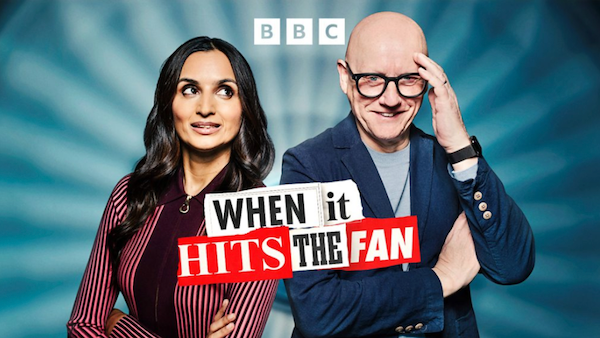
This week on When It Hits the Fan, David Yelland and I looked at the growing business of engineering them. Marks & Spencer has spent the summer generating the kind of positive attention most consumer brands would envy. Nigel Farage showed us a rather different communications technique when he said he “wasn’t listening” during a controversial conversation. And a rumor linking Meghan to Guy Ritchie’s The Gentlemen showed how quickly an information vacuum can acquire a life of its own.
M&S and the Vibes Economy
Advertisement
Marks & Spencer is having quite a moment. The British retailer is preparing for its London Fashion Week debut, Gillian Anderson has been installed as its wonderfully invented “Chief Compliments Officer,” and a steady stream of campaigns and announcements has kept M&S unusually present in the cultural conversation.
For a company founded in 1884, it suddenly feels very current. There is always a temptation in PR to look at a run like this and credit the communications team. The communications are certainly doing their job, but the more basic truth is that you cannot sustain good vibes around a product people do not actually want.
For a while, M&S fashion felt like a slightly sleepy Bagpuss sitting on the British retail mantelpiece. Familiar and comforting, but not necessarily somewhere you went looking for excitement. That has changed. The clothes have become more desirable and the communications now have something real to amplify rather than something they are being asked to invent.
M&S also has an advantage many newer retailers would pay handsomely for: generations of accumulated affection. It has accompanied people through school uniforms, underwear drawers and Christmas dinners. For many British families, it sits somewhere between a shop and a national institution. But nostalgia on its own is no business strategy. The clever part has been giving people new reasons to care about it now.
You can see that in the choices being made around the brand. Gillian Anderson feels close enough to what people already imagine M&S to be, sensible, while moving that image somewhere more sexy. Chief executive Stuart Machin has also been willing to put himself into the public conversation, talking about leaving school at 16 while M&S creates training routes for
young people without degrees. It carries risk, but becoming interesting usually requires taking some.
What M&S appears to understand particularly well is that consumers do not experience brands as a collection of rational arguments. They experience them as feelings. Long before somebody reads the annual report or examines the price point, they have already formed an impression of what a brand means to them.
That is what I mean by the vibes economy. M&S has managed to create a sense of energy around the business because its fashion, food and corporate communications are broadly pulling in the same direction. But good vibes also raise expectations, and eventually the experience has to live up to them.
PR can generate anticipation, but it cannot indefinitely compensate for disappointment. For now, M&S has the combination every consumer brand wants: the story being told about the business broadly matches the experience people are having of it. That is why the good vibes feel convincing.
The Reputation Bank Account
Nigel Farage found himself answering uncomfortable questions after an undercover Channel 4 investigation into discussions about how money from a supposed American donor might reach Reform UK.
When Laura Kuenssberg challenged him about a conversation that had taken place in his presence, Farage offered a remarkably simple explanation: “I frankly wasn’t even listening.”
It is a difficult defense to disprove. “I don’t recall.” “I didn’t see the email.” “I wasn’t listening.” These familiar lines cast just enough doubt to expand the grey area. They may not persuade everyone, but they can create uncertainty, give supporters a position to repeat and buy time for the news cycle to move on.
Whether they work depends heavily on your residual reputation. I tend to think of reputation as a bank account. You build up goodwill over time, through what you say and do, and when a crisis arrives you may need to draw on it. Audiences never encounter a crisis with a blank slate; they bring everything they already believe about you into the room.
There is also something particularly dangerous about an excuse that is too memorable. Years later, we still remember Prince Andrew saying he was unable to sweat, Dominic Cummings driving to Barnard Castle to test his eyesight and Boris Johnson saying he was “ambushed with a cake.” The explanation becomes a punchline, and sometimes survives in the public memory long after the details of the original controversy have faded.
In reputation management, boring can be underrated. The excuse nobody remembers is usually preferable to the one people are still laughing about years later.
When Rumor Fills the Vacuum
For a brief period this summer, it appeared Meghan might be returning to scripted television. Reports claimed that the Duchess of Sussex was in discussions to appear in the third series of Guy Ritchie’s The Gentlemen. It had just enough plausibility to travel: Meghan is an established actor with a Netflix relationship, while the show has featured its share of famous faces and cameos.
I believed it when I first saw it, and so did plenty of other people. The story travelled internationally just as the second series was arriving. Then things became murkier. Reports suggested any conversations had only been preliminary, while Royal biographer, Tina Brown later claimed the proposed casting had been withdrawn following the reaction in Britain. Meghan had never actually been announced as part of the cast.
When a rumor takes off, one of the first questions communicators should ask is: who benefits? Netflix and Guy Ritchie received enormous publicity for The Gentlemen. Initially, the story appeared useful to Meghan too, placing her back at the center of the entertainment conversation rather than simply the royal one.
The problem was what happened next. The narrative shifted from a possible acting return to claims that the opportunity had been withdrawn because the reaction to Meghan made it untenable. For someone seeking new commercial and creative partnerships, that is a much more damaging story to leave unanswered.
There is good reason not to dignify every rumor with a response. But for high-profile figures, an information vacuum can quickly be filled by other people, and the story they create may be considerably worse than the truth.
On this occasion, The Gentlemen may have got the best deal of all: global publicity from a casting story that was never officially confirmed.
Disclaimer: The opinions and views expressed in this article/column are those of the author(s) and do not necessarily reflect the views or positions of South Asian Herald.