On 28 February, Micron marked the opening of its semiconductor assembly and test plant in Sanand, Gujarat, by presenting its first shipment of Indian-made memory modules to Dell. Their destination was telling. Dell would use them in laptops made in India for Indian customers. The American chipmaker had brought one stage of its global production network into India, connecting a new factory to an existing market.
A year earlier, another company had moved in the opposite direction. India’s Waaree began producing solar modules in Brookshire, Texas, at a facility with an initial annual capacity of 1.6 gigawatts. An Indian manufacturer was investing in American production, just as an American technology company was investing in India. Together, these projects show how industrial growth in one country can create opportunities in the other.
This should be the starting point for the next phase of India–US relations. Defence cooperation and diplomatic alignment matter, but a partnership also needs people and businesses whose livelihoods depend on its success. India and America need an industrial bargain: an understanding that access to each other’s markets should help both countries build productive capabilities, with gains substantial enough to sustain cooperation when their governments disagree.
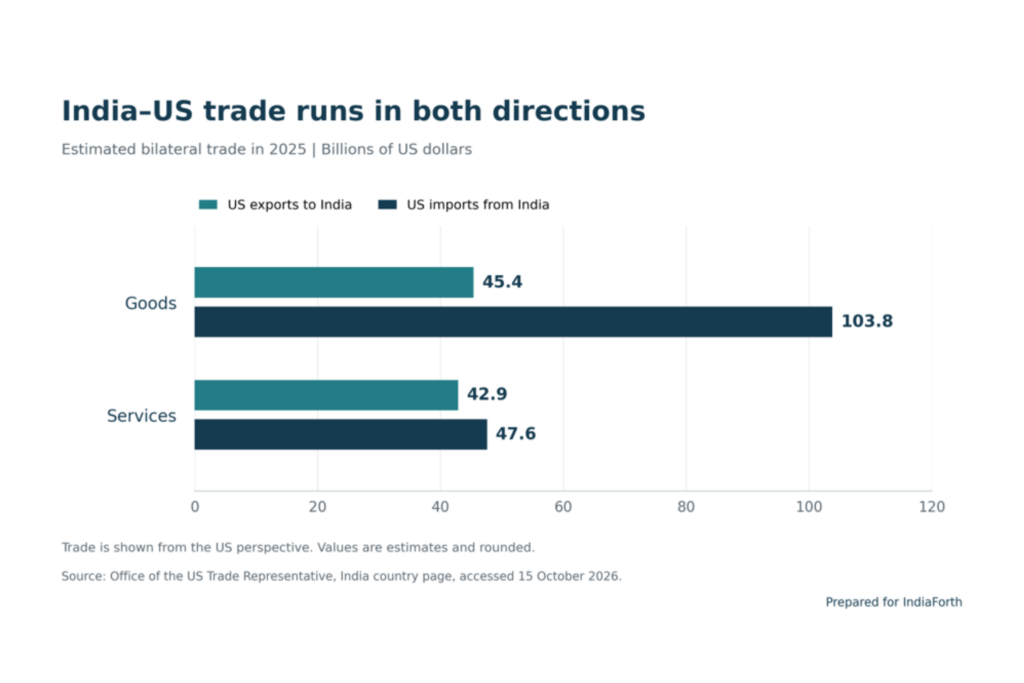
The commercial foundation already exists. The US Trade Representative estimates that bilateral trade in goods and services reached $239.6 billion in 2025. Yet a trade total captures only part of the relationship. It counts what crosses borders more readily than it explains what firms build together. An Indian-owned factory producing in Texas contributes to American manufacturing, even though its output is not an Indian export.
Advertisement
That distinction matters because both governments face pressure to bring production home. American workers want investment that supports employment in their communities. India needs manufacturing that creates jobs and develops technological expertise. Neither government can sustain a partnership by asking its citizens to accept economic losses for an abstract strategic benefit. Cooperation has to offer a convincing answer to a domestic question: what does this relationship allow us to make, learn and earn?
The trade negotiations offer an opportunity to answer it. On 15 October, India’s trade secretary said the first phase of a bilateral deal had been finalised and was undergoing legal drafting, according to Reuters. That is progress, although the agreement still has to be signed and implemented. Its eventual value will depend on whether firms can use its terms to plan investments that take years to repay.
The February framework had already linked trade to technology, supply-chain resilience and cooperation on export controls. These commitments need to reinforce one another. Encouraging a semiconductor investment achieves little if the firm cannot reliably obtain equipment or secure permission to use it. Offering market access is less persuasive if tariffs can change before a new factory recovers its costs.
For India, the ambition should be to use these investments to become a more capable producer. Micron’s Sanand plant assembles and tests products using wafers from its global network; it does not fabricate those wafers. That is a meaningful entry into semiconductor manufacturing, with scope for technical learning. The next question is whether Indian engineers and suppliers can take on more demanding work as the operation matures.
This will require effort from Indian institutions as well as foreign investors. Technical colleges need to teach skills that factories actually use. Smaller suppliers need access to testing facilities and finance while they qualify for orders. Public subsidies should be assessed against evidence of learning, productivity and sustained employment. A factory receiving support should help expand the country’s capabilities, rather than remain an isolated operation dependent on imported expertise.
Washington, meanwhile, should recognise the value of Indian firms investing in American industry. Waaree’s Texas operation illustrates why India’s industrial rise need not mean production moving out of the United States. Indian companies can bring capital and manufacturing experience to American locations. That gives the relationship a broader political base: local suppliers and employees have a reason to support cooperation because they participate in it.
Such commitments remain vulnerable to policy shocks. A manufacturer can absorb ordinary commercial risk; an unexpected tariff can change the economics of an entire production line. Both governments should publish clear schedules, provide workable transition periods and establish procedures for resolving disputes. The objective is to give firms enough confidence to invest while preserving each country’s ability to respond to genuine security concerns.
Technology rules require the same care. Security restrictions should identify what is controlled and provide a clear process for legitimate applications. India must also make customs clearance and certification more dependable. A shipment held at a port or a component awaiting approval can interrupt production far from the border. Reducing these delays would make the partnership useful to smaller businesses with little capacity to navigate regulatory uncertainty.
Trade rules should also reflect how factories operate. Rules of origin determine which goods qualify for negotiated benefits. They should prevent products being relabelled and routed through a partner country, while recognising substantial manufacturing that uses imported components. Otherwise, governments risk excluding the very production networks they are trying to develop.
Indian American business networks can help extend these opportunities. For a small Indian manufacturer, an introduction to a credible buyer or advice on qualification requirements can be more useful than another investment conference. Universities and firms can support engineering placements tied to actual production needs. These connections turn a bilateral agenda into opportunities that businesses can act on.
Sanand and Brookshire suggest what a stronger relationship could look like. Its resilience will depend on factories that remain competitive, suppliers that win repeat orders and workers who gain skills they can carry forward. India and America will continue to disagree. Giving more people an economic stake in managing those disagreements would make the partnership harder to abandon and easier to defend.
Disclaimer: The opinions and views expressed in this article/column are those of the author(s) and do not necessarily reflect the views or positions of South Asian Herald.