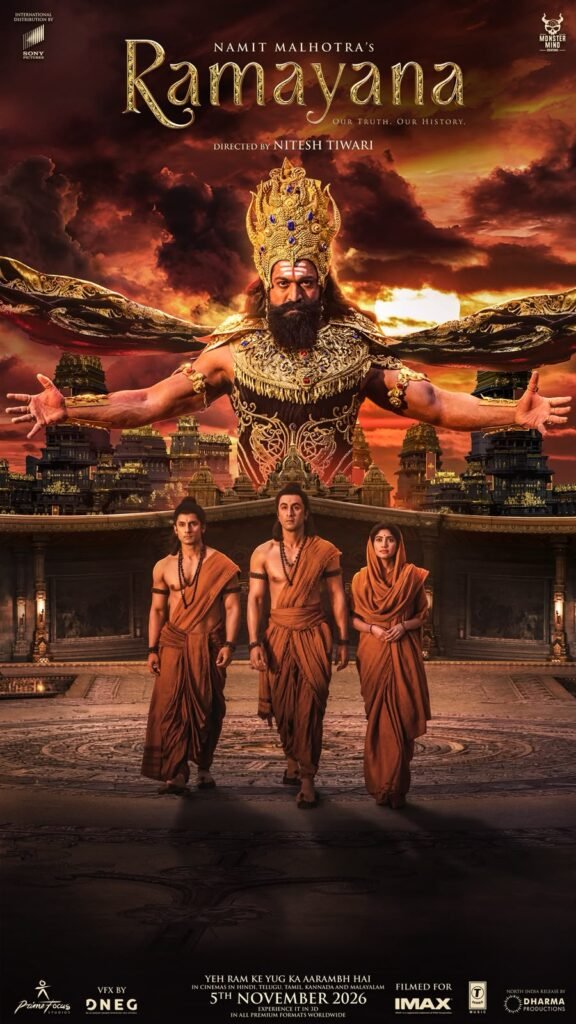
For years, the pre-Diwali period has remained one of the most challenging windows for big-ticket Hindi film releases. Namit Malhotra’s Ramayana Part 1 is now rewriting that box-office narrative with an extraordinary advance-booking response.
Historical facts
In 1985, Amitabh Bachchan’s Mard had opened four days before Diwali and became a phenomenon. Baazigar (1993) and Dilwale Dulhania Le Jayenge (1995) opened well in the pre-Diwali days and became major hits. In 1998, Kuch Kuch Hota Hai and Bade Miyan Chote Miyan both opened well four days before the festival. The latter took the year’s biggest opening and the former became the biggest hit of the year.
But things had changed for a long while later. In 1999 itself, Hum Saath Saath Hain opened to a mere Rs. 1.21 crore two days before Diwali. The Indian box-office has thus witnessed a rather interesting trend over recent years. While Diwali has traditionally been considered one of the most lucrative festive periods for film releases, the days leading up to the festival have often presented a different challenge for filmmakers and distributors.
Advertisement
Audiences are occupied with festive preparations, shopping, travel and family commitments, all of which frequently affect theatrical footfalls. Even films featuring major superstars have found it difficult to translate their star-power into massive opening-day numbers during this period.
For years, the industry has approached the pre-Diwali period with caution. A look at previous pre-Diwali releases illustrates this pattern. Shahid Kapoor and Alia Bhatt’s Shaandaar opened at approximately Rs.13.10 crore in 2015. Hrithik Roshan’s Krrish 3 opened at Rs. 25 crore.
Karan Johar’s Ae Dil Hai Mushkil, starring Ranbir Kapoor, Anushka Sharma and Aishwarya Rai Bachchan, collected approximately Rs.13.30 crore on its opening day in 2016. Ajay Devgn’s Shivaay opened at Rs. 10.24 crore.
Even Akshay Kumar’s Housefull 4, which arrived just ahead of Diwali in 2019, opened at approximately Rs. 19 crore, with trade reports acknowledging the impact of pre-Diwali festivities on its opening-day business.
These examples underline how the festive calendar can influence theatrical performance, irrespective of a film’s star cast, allure or franchise value.
That long-standing narrative is now being challenged by Namit Malhotra’s Ramayana: Part One. The ambitious cinematic adaptation has generated an extraordinary response even before its theatrical journey has properly begun.
The film has recorded approximately Rs. 42.96 crore in opening-day advance bookings at the Indian box-office, amounting to Rs. 36.41 crore net, according to reported trade figures. This is particularly significant because the film has achieved this milestone during a period traditionally considered “challenging” for theatrical business.
With substantial spot bookings still to contribute throughout the day, the opening-day business could potentially move towards the Rs. 75 crore gross mark, subject to actual audience turnout and ticket sales. What makes this achievement noteworthy is not just the advance-booking number, but the larger box-office trend it represents.
The assumption has often been that audiences would reserve their theatrical outings for the festival itself. Ramayana is challenging that assumption. The film’s advance-booking momentum, extensive theatrical release and strong demand across premium formats demonstrate the potential of a large-scale cinematic spectacle to attract audiences even during a traditionally difficult release window. It also reinforces the importance of scale, audience anticipation, event-film positioning and nationwide theatrical reach in driving opening-day business.
If the projected opening-day business materializes, Ramayana could establish a new benchmark for films releasing immediately before Diwali. More importantly, it could encourage filmmakers and distributors to reconsider the commercial potential of the pre-Diwali window rather than automatically treating it as an unfavorable release period.
For the team behind Ramayana, this is a significant pre-release milestone. For the Indian film industry, it is an interesting box-office development that challenges an established belief about festive release calendars.
Ramayana is not merely chasing a big opening. It is changing the conversation around when a big Indian film can open big.