Join WhatsApp Channel

The United States has overtaken Qatar as India’s largest supplier of liquefied natural gas (LNG), marking one of the most significant shifts in India’s energy import strategy in decades and underscoring how geopolitics is redrawing global energy trade.
The transition, triggered by supply disruptions in West Asia and India’s scramble to diversify sourcing, extends well beyond the energy sector. It comes at a time when New Delhi and Washington are negotiating a broader bilateral trade agreement, raising the prospect that energy could become a strategic bargaining chip in the world’s fastest-growing major economy’s relationship with its largest trading partner.
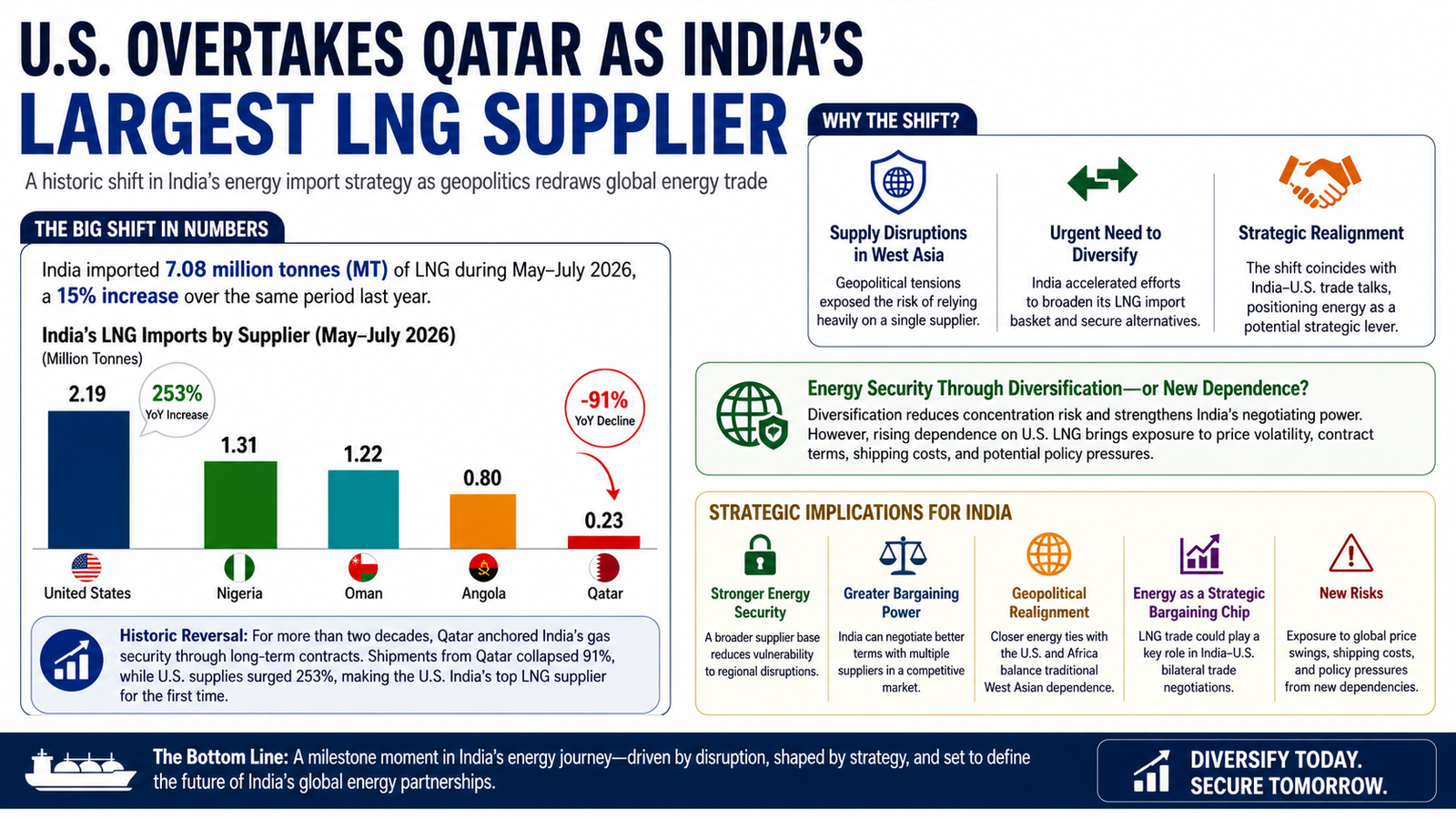
According to Equirus Securities’ latest report, “Natural Gas Compass | Monthly Edition: Consumption Returns to Pre-War Normal,” India imported 7.08 million tons (MT) of LNG during May-July 2026, a 15 per cent increase over the same period last year. The United States supplied 2.19 MT, registering a staggering 253 per cent year-on-year increase, making it India’s largest LNG supplier for the first time. Nigeria followed with 1.31 MT, Oman with 1.22 MT, Angola with 0.80 MT, while Qatar—traditionally India’s dominant supplier—saw shipments collapse 91 per cent to just 0.23 MT.
The figures represent a dramatic reversal in India’s LNG sourcing pattern. For more than two decades, Qatar had anchored India’s gas security through long-term contracts with relatively stable oil-linked pricing. Today, the country’s LNG import basket is increasingly dominated by American, African and non-Qatari Middle Eastern supplies, fundamentally altering both its energy security architecture and geopolitical exposure.
Energy security through diversification—or new dependence?
At first glance, the shift appears to strengthen India’s energy security. Diversification reduces concentration risk after geopolitical tensions in West Asia exposed the vulnerability of relying heavily on a single supplier. The report notes that India has successfully broadened its procurement strategy, sourcing LNG from multiple regions instead of depending overwhelmingly on Qatar.
However, the diversification also reflects a more uncomfortable reality: India’s growing dependence on imported LNG. Natural gas consumption recovered sharply to 197 million metric standard cubic meters per day (mmscmd) in June, up 7 per cent month-on-month and 2 per cent year-on-year, returning to pre-conflict levels. LNG consumption climbed to 110 mmscmd, increasing 13 per cent sequentially and 10 per cent annually, while domestic gas supply remained stagnant at 87 mmscmd. As a result, import dependence rose to 56 per cent, meaning imported LNG now accounts for more than half of India’s gas requirements.
That dependence is structural rather than temporary. The recovery has been powered almost entirely by imported LNG instead of rising domestic production, raising questions about whether India’s ambition to increase natural gas’s share in the national energy mix can be achieved without exposing itself to international market volatility.
Stronger US ties, but a more complex trade equation
The timing of America’s emergence as India’s largest LNG supplier is strategically significant.
India and the United States remain engaged in negotiations over a comprehensive bilateral trade agreement amid continuing disagreements over tariffs, agriculture, digital commerce and market access. One of Washington’s longstanding concerns has been reducing its trade deficit with India.
Although the Equirus report makes no connection between LNG imports and trade negotiations, the surge in American energy exports could strengthen the economic foundation of the bilateral relationship. Every additional LNG cargo purchased from the United States adds to American exports while helping narrow the bilateral merchandise trade imbalance, potentially providing New Delhi greater negotiating flexibility in other contentious areas.
Energy is increasingly becoming an important pillar of India-US strategic engagement, alongside defense, technology and critical minerals.
For Washington, India represents one of the fastest-growing LNG markets in the world. For New Delhi, American LNG provides diversification away from politically volatile supply regions while deepening commercial ties with a strategic partner in the Indo-Pacific.
Yet the relationship is unlikely to be one-sided.
As India’s dependence on American LNG grows, Washington’s energy policies, export approvals and domestic production decisions could acquire greater significance for India’s energy security.
A changing global LNG order
The report suggests the shift is occurring against a backdrop of profound changes in global LNG markets.
The United States has consolidated its position as the world’s leading LNG exporter following massive investments in export infrastructure. Equirus notes that US LNG exports remained robust at 10.5-10.7 MT during June and July, while seven new American LNG projects have reached final investment decision since export approvals resumed in January 2025.
This expansion is allowing the United States to replace disrupted Middle Eastern supplies across Asia and Europe, transforming energy exports into an increasingly influential instrument of American economic diplomacy.
For India, however, sourcing more LNG from North America changes the economics of imports.
Unlike Qatar’s long-term oil-indexed contracts, US LNG is more closely linked to Henry Hub gas prices, liquefaction fees and international freight costs. Cargoes also travel much longer distances, making Indian buyers more exposed to shipping disruptions, insurance costs and maritime security risks through strategic sea lanes including the Red Sea and Suez Canal.
Demand recovery masks structural vulnerabilities
Domestically, gas demand has rebounded across almost every major consuming sector.
City gas distribution (CGD) consumption reached 58 mmscmd, miscellaneous industries 41 mmscmd, fertilizer 55 mmscmd, refinery demand 15 mmscmd, and gas-fired power generation improved to 21 mmscmd. Petrochemical demand recovered to 7 mmscmd, although it remained 48 per cent below last year’s level.
Import infrastructure has also operated at elevated levels.
LNG arrivals totaled 2.4 MT in May and 2.3 MT in June, taking first-quarter FY27 imports to 6.2 MT, while preliminary July arrivals remained robust at 2.1 MT, despite rising international prices.
The willingness of Indian buyers to continue importing large volumes despite expensive spot prices illustrates both resilient demand and limited alternatives.
China’s return raises the stakes
India’s diversification strategy also faces fresh global challenges.
China has returned aggressively to LNG markets after a subdued start to the year, with imports now exceeding seasonal averages. Since global LNG trade has remained broadly unchanged at around 34.5 MT per month, stronger Chinese buying is redirecting existing cargoes rather than drawing from abundant new supply.
Europe adds another layer of uncertainty.
Gas storage across the European Union stood at just 58 per cent ahead of winter, well below historical norms. Combined with recovering Chinese demand, this has pushed Asian spot LNG prices above US$20 per million British thermal units (mmbtu), increasing procurement costs for major importers such as India.
If Europe experiences a severe winter or Chinese demand accelerates further, India could once again find itself competing aggressively for flexible LNG cargoes.
Strategic gains—but new vulnerabilities
Equirus expects Indian gas demand to remain broadly stable through July before moderating in August because of seasonal factors and lower industrial consumption from Morbi’s ceramic cluster.
But the report points to a larger structural transformation.
India has reduced its dependence on a single supplier, improving resilience against regional disruptions. At the same time, it has become more dependent on imported LNG itself, tying its energy future more closely to international prices, US export capacity, global shipping routes and geopolitical competition.
The United States replacing Qatar as India’s largest LNG supplier is therefore not merely a statistical milestone. It reflects the emergence of energy as a strategic pillar of India-US economic relations, one that could reinforce bilateral trade ties while simultaneously exposing India to new forms of geopolitical and market risk. For policymakers, the challenge will be to leverage deeper energy cooperation with Washington without exchanging one form of dependence for another.