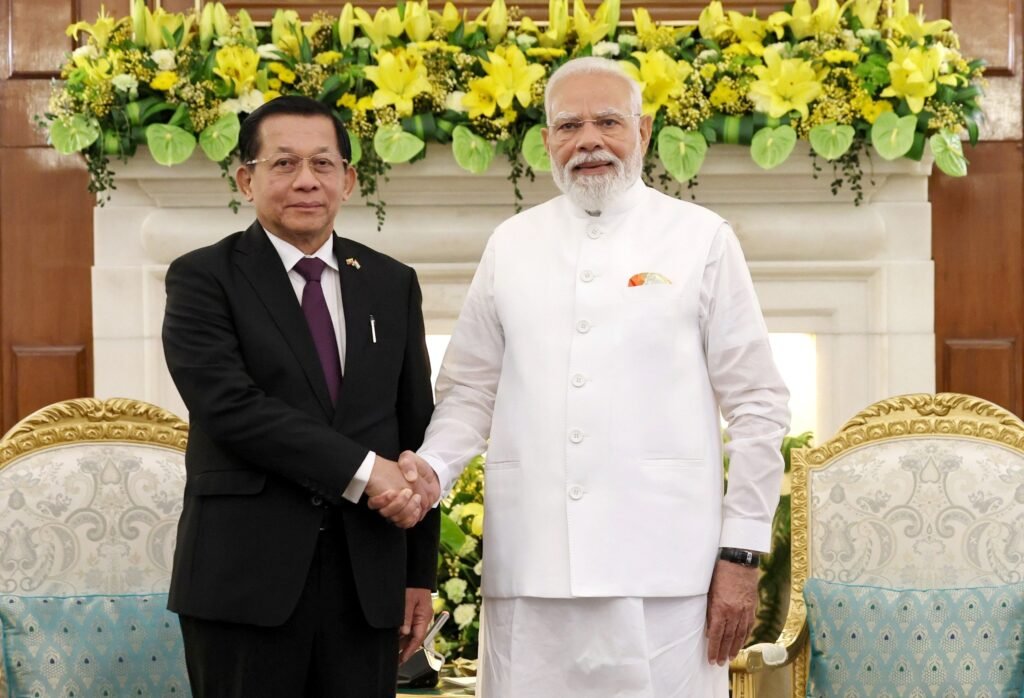
India welcomed a rather unusual guest this week.
Myanmar President Min Aung Hlaing’s four-day visit began on May 30. It comes about two months after he successfully changed his military fatigues for civilian attire through a parliamentary vote. This after an election – dismissed by critics as a sham – in December 2025/January 2026 that was won by an army-backed party. This naturally made Min Aung Hlaing a shoo-in for president, turning a page on his previous role as the military general who ousted Myanmar’s pro-democracy icon Aung San Suu Kyi’s government in a coup in 2021.
Min Aung Hlaing’s visit is important for many reasons. For him, the India visit, his first one abroad since donning civilian attire, marks the start of a cautious re-engagement with the world after being shunned for the coup. India, the world’s largest democracy, presents him with the appropriate opportunity. (Critics could view this as an exercise in double standards by India. After all, India shuns Pakistan, run by its Army, barely hidden behind a civilian leadership façade. From India’s point of view, the difference is stark – Myanmar has never been malevolently opposed to India as Pakistan.)
Since the coup, Myanmar’s dependence on China has grown. India gives Min Aung Hlaing an option to hedge his country’s bets and not lean on Beijing alone.
Advertisement
For India, security is a major reason to engage Myanmar. The two share a 1,643 kilometers-long border. Indian insurgents have previously been based there and used Myanmar to launch attacks. Keeping Myanmar on its side has been a conscious policy pivot by India since the 1990s, after staunchly backing Suu Kyi in the 1980s. India and Myanmar have conducted joint exercises to destroy insurgent bases several times. With India trying to build ties with new governments in Bangladesh and Nepal, stability on the Myanmar front is key.
Second, India views Myanmar as the connect between its South Asia “Neighbourhood First” and Southeast Asia “Act East” policies. Connectivity projects aiming to link India to Southeast Asia have stalled due to the unrest in Myanmar – i.e. the coup and the fighting between Myanmar troops and ethnic armed groups like the Kachin Independence Army. Hopefully, Min Aung Hlaing’s visit will re-energize the connectivity agenda. Myanmar is also indispensable for India’s Indo-Pacific strategy, given its strategic location in the Bay of Bengal region.
Third, India has been eyeing the rare earth minerals in Myanmar. The catch: the minerals are in an area along Myanmar’s northeast, under the control of the rebel Kachins. Reuters reported last year that India was in touch with the group – a rare instance of it reaching out to a non-state actor. China has near-absolute control over the technology that processes these minerals into magnets, critical to the manufacture of cars, smart phones to modern fighter jets. Last year, Beijing had sharply restricted exports of processed rare earths to major economies, including India, to shore up geopolitical leverage amid its trade war with the United States.
All told, this makes for an interesting visit.
Disclaimer: The opinions and views expressed in this article/column are those of the author(s) and do not necessarily reflect the views or positions of South Asian Herald.