
When Vidhi Megha left her hometown of Borsad in Gujarat four years ago, her family believed they were investing in a future.
Like thousands of Indian parents, they poured their savings into an overseas education that promised opportunity, security and eventually permanent residency. The 22-year-old law student worked part-time, attended classes and was preparing to apply for Canadian permanent residence. She was doing everything right.
Then, on May 15, she was stabbed to death in broad daylight in Canada’s Niagara region.
For days, her family could not reach her. They assumed she was busy with studies or work. The truth arrived later through diplomatic channels. Their daughter, who had travelled 12,000 kilometers from home in pursuit of a better life, was dead.
Advertisement
The image is heartbreaking: parents waiting for a call from their child, only to receive arrangements for the return of her body.
Vidhi’s killing has shocked India. But it has also reopened an uncomfortable conversation about the human cost of the country’s booming overseas education industry.
Every year, more than a million Indian students leave home carrying dreams that are often bigger than their suitcases. Families sell land, mortgage homes and take education loans worth ₹20 lakh to ₹60 lakh ($23,000-$70,000) to fund degrees abroad. Canada, the United States, Britain and Australia are marketed as gateways to prosperity.
For most students, they are.
For a growing number, however, the dream is ending in tragedy.
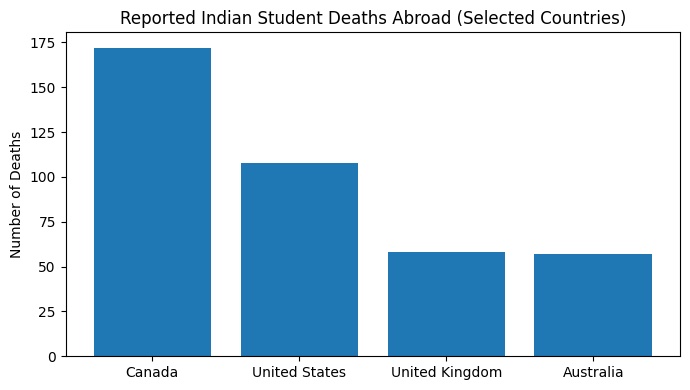
The numbers are sobering. Government data show that more than 800 Indian students have died abroad since 2018. That is roughly one student death every three days. Canada alone accounted for 172 deaths in one recent five-year government review, while the United States recorded 108.
Behind every number is a family shattered by loss.
A mother waiting for a graduation photograph that never arrives. A father still paying off an education loan for a child who will never come home alive. Siblings scrolling through old WhatsApp messages because there will be no new ones.
The recent cases have been particularly painful.
Earlier this year, Saketh Sreenivasaiah, a 22-year-old Indian student and IIT-Madras alumnus studying at the University of California, Berkeley, was found dead after going missing in San Francisco. In May, 25-year-old Navya Gadusu was killed in a devastating highway accident in Indiana. In Canada, Gurkirat Singh Manocha from Madhya Pradesh died after a violent assault in British Columbia.
These deaths generate headlines because they are dramatic and shocking. Yet they reveal only part of the story.
Contrary to public perception, violent attacks account for a small fraction of Indian student deaths overseas. Of the more than 800 recorded fatalities, nearly 96 per cent resulted from accidents, medical emergencies, suicides and other non-violent causes.
That statistic may be even more troubling.
It suggests the biggest threat to Indian students abroad is often not a knife, a gun or a hate crime. It is isolation.
Many students arrive carrying enormous expectations. A family that spends ₹40 lakh ($47,000) on overseas education often sees the investment as a pathway to financial transformation. Failure is not an option. Returning home without a job can feel devastating. Visa deadlines create anxiety. Rising rents consume savings. Part-time jobs barely cover living expenses.
The pressure is relentless.
Students who once topped classrooms in India suddenly find themselves alone in unfamiliar cities, navigating cultural barriers, academic competition and uncertain immigration rules.
The emotional toll is rarely discussed.
Study-abroad advertisements showcase smiling graduates and skyline photographs. They do not show students working night shifts in warehouses, skipping meals to save money, struggling with depression, or worrying whether they can find employment before their visas expire.
The tragedy of Indian students abroad is therefore not simply a law-and-order issue. It is a human story about ambition, sacrifice and vulnerability.
There is also a cruel reality that begins after death.
Families often spend weeks battling bureaucracy to bring their children home. Repatriating remains can cost several lakh rupees, often thousands of dollars. Police investigations unfold in foreign jurisdictions. Legal systems are unfamiliar. Insurance claims become complicated. Grieving parents must navigate paperwork while coping with unimaginable loss.
For many, justice feels distant and inaccessible.
The Ministry of External Affairs says Indian missions have expanded student outreach, strengthened emergency assistance and increased engagement with student associations. Those efforts are important. Yet the scale of the challenge is growing faster than the support system.
India today celebrates the success of its global student diaspora. Universities abroad rely heavily on Indian enrolments. Countries compete for Indian talent and tuition dollars. International education has become a multi-billion-dollar industry.
But the deaths of students such as Vidhi Megha expose a troubling imbalance. Tremendous effort goes into helping students leave India. Far less attention is paid to protecting them once they arrive.
Vidhi’s death is not just another crime statistic from Canada.
It is a reminder that behind every overseas education success story lies a family’s faith, savings and sacrifice. Most students will build successful lives abroad. Many will fulfil the dreams that sent them overseas.
But for some families, the return journey is not marked by graduation caps, job offers or permanent residency approvals.
It is marked by a coffin arriving at an airport.
And as India mourns yet another young life cut short, one question lingers: in the rush to export talent and chase opportunity, have we done enough to protect the children who carry those dreams across oceans?