Join WhatsApp Channel


Prime Minister Narendra Modi wrapped up a tour of three key countries in the Indo-Pacific region — Indonesia, Australia and New Zealand on July 11. The visit, however, has been seen in conjunction with some recent developments, i.e. the visits to India of Japanese Prime Minister Sanae Takaichi earlier this month and South Korean President Lee Jae-myung in April.
All these come at a time of immense flux in the strategic landscape in the Indo-Pacific. China’s rapidly growing military and economic assertiveness is reshaping regional security. Then there is the continuation of the Russia-Ukraine war, the turmoil in the Middle East/West Asia region and the unpredictability of the US as security guarantor and organizer of cooperation among Asian countries. There is also the balance that the US and China are trying to bring into their relationship that could affect Indo-Pacific nations.
Against this backdrop, it is natural for Indo-Pacific countries to seek convergences and alignments. Weaponization of trade, technology denial, access to energy and security are some of the issues that are bringing countries together.
This is what makes Modi’s interactions with Indo-Pacific leaders significant.
Japan’s expertise lies in cutting-edge technologies and infrastructure finance. South Korea offers expert capabilities in shipbuilding, semiconductors and defense production.
In Indonesia, Modi’s visit resulted in a stronger defense partnership. The two countries signed off on the sale by India of the Brahmos supersonic missiles in a $630 million deal. Indonesia is now the third Southeast Asian nation after the Philippines and Vietnam to acquire the BrahMos. There was another agreement reportedly finalized for the Astra Mk-1 beyond-visual-range air-to-air missiles for Indonesia’s fleet of 16 Su-30 fighters. Through these moves, India is positioning itself as a credible defense partner to Southeast Asia that is seen as China’s backyard.
“We have also concluded an important agreement to strengthen supply-chain resilience in the areas of critical minerals and steel,” Modi said at a press conference in Jakarta, adding that Indian and Indonesian companies were “embarking on a new phase of partnership in stainless steel and rare earth magnets.” India will invest in manufacturing steel, nickel, and rare earth permanent magnets in Indonesia – areas where China also has a significant presence.
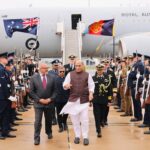
In Australia, the outcomes during Modi’s visit included the renewal of a decade-old understanding on defense collaboration. The Joint Declaration on Defense and Security Cooperation will build on interoperability of forces, defense industrial collaboration and cyber security and technology, besides maritime domain awareness. Alongside, there was a Maritime Security Collaboration Roadmap seen as critical for strengthening Indo-Pacific ties with the promotion of information sharing and operational coordination.
Then there was a pact on India buying uranium from Australia that builds on an earlier agreement signed in 2014.
On the last leg of the tour in New Zealand, there was a framework agreed on for cooperation in the maritime space, an agreement on mutual logistics support between the Indian Navy and New Zealand Defense Forces, and counter terrorism cooperation.
All these outcomes signal agreement on a mutual understanding of what the challenges are and how the countries involved plan to deal with it. While the objective is not an anti-China coalition nor an alternative to the US-underwritten security framework, it is an effort to find as many like-minded partners, minimize risks and maximize mutual advantages.
Disclaimer: The opinions and views expressed in this article/column are those of the author(s) and do not necessarily reflect the views or positions of South Asian Herald.